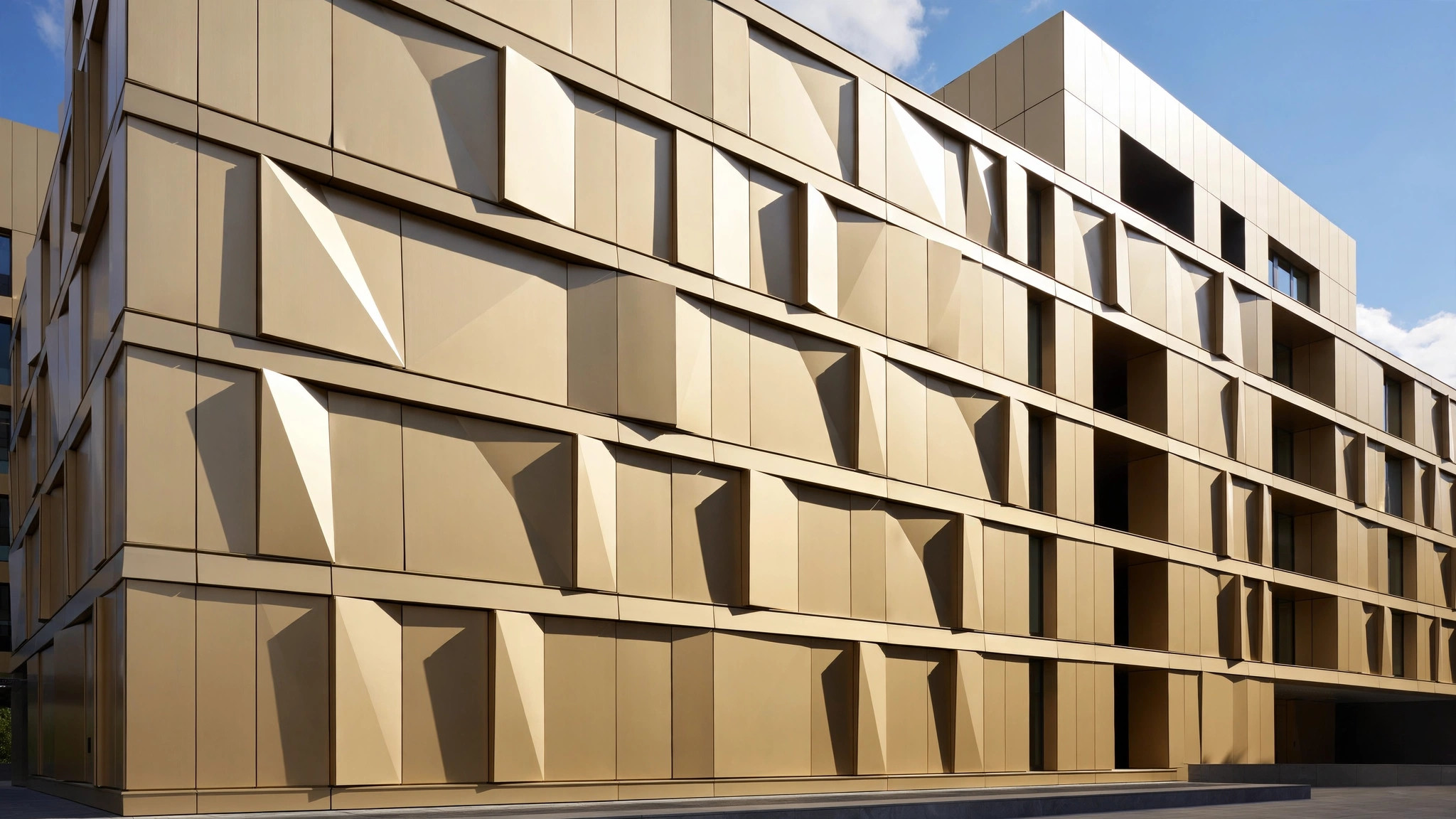
When architects and developers talk about a building’s environmental footprint, most of the attention goes to energy use, HVAC, and lighting. Yet the façade — the single largest material surface of most commercial buildings — quietly carries a large share of the embodied carbon. Specifying the right cladding material is one of the most effective decisions a project team can make. For projects aiming at lower environmental impact, solid aluminum façade panels are one of the strongest choices available: they are recyclable by design, last for decades, and generate minimal waste at every stage of their life.
Aluminum Is the Most Recyclable Cladding Material in Construction
Aluminum stands apart from nearly every other façade material because it can be recycled indefinitely without any loss of quality. Steel rusts and degrades, concrete is crushed into aggregate at best, and plastic-based cladding ends its life in landfill. Aluminum, by contrast, melts and returns as the same high-grade metal, ready for the next curtain wall or rainscreen.
The numbers tell the story. Recycled aluminum is widely used across the construction industry, and recycling aluminum requires only a small fraction of the energy needed to produce primary aluminum from bauxite — commonly cited at around 5% of the original energy input. That means the embodied energy of recycled aluminum content is dramatically lower than that of virgin material. When you specify aluminum facade panels with recycled content, you are locking that energy saving into the building envelope for decades.
Equally important is what happens at the end of a panel’s service life. A solid aluminum panel is a single, homogeneous sheet of metal. There is no plastic core to separate, no bonded composite to shred, no mixed waste stream. Demolition crews can pull panels off a cassette substructure, stack them, and send them straight to a smelter. That simple loop is why aluminum has one of the highest recycling rates of any construction material.
Solid Aluminum Panels vs. Aluminum Composite Panels: A Sustainability View
It helps to compare solid aluminum panels with the most common alternative, aluminum composite panels (ACP). ACP sandwiches a polyethylene or mineral-filled core between two thin aluminum skins. On paper, it is light and economical; in practice, separating the thin skins from the core at end of life is difficult and energy-intensive, and panels with combustible plastic cores have driven tougher fire regulations worldwide.
Solid aluminum facade panels avoid both problems. A typical panel is a formed sheet of 2.0mm, 2.5mm, or 3.0mm aluminum alloy — commonly 1100 or 3003 in the H24 temper — with a high-performance coating. There is nothing to delaminate, no core material to become waste, and the metal itself is non-combustible. One product solves the fire question and the recyclability question at the same time, which is a rare combination in façade materials.
Longevity Is a Sustainability Feature
The greenest panel is the one that never needs replacing. High-quality solid aluminum panels are coated with PVDF (fluorocarbon) finishes — the same coating family specified for landmark buildings worldwide — or with durable powder or roller coatings for standard applications. PVDF coatings are known for exceptional resistance to UV radiation, salt spray, acid rain, and urban pollution, and they hold their color and gloss for decades in exterior service.
Because the panels are formed as rigid cassettes with reinforced returns and are fixed on an engineered substructure, they also resist wind load, thermal cycling, and impact far better than thinner alternatives. A façade that survives its design life without panel-by-panel replacement avoids the material, energy, and logistics costs of repeat retrofits — an environmental saving that rarely appears in product brochures but matters enormously in a whole-life carbon assessment.
Designed for Disassembly and Low-Waste Installation
Sustainability does not begin at end of life; it starts on the construction site. Cassette-based aluminum panel systems are engineered for precise, modular installation: panels arrive cut, folded, and pre-finished from the factory, with standard maximum panel sizes up to 1300 × 4000mm, and are hung on rails or fixed to an aluminum sub-frame with concealed fasteners.
This factory-controlled approach has three practical benefits. First, off-site fabrication means offcuts and trimmings stay at the factory, where they go straight back into the recycling stream instead of into site dumpsters. Second, precise CNC cutting dramatically reduces rework and wasted material compared with site-cut cladding. Third, because each cassette is an independent module, a single damaged panel can be unhooked and replaced without disturbing its neighbors — maintenance becomes a one-panel operation instead of a façade-wide rebuild.
For specifiers working toward green building targets, that modularity is a feature worth naming explicitly in the specification: require mechanically fixed, individually removable cassettes, and require that panels, sub-frames, and fasteners be separable into single-material streams at end of life.
A Practical Checklist for Low-Impact Aluminum Façade Specification
If your project team is evaluating aluminum veneer panels on environmental grounds, use this checklist when comparing suppliers and writing the spec:
- Material clarity: Specify solid aluminum panels with a stated alloy and temper (e.g., 1100 or 3003-H24) and stated thickness (2.0, 2.5, or 3.0mm for exterior use). Clear material data makes recycling traceable decades later.
- Coating system: For the longest service life with the least maintenance, specify PVDF fluorocarbon coating; powder or roller coatings are sound options for lower-exposure applications. Ask how the coating line controls film thickness and color consistency.
- Recycled content: Ask suppliers about the recycled content of the aluminum they use. Many mills routinely supply sheet with significant recycled content — document it for your project’s material accounting.
- Modular, detachable fixing: Prefer cassette systems with concealed mechanical fixing so panels can be removed individually for repair, reuse, or recycling without demolition.
- Finish durability vs. repainting: A façade that never needs repainting avoids the VOCs and material waste of maintenance cycles. Factor coating performance into the life-cycle comparison, not just the first cost.
- End-of-life plan: Name aluminum’s single-stream recyclability in the deconstruction plan. It costs nothing to write and preserves real value for the building owner.
The Quiet Business Case
Beyond the environmental argument, there is a straightforward business case. A recyclable, long-life façade reduces a building owner’s exposure to future retrofit costs, supports green building certification narratives, and aligns with the procurement policies that more and more institutional developers now require. Contractors benefit too: factory-fabricated cassettes install faster, with less site waste and fewer callbacks than site-cut systems.
None of this requires exotic technology. It requires choosing a material whose chemistry already closes the loop — and specifying it carefully.
Solid aluminum facade panels give project teams a cladding material that is non-combustible, formable into almost any geometry, durable for decades, and recyclable at full value when its service ends. For buildings designed to outlast trends, that combination is hard to beat. Browse panel systems and finishes at juchangalu.com, or send your elevation drawings for a detailed quotation tailored to your project.