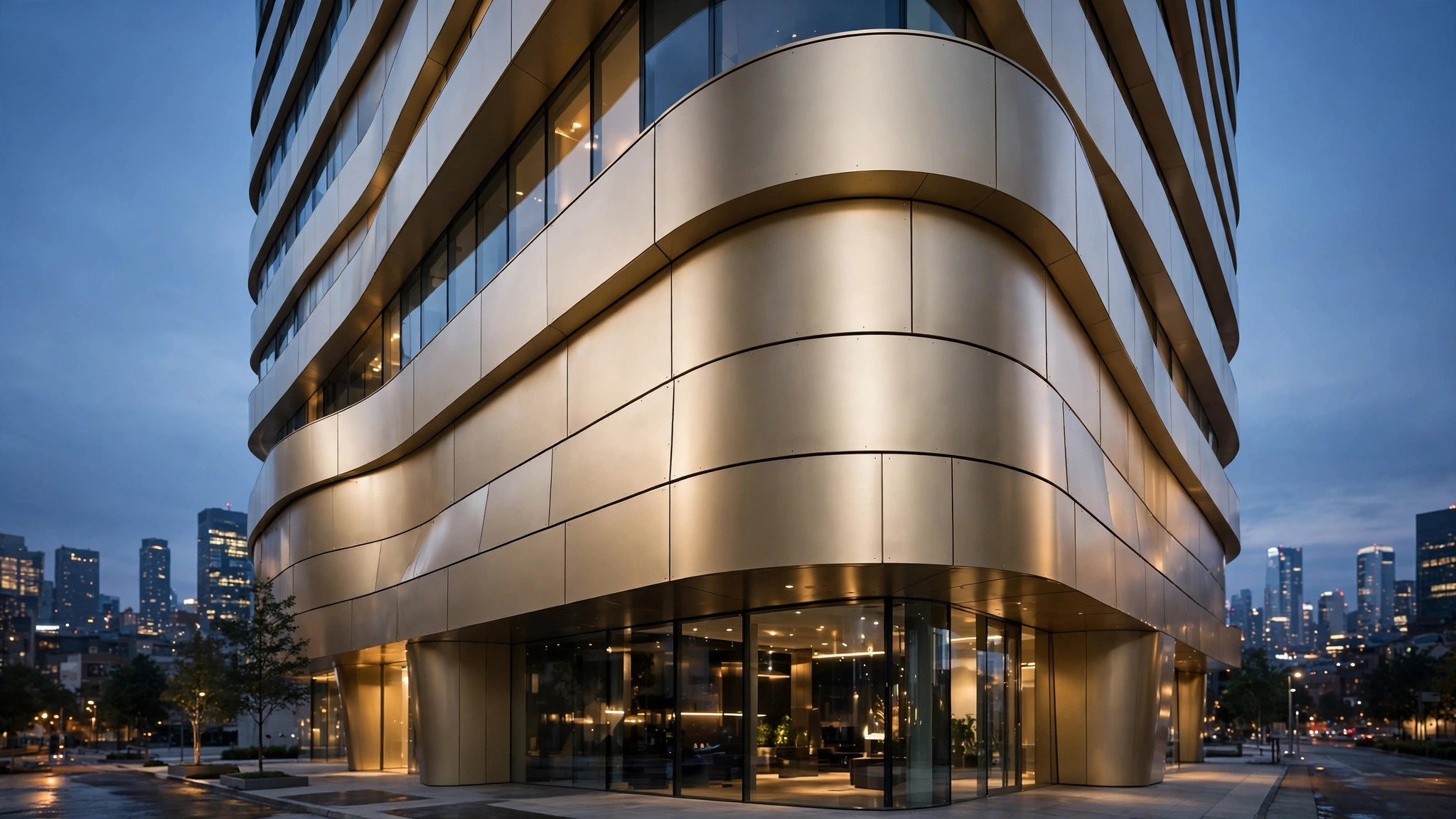
Flat, crisp, and clean will always have its place in facade design. But walk through any modern airport terminal, museum, or downtown retail district and you will notice something else: aluminum facades that bend, curve, and fold their way around corners, columns, and canopy edges. These sculpted surfaces are not exotic one-offs — solid aluminum panels are among the few facade materials that can be shaped into curved geometries while keeping their strength, finish quality, and long service life.
This article explains what bending, curving, and folding mean in aluminum panel fabrication, the practical limits architects and contractors should know, and how to specify curved aluminum facade panels so that the finished building looks the way the renderings promised.
What Bending, Curving, and Folding Actually Mean in Panel Fabrication
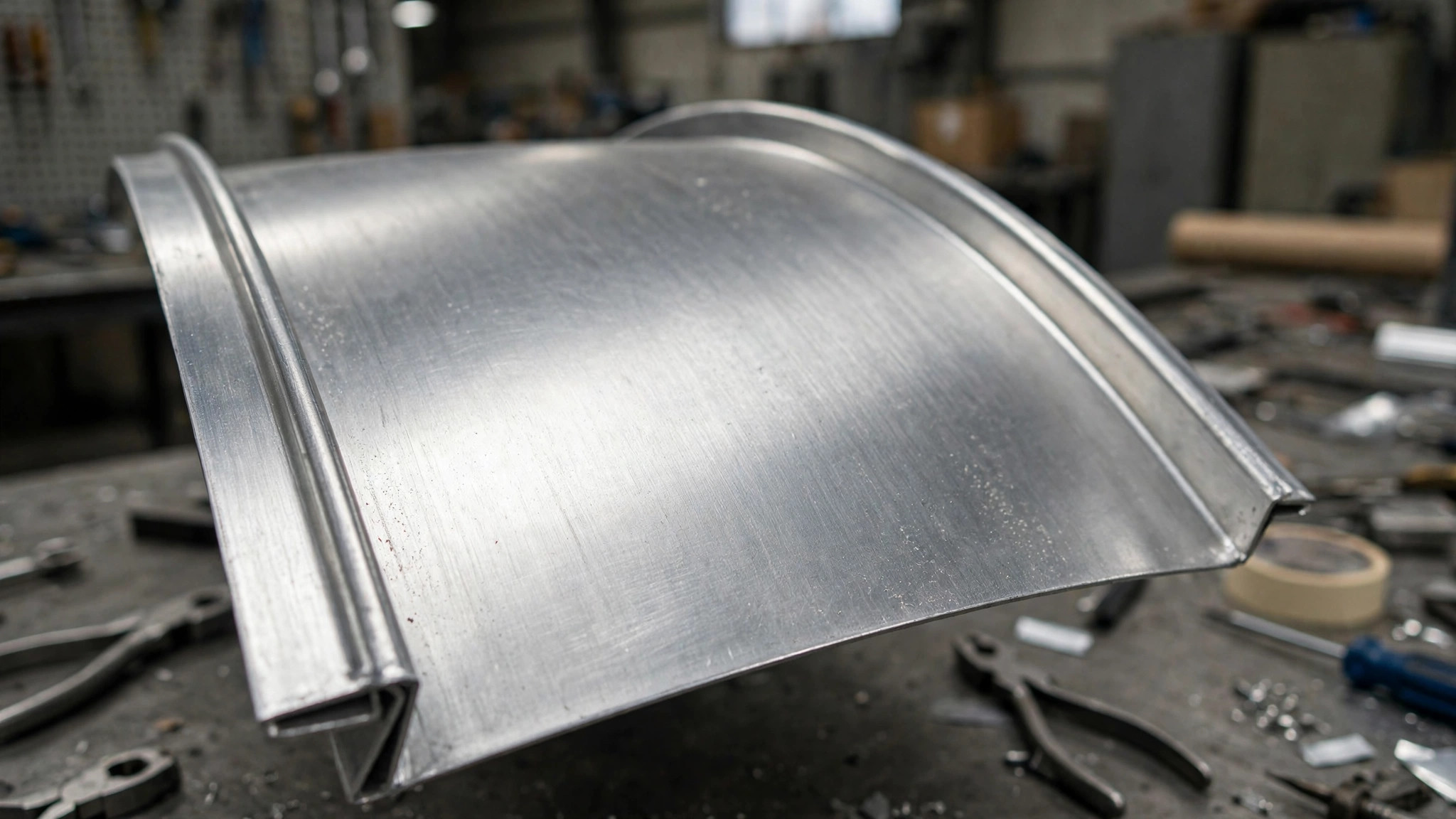
These three words are often used interchangeably on construction sites, but in the factory they describe different operations. Bending usually refers to forming a panel along a straight line — creating the hems, stiffening flanges, and angled returns that give every solid aluminum facade panel its rigid, tray-like “cassette” shape. Curving means rolling or gradually forming the panel face into a radius, whether a gentle arc across a wide panel or a tight bend around a column. Folding describes sharp, intentional creases used as a design language — the faceted, origami-like surfaces you see on cultural buildings and showrooms.
All three start from the same flat sheet, typically in 2.0mm, 2.5mm, or 3.0mm thickness, cut to size and then shaped. After shaping, the panel is welded at corners where needed, ground smooth, and then finished — most commonly with PVDF fluorocarbon coating, powder coating, or roller coating. Because the coating is applied after shaping, a curved panel and a flat panel from the same batch carry the same finish and color system, which matters enormously when both appear on one facade.
The Fabrication Methods Behind Curved Aluminum Facade Panels
Curved panels are usually produced on plate rolling machines, which pass the sheet between rollers to create a consistent arc, or with press-brake equipment fitted with special tooling for segmented curves. For faceted designs, CNC press brakes form a series of precise angular bends that read as a smooth curve from a distance.
Thicker panels hold a curve more crisply and need less internal stiffening. A 3.0mm panel can carry a broader radius without visible oil-canning, while a 2.0mm panel is easier to form into tighter radii but may need more frequent fixing points and stiffeners behind it. Common alloys such as 1100 and 3003-H24 are chosen for this work precisely because they form well: the H24 temper gives the panel enough rigidity for facade service while remaining formable in the shop.
One practical detail that is easy to overlook: direction of the grain. Brushed or directional finishes have a visible grain, and on a curved panel the grain should run consistently from panel to panel, especially on columns where a grain mismatch around a curved surface is immediately noticeable. This is the kind of detail that belongs in the fabrication drawings, not discovered on site.
Design Limits: Thickness, Size, and Curvature
Every material has a sweet spot, and curved aluminum panels are no exception. Understanding the limits early saves redesign costs later:
- Panel size. Standard production commonly works within sheet sizes up to about 1300 × 4000mm. Larger curved pieces are possible but require splicing multiple panels or special handling, so it is worth confirming maximum workable dimensions with the factory before finalizing the panel layout.
- Minimum radius. The tighter the curve, the harder the forming operation. Very tight radii on thick material can stress the metal or crack the coating, particularly with fluorocarbon finishes that are less forgiving of sharp deformation than powder coatings. As a rule of thumb, the smaller the radius, the thinner the panel or the gentler the finish system should be.
- Corner conditions. Panels that curve in one direction are straightforward; panels that curve in two directions (compound curves, like a dome segment) require stretch-forming or hand work and are significantly more expensive. If a compound curve can be approximated with faceted segments, the cost drops sharply.
- Tolerances. Curved panels are harder to hold to tight dimensional tolerances than flat ones. Joint widths should be drawn slightly more generous on curved runs, and the subframe should allow for adjustment — slotted clips and shimmable brackets are your friends here.
None of these limits are absolute; they are conversation points. A good fabricator will review your elevation drawings and tell you where the design pushes past economical forming practice — ideally before you bid the project.
Surface Finishes and Color Consistency on Curved Panels
Finish quality is where curved panels are won or lost visually. On a flat facade, small color variations between panels hide easily. On a curved surface, light rakes across the metal at continuously changing angles, and any batch-to-batch difference in gloss or hue becomes visible.
This is why PVDF fluorocarbon coatings are the default specification for high-end curved facades: the coating system is applied in controlled factory conditions and offers excellent color stability over time. Powder coating is a cost-effective alternative for tighter budgets and handles forming well, while roller coating suits simpler profiles produced in volume.
Two specification habits prevent most finish disputes on curved work. First, require that all panels for a continuous curved surface be coated in a single production run — or at minimum, from the same coating batch. Second, ask for a full-size curved sample panel in the specified color and finish, viewed outdoors at different times of day, before releasing the full order. A small flat chip cannot tell you how a finish will behave on a curve.
Practical Tips for Specifying Curved Panels on US Projects
Curved aluminum panels are well established on US commercial and institutional projects, and most of the lessons are about coordination rather than the metal itself:
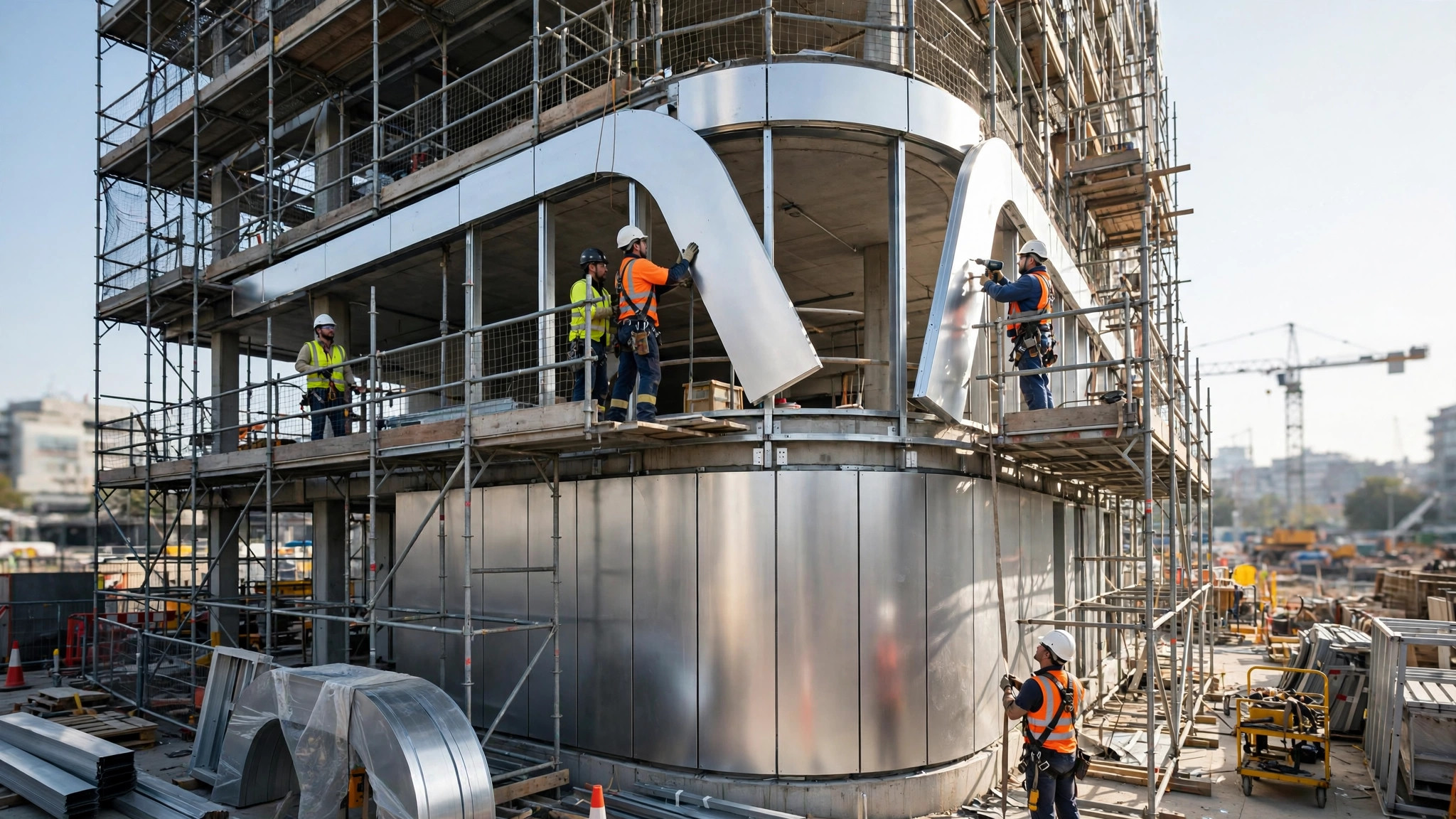
- Engage the fabricator during design development. Send radius studies, column schedules, and canopy sections to the factory early. A fabricator who works with 2.0–3.0mm aluminum daily can flag an unformable radius in one email, saving weeks of redesign.
- Detail the transitions. Where a curved panel meets a flat panel, a window frame, or a parapet, draw the transition explicitly. These junctions are where installers need the most guidance, and generic details will be improvised on site.
- Mock up the critical curve. A full-size mock-up of the tightest radius and the most visible curved bay lets everyone — architect, owner, installer — agree on what “smooth” means before production starts.
- Plan for replacement. Curved panels are custom; ordering a small number of attic stock panels in the same coating batch as the main production is cheap insurance against future damage from impacts or maintenance work.
Curved and folded aluminum facades do not require exotic budgets — they require clear communication between the design team and the factory. When the radius, thickness, finish, and tolerances are settled before production, the result is a facade that performs like aluminum always does: rigid, weather-tight, and holding its color for decades.
If your next project includes curved geometries, browse products at juchangalu.com — or send your drawings for a detailed quotation and fabrication review.