
Ordering solid aluminum facade panels from a Chinese factory is often the most cost-effective way to supply a curtain wall project in the United States. But the journey those panels take — from factory floor to your job site or warehouse — is where many buyers lose money, time, or both. Scratched PVDF coatings, dented edges, bent panels, and customs delays are all preventable problems when you understand how aluminum panels should be packaged, shipped, and received. This guide walks through the practical logistics of importing solid aluminum facade panels, so your shipment arrives in the condition you paid for.
Why Aluminum Facade Panels Need Special Attention in Transit
Solid aluminum facade panels are thin by design — typically 2.0mm, 2.5mm, or 3.0mm thick — yet they can span up to 1300mm × 4000mm in a single sheet. That combination of large surface area and light weight makes them vulnerable in ways that bulkier building materials are not. The most common transit damage falls into three categories:
- Surface scratches and abrasion. PVDF, powder-coated, or roll-coated finishes look flawless leaving the factory but can be dulled or scored when panels rub against each other or against crate surfaces during weeks of vibration at sea.
- Edge and corner dents. Panel edges are the thinnest points of the folded cassette. A sharp impact — from a forklift tine, a shifting crate, or a dropped bundle — can deform them beyond what installation tolerances allow.
- Bending and oil-canning marks. Long panels flex. If they are stacked flat without support or lashed unevenly, the flex can leave visible waviness that catches light on a finished facade.
None of these are manufacturing defects; they are logistics failures. The good news is that experienced factories have standardized packaging systems specifically designed to eliminate them.
Factory Packaging: What Good Protection Actually Looks Like
When you are evaluating a supplier, ask for photos or a video of their export packaging before you place an order. Professional export-grade packaging for solid aluminum panels should include:
- Individual protective film. Every visible panel face should leave the factory with a peelable protective film. The film should stay on through installation and only be removed during final cleaning.
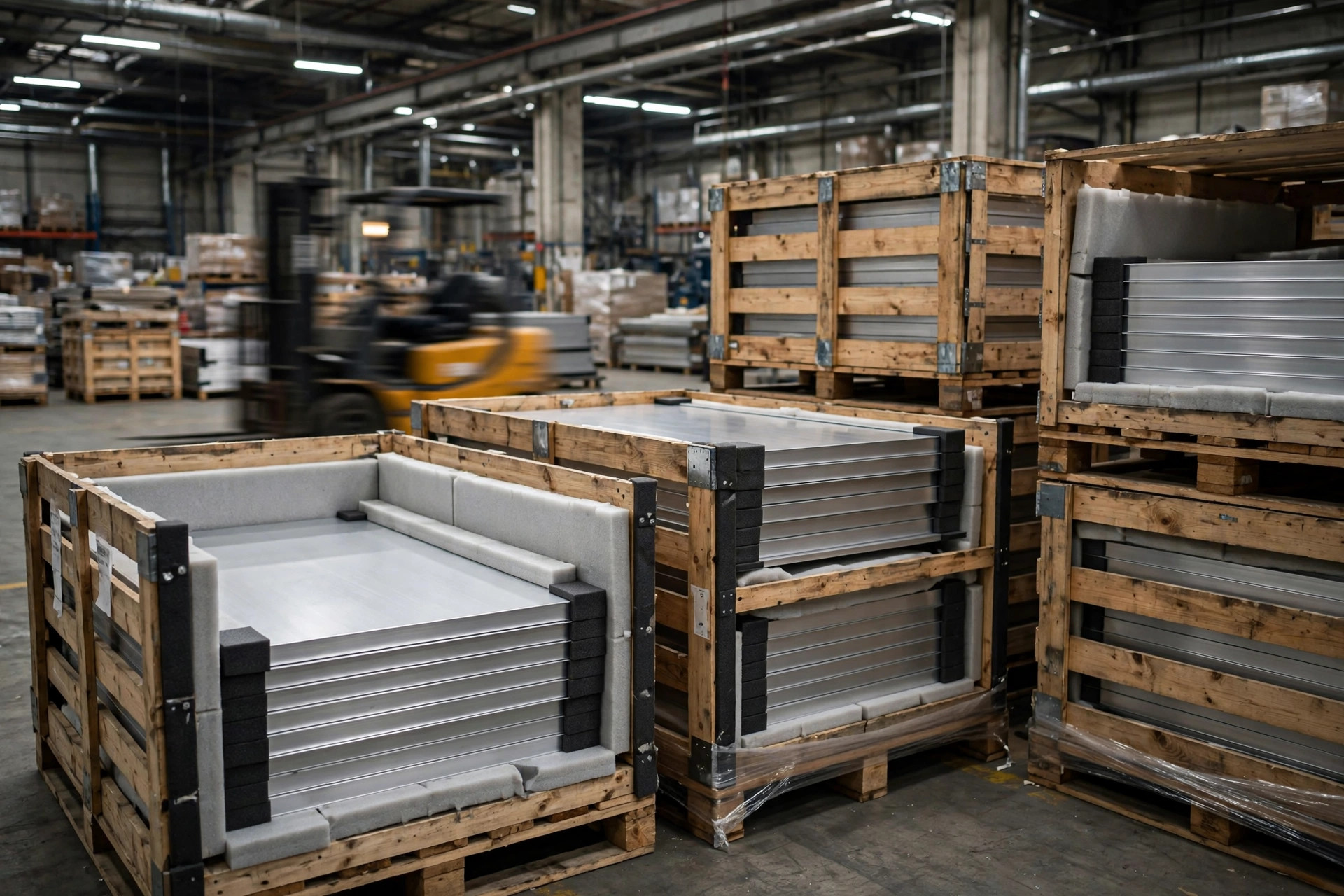
- Foam or paper interlayers. Panels should never touch face-to-face. Foam sheets, kraft paper, or bubble interlayers between panels prevent abrasion when the stack vibrates in a container.
- Edge protectors and corner guards. Rigid plastic or cardboard edge protectors absorb the impacts that panels inevitably take during loading and unloading.
- Seaworthy wooden crates or A-frame racks. For sea freight, panels are typically fixed into fumigated wooden crates or strapped to steel A-frame racks. The crate must be sized so panels cannot shift — movement inside the crate is what causes most damage.
- Vertical vs. flat stacking. Large cassette panels are often shipped vertically on A-frames to reduce pressure marks; flat sheets in crates should be fully supported across their length.
If a factory cannot show you its export packaging, or ships panels wrapped in nothing but plastic film, treat that as a red flag — no matter how competitive the quotation looks.
FCL vs LCL: Choosing the Right Freight Option
Most US buyers import aluminum panels by sea. The two main options are full container load (FCL) and less-than-container load (LCL), and the choice affects both cost and damage risk:
- FCL (20ft or 40ft container). Your panels fill their own container. With a maximum panel length of 4000mm, a standard 40ft container accommodates full-size panels without cutting them down. FCL is the safer option: your goods are loaded once at the factory, sealed, and unloaded once at destination, with minimal handling in between. For facade projects, this is almost always the right choice.
- LCL (shared container). Your crates share a container with other shippers’ cargo. It costs less per shipment for small quantities, but every additional touch point — consolidation warehouse, deconsolidation at the port — adds handling risk. Reserve LCL for sample shipments or small replacement orders, never for a full facade’s worth of panels.
Door-to-door services (factory to your warehouse) are convenient and shift more responsibility to the forwarder, while port-to-port (FOB) gives you control over the US-side carrier. Whichever you choose, confirm who is responsible for insurance: marine cargo insurance is inexpensive relative to a full container of finished panels, and you want it in writing before the vessel sails.
Documentation and US Customs: Getting It Right the First Time
Customs clearance delays are among the most expensive avoidable problems in importing aluminum panels — port storage fees accumulate daily. Prepare these documents in advance with your supplier and freight forwarder:
- Commercial invoice and packing list. Must match the actual goods: panel dimensions, quantities, alloy (1100/3003 H24), and finish type (PVDF, powder coating, or roll coating). Inconsistencies between documents and cargo trigger inspections.
- Bill of lading. Confirms the consignee and delivery terms (FOB, CIF, DDP, etc.). Understand your Incoterms: DDP means the seller handles everything through US delivery, while FOB leaves the ocean freight and US-side logistics to you.
- Certificate of origin. Many buyers and some trade programs require proof of where the panels were manufactured.
- Duty and tariff planning. US import duty rates for aluminum products have changed over time, so confirm the current classification and duty rate with your customs broker before you budget — do not rely on a supplier’s informal estimate.
A reputable factory should provide export documentation routinely; if paperwork feels like a struggle during the quoting stage, it will not get easier after production.

Receiving Inspection: Catching Damage Before You Sign
The moment of delivery is your last chance to document problems with evidence that a freight claim requires. Build this into your site or warehouse routine:
- Photograph everything before unloading. Take wide shots of the container interior or truck, close-ups of each crate, and the seal number. If a crate is visibly damaged, photograph it from multiple angles before opening it.
- Open crates and inspect a sample on the spot. Peel back the protective film on a few panels from different crates — edge dents and scratches are what you are looking for. Do not sign a clean receipt if you find damage; note the exceptions on the delivery paperwork.
- Count and measure. Verify quantities against the packing list and spot-check panel dimensions. Shortages discovered weeks later are nearly impossible to claim.
- Store panels correctly. Keep crates in a dry, covered area. Do not leave unopened crates in standing water — moisture wicking into packaging is a common cause of finish staining. Store crated panels on level ground, supported evenly.
Report any damage to the supplier and your freight forwarder within the claim window stated in your freight documents, with your photos attached. Prompt, documented reporting is the difference between a resolved claim and an argument.
A Pre-Shipment Checklist for Your Next Order
Before production begins, align on these logistics points with your factory so nothing is improvised at the loading dock:
- Confirm export packaging method in writing (crate or A-frame, interlayers, edge protectors, protective film).
- Agree on FCL vs LCL and Incoterms, with marine insurance confirmed.
- Set the panel size plan against container capacity — panels up to 1300mm × 4000mm fit a 40ft container without length compromises.
- Require pre-loading photos or video from the factory.
- Have your customs broker review the invoice, packing list, and classification before the vessel departs.
Panels that travel well are panels that install well. A supplier who is disciplined about export logistics is usually disciplined about everything else too — treat the packaging conversation as an early test of the partnership, not an afterthought.
Browse the range of solid aluminum facade panels at juchangalu.com, or send your drawings for a detailed quotation and export packaging plan.