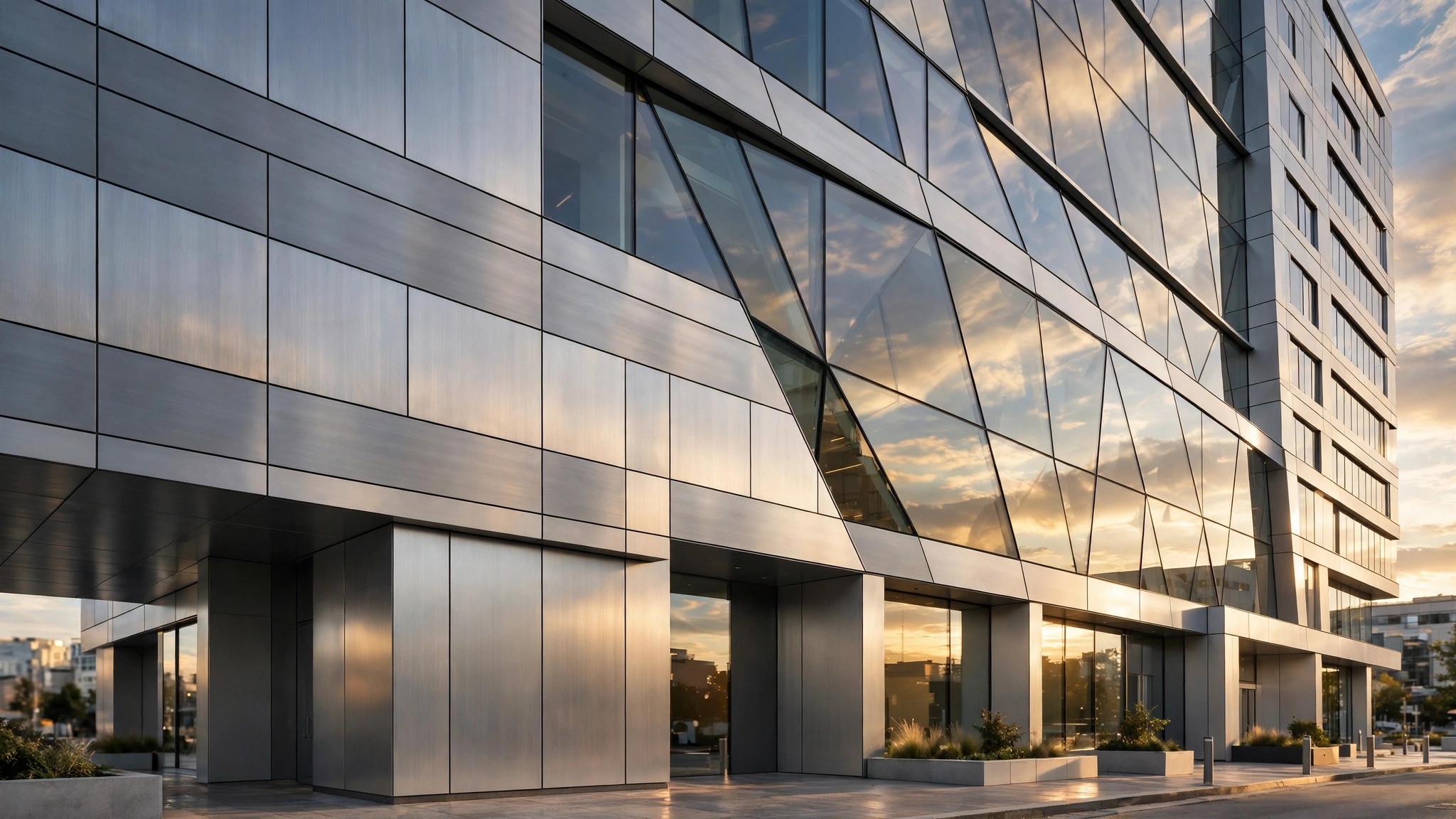
Most aluminum facade panels look the same at first glance: flat, smooth, and predictably metallic. But for architects who need a facade that carries a building’s identity — a hotel that wants a signature pattern, or a cultural center that references local motifs — carved aluminum facade panels offer something flat panels cannot: depth, shadow, and a truly custom surface.
What Are Carved Aluminum Panels?
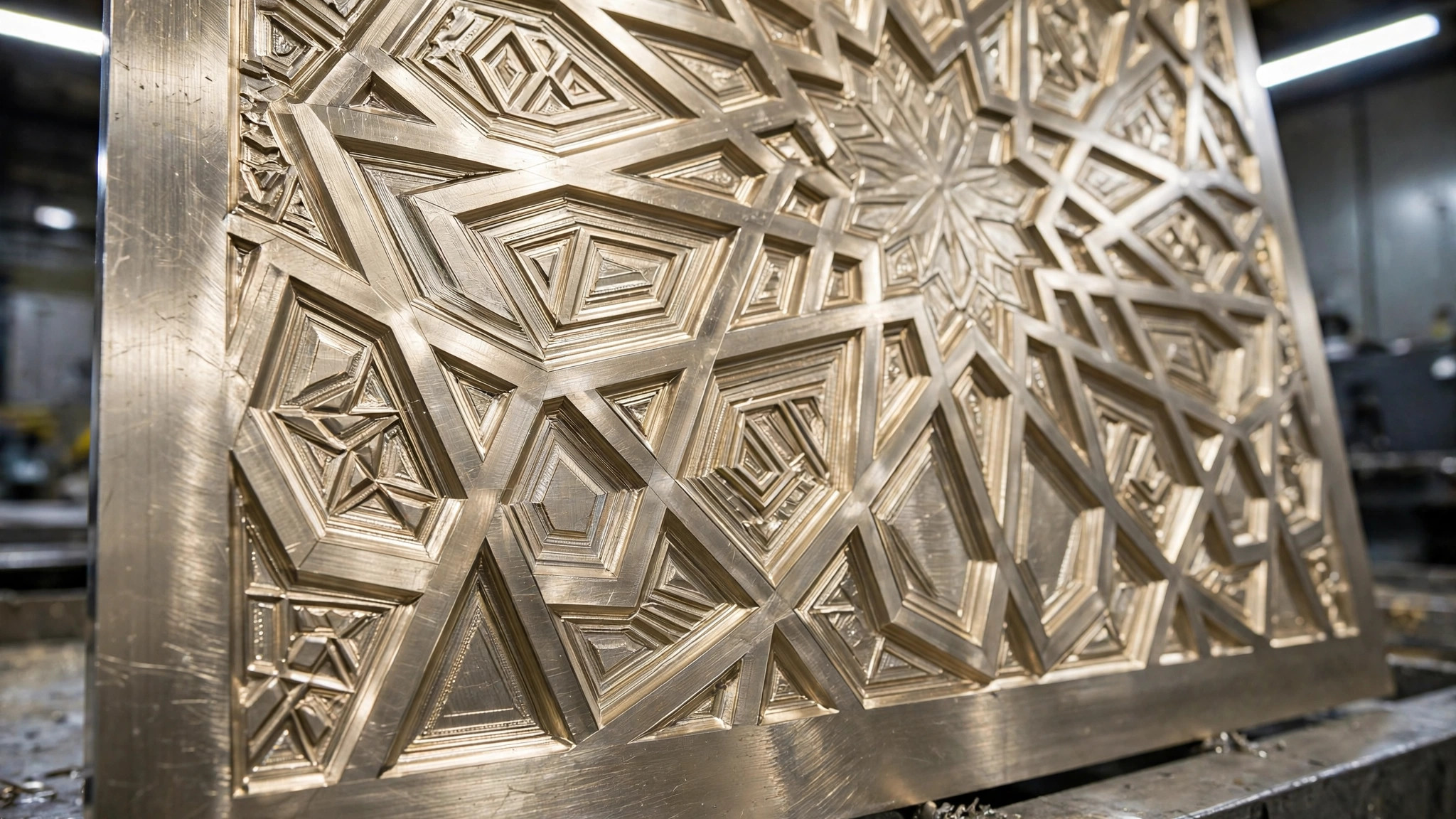
Carved aluminum panels — also called engraved or CNC-carved panels — are solid aluminum panels whose surface is cut with relief patterns using computer-controlled carving equipment. Unlike perforated panels, where material is cut through to create holes, carving removes only part of the panel thickness, leaving a three-dimensional relief that plays with light and shadow throughout the day.
The base material is the same as standard solid aluminum facade panels: 1001 or 3003 series aluminum alloy in the H24 temper, in thicknesses of 2.0, 2.5, or 3.0 mm, with a conventional maximum panel size of 1300 × 4000 mm. Because the pattern lives in the metal itself rather than in a printed or applied layer, it will not fade, peel, or delaminate.
Pattern Design Options for Carved Aluminum Facade Panels
Almost any vector-based artwork can be translated into a carved pattern, but in practice, architectural patterns fall into a few families:
- Geometric patterns — repeating triangles, hexagons, diamonds, and lattice grids. The most popular choice for commercial facades: crisp, scalable, and forgiving at large sizes.
- Floral and botanical motifs — stylized leaves, waves, and organic curves. Common in hospitality and cultural projects where the facade should feel warmer.
- Regional and cultural motifs — patterns referencing local architecture, textiles, or symbols. These give civic buildings and airport terminals a sense of place.
- Custom brand geometry — abstract forms derived from a company or institution’s visual identity, sized to read clearly from the street.
How Carved Patterns Are Fabricated
Once the pattern drawing is finalized, the workflow in the factory is straightforward:
- Panel folding: the flat aluminum sheet is cut, folded, and reinforced into a cassette (tray) panel with stiffening ribs, the same as a standard solid aluminum panel.
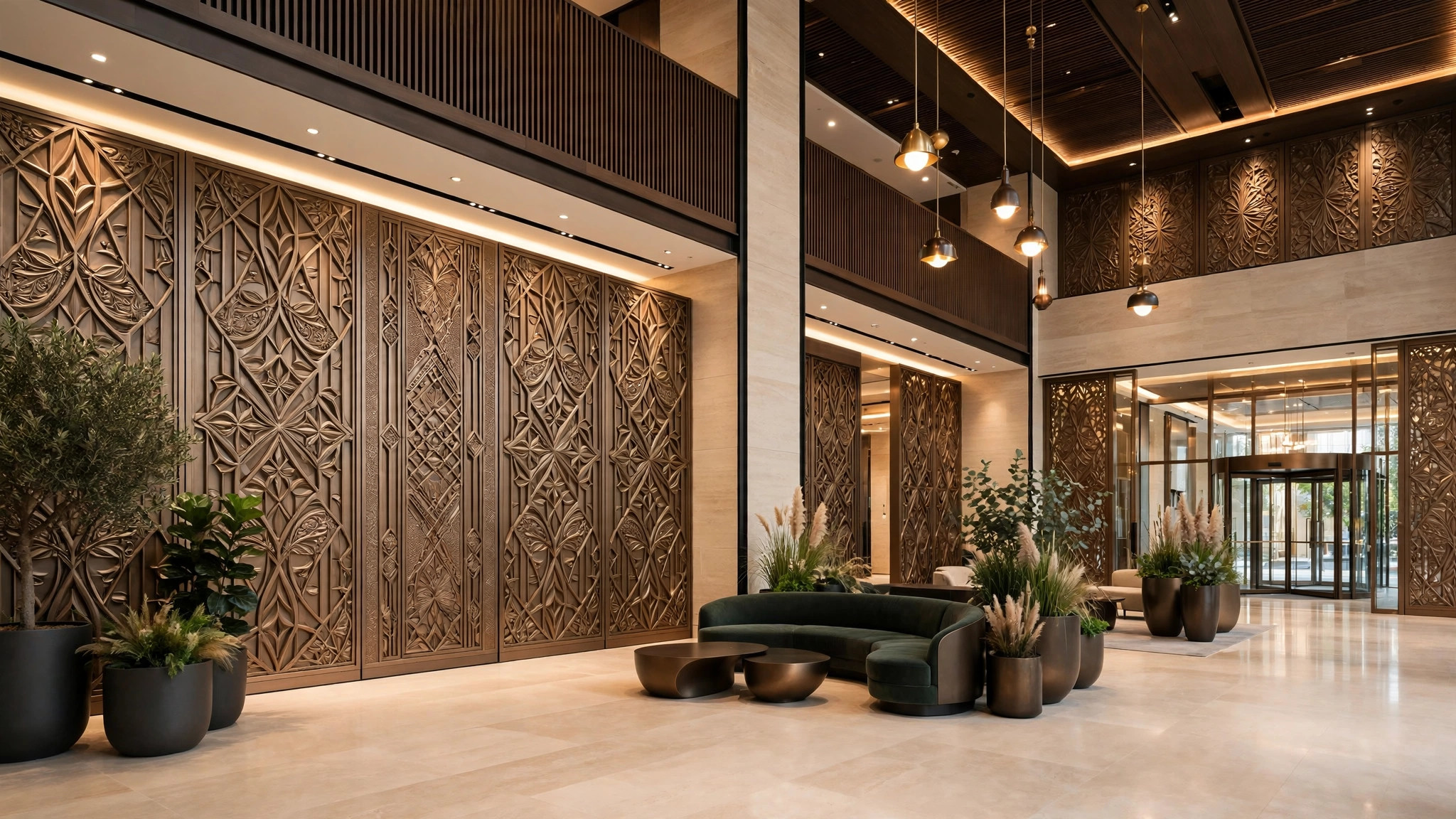
- CNC carving: the cassette face is fixed on the carving bed and the machine traces the pattern at the specified depth. Each panel is numbered so the pattern continues seamlessly across the facade.
- Surface finishing: the panel is cleaned and finished with PVDF fluorocarbon coating, powder coating, or roll coating, depending on the project specification. The finish flows into the carved recesses, protecting every exposed surface.
- Inspection and numbering: panels are checked against the approved pattern drawing and labeled by elevation and sequence so the installer can hang them in the right order.
Design Rules: Pattern Scale, Thickness, and Panel Size
Carving changes the panel’s cross-section, so a few design rules shape the work:
- Thickness selection: for carved panels, 2.5 mm or 3.0 mm is the standard recommendation. The extra thickness leaves sufficient material beneath the deepest part of the relief. 2.0 mm panels are generally reserved for shallow, decorative patterns on interior applications.
- Panel size limits: the conventional maximum remains 1300 × 4000 mm. Large-scale patterns are designed to span multiple panels, with the artwork split along panel joints so the seams fall on natural breaks in the motif.
- Relief depth vs. weathering: exterior patterns with moderate depth (a fraction of the panel thickness) shed rain naturally. Very deep, narrow grooves on a facade can trap dust over time; exterior patterns are usually designed with slightly wider channels for this reason.
- Wind and structural behavior: carving does not change how a panel is fixed — cassettes still hang on the same subframe systems — but the factory should review the pattern against the panel’s structural role, especially for large exterior cassettes in high-wind zones.
Finishes That Make Carved Panels Last
- PVDF (fluorocarbon) coating: the premium choice for exterior carved panels. It keeps color stable under UV exposure and resists chalking, which matters because a carved surface catches light from many angles and any uneven fading would be visible.
- Powder coating: a practical option for interior carved panels and sheltered exterior areas, available in a wide color range with good mechanical protection.
- Roll coating: factory-applied coil coating that gives a uniform finish before the sheet is formed; a solid choice for projects that prioritize consistent color across hundreds of panels.
Metallic tones — champagne, bronze, copper — are the most requested colors for carved panels because the relief’s highlights and shadows exaggerate the metallic effect. Whatever the color, request that carved samples be coated with the same process as the production run, so the sample shows how light will actually behave on the finished surface.
Where Carved Aluminum Facade Panels Work Best
Carved aluminum panels earn their premium where the facade is a brand statement:
- Hotel and hospitality entrances: a carved feature wall at the drop-off or lobby turns the arrival experience into a photo moment.
- Cultural and civic buildings: museums, theaters, and terminals use carved motifs to connect the building to its context.
- Corporate headquarters: subtle geometric reliefs give glass-and-metal towers a distinctive texture without changing the overall massing.
- High-end interiors: lobbies, elevator lobbies, and atrium walls are the most common use — the carved pattern becomes the interior’s signature surface.
For facades, carved panels are often combined with flat panels of the same color: the carved panels form a focal band or entrance zone while flat panels cover the field. This mix controls cost while concentrating visual impact where people actually look.
Specifying Carved Panels: What the Factory Needs From You
A carved-panel inquiry moves fastest when it arrives with these items:
- Vector artwork — the pattern in CAD or vector format (DWG, DXF, or AI), drawn at real scale or with a defined repeat unit.
- Elevation drawings — showing where carved panels go, panel module sizes, and which areas use flat panels.
- Color reference — a RAL or project-specific color chip, so the finish can be matched before carving begins.
- Interior or exterior — this decides the finish system and the recommended thickness.
- Desired relief depth — deep sculptural relief or shallow decorative texture; the factory will confirm what the panel thickness allows.
Before full production, a full-size carved sample panel is strongly recommended. It is the only reliable way to judge how the pattern reads at distance, how shadows fall across the relief, and whether the pattern scale needs adjustment. A sample also lets the architect confirm the coating color in the exact finish specified for the project.
Carved aluminum facade panels turn a standard curtain wall material into a custom architectural surface — with the same alloy, the same fixation systems, and the same weatherproof performance as the flat panels around them. If your project calls for a facade with a signature, browse the panel range at juchangalu.com or send your drawings for a detailed quotation.