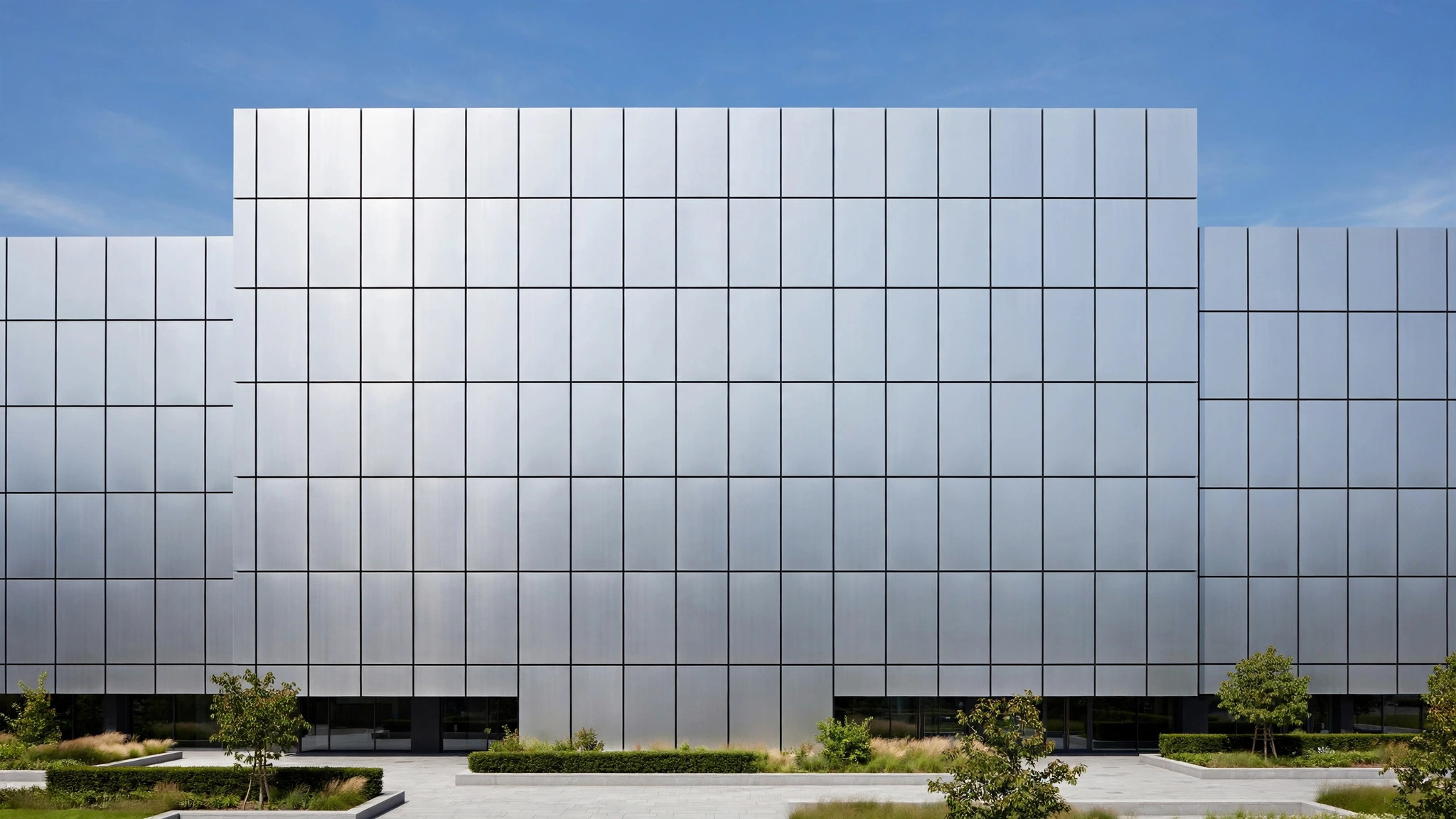
When a project calls for broad, mirror-flat metal surfaces on a building facade, the first question specifiers ask is rarely about color or texture. It is about flatness. Solid aluminum panels and aluminum honeycomb panels can look nearly identical from the street, yet they behave very differently once installed at large panel sizes. Understanding where each one wins — and where the extra cost of honeycomb construction is actually justified — keeps budgets realistic and keeps the finished facade free of oil canning and visible waviness.
What Solid Aluminum Panels and Aluminum Honeycomb Panels Actually Are
A solid aluminum panel is exactly what the name says: a single sheet of aluminum alloy — typically 1100 or 3003 in the H24 temper, in thicknesses of 2.0, 2.5, or 3.0 mm — folded at the edges and stiffened on the back with reinforcing ribs. Stiffness comes from the metal gauge itself plus the rib layout behind it.
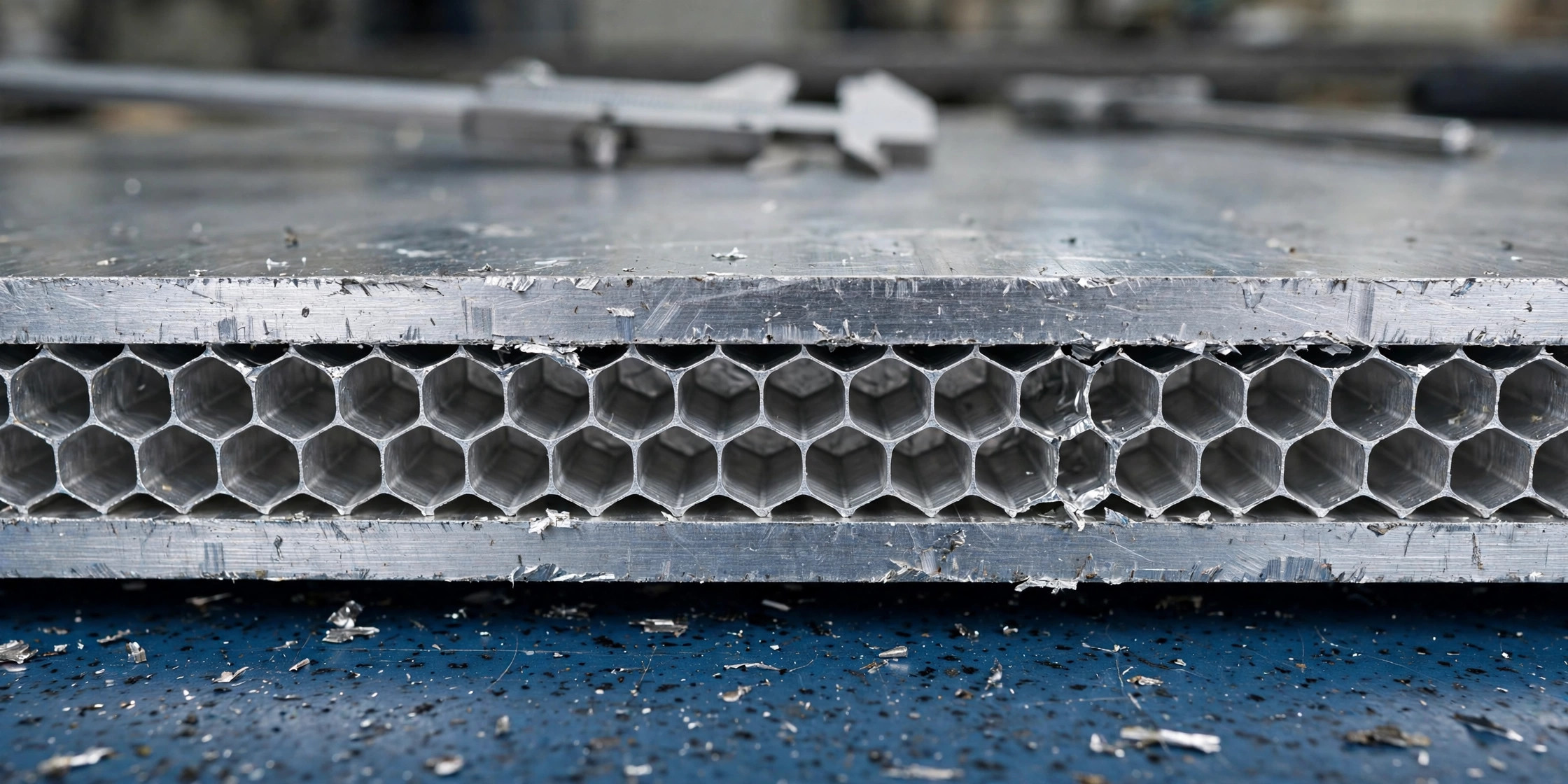
An aluminum honeycomb panel is a sandwich construction: two thin aluminum skins bonded to a lightweight aluminum honeycomb core. The skins provide the finished surface; the honeycomb core provides the stiffness. The result is a panel that is far thicker overall — often 10 to 25 mm — while weighing less than a solid panel of comparable rigidity.
This structural difference is the root of every trade-off between the two systems: flatness, weight, cost, edge treatment, and repairability all flow from whether stiffness comes from metal gauge or from a bonded core.
The Flatness Factor: Why Oil Canning Drives the Decision
Oil canning — the subtle rippling or waviness that appears across wide metal surfaces under changing light — is the number one visual complaint on metal facades, and it is the main reason honeycomb panels exist. Thin flat metal wants to buckle under thermal stress and installation tension; the wider the unsupported span, the more visible the effect.
For solid panels, flatness is managed through gauge selection, closer rib spacing, careful installation tension, and sometimes narrower panel widths. On moderate panel sizes, a well-fabricated 3.0 mm solid panel reads perfectly flat from any distance a pedestrian or camera will see.
Honeycomb panels, by contrast, are inherently flat across their entire surface because the continuous bonded core resists buckling in every direction. On very large panel formats — full-story heights or long horizontal bands where a single panel covers several square meters — honeycomb construction delivers the billboard-flat look that solid panels can only approximate with extra ribs and tighter spans.
Practical rule: if the design uses standard panel sizes and the lighting is forgiving, solid panels deliver the look at lower cost. If the design depends on extra-large, perfectly flat planes — especially smooth dark finishes, which show every ripple — the flatness premium of honeycomb construction is doing real work.
Strength-to-Weight: Span, Support Structure, and Handling
Because the honeycomb core separates the two skins, the panel behaves like an I-beam: enormous bending stiffness for its weight. A honeycomb panel can span further between fixing points than a solid panel, which means fewer support rails and a lighter substructure behind the facade.
That weight advantage ripples through the project. Lighter panels mean lighter secondary framing, easier lifting, and sometimes a measurable saving on the support structure that partly offsets the panel premium. On retrofit and recladding projects — where the existing structure has limited capacity — the lower weight of honeycomb panels can be the deciding factor.
Solid panels, while heavier per unit of stiffness, are simple and robust: a bent sheet of metal with welded or bonded ribs. There is no adhesive bond that can delaminate, no core that can crush at a fixing point, and edge damage is limited to the metal itself. For most mid-size facades, that simplicity wins on both cost and long-term durability.
Cost Comparison: Where the Honeycomb Premium Comes From
Price-class comparisons in this article stay at the level of cost drivers and publicly listed ranges — exact figures depend on thickness, panel size, finish, pattern, and order volume, so always request a project-specific quotation with drawings.
Solid aluminum panels carry the lower material and fabrication cost. The inputs are straightforward: aluminum sheet, forming and folding, rib stiffeners, and a PVDF, powder-coat, or roll-coated finish. It is a mature, competitive fabrication chain, and publicly listed B2B price bands for solid aluminum facade panels reflect that efficiency.
Honeycomb panels cost more because there are more steps and more materials: two finished skins, the honeycomb core itself, precision bonding under controlled conditions, and — critically — edge treatment. An open honeycomb edge cannot be left exposed to weather; every cut edge must be sealed with folded aluminum profiles or solid inserts, and corner fabrication is more complex than folding a solid sheet. That edge work is where a significant share of the honeycomb premium lives.
Buyers should think of honeycomb not as a flatness upgrade at a flat markup, but as a system whose premium scales with panel size and edge complexity. A simple rectangular honeycomb panel costs more than its solid equivalent, but the gap narrows when the alternative solid design would need heavier ribs, narrower modules, or extra subframing to stay flat.
Fabrication and Edge Details: What Buyers Need to Specify
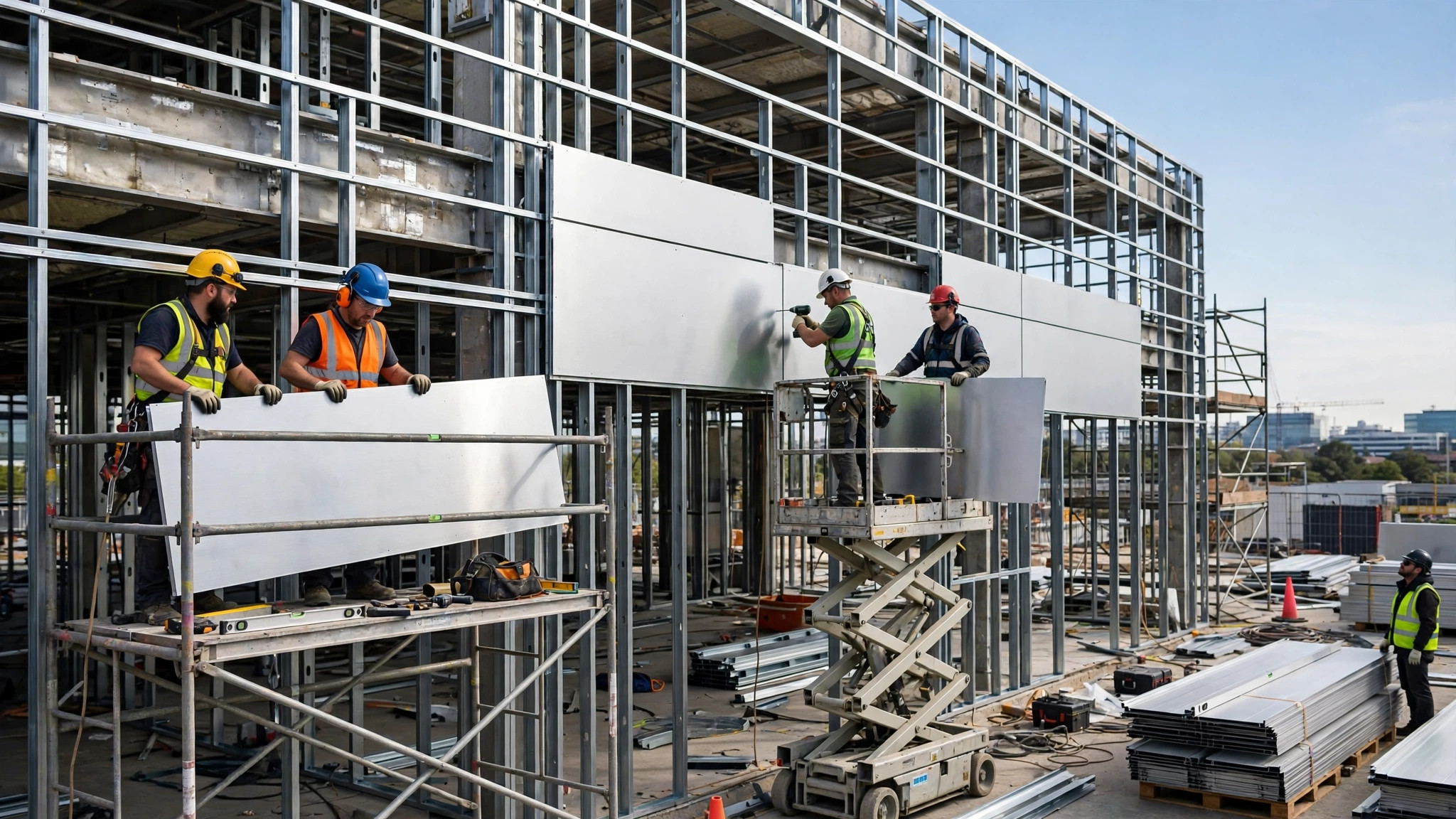
Specifying the right system means asking the right questions at the RFQ stage. For either panel type, provide: panel dimensions and layout, finish and color (with a physical sample if color matching matters), fixing system (cassette, hook-on, or visible fasteners), and the substrate it mounts to.
For honeycomb panels specifically, add three items to the checklist:
- Edge treatment method: confirm whether exposed edges are sealed with solid aluminum inserts, folded profiles, or potting compound, and how corners are fabricated.
- Skin thickness and core specification: ask what each skin gauge is and what core cell size and density the factory uses, so different suppliers can be compared like-for-like.
- Flatness tolerance: ask for a measurable commitment — a maximum deviation in millimeters over a stated span — rather than the word “flat.”
For solid panels, the equivalent checklist centers on gauge (2.0, 2.5, or 3.0 mm), rib spacing and attachment method, and how the factory controls oil canning at your specific panel size. A supplier who can show mock-ups or reference projects at comparable sizes is worth more than a specification paragraph.
Which Should Your Project Specify? A Decision Framework
Use this quick decision tree when choosing between the two:
- Choose solid aluminum panels when: panel sizes are standard (roughly up to 1300 × 4000 mm in common fabrication), the budget is tight, impact resistance and simple repairability matter, or the design can accept standard module widths with well-designed ribs behind them.
- Choose aluminum honeycomb panels when: the design demands oversized, perfectly flat surfaces; smooth dark or metallic finishes will show every ripple; the substructure weight budget is limited (retrofit projects); or wide spans between fixings reduce subframing cost enough to offset the panel premium.
- Ask for both quotes when: the project sits in the middle — large but not extreme panels, or a premium aesthetic on a disciplined budget. A good factory will price both options from the same drawings, which is the only comparison that reflects your real geometry.
One final note on mixing systems: solid and honeycomb panels can coexist on the same facade — solid panels on typical floors, honeycomb on a signature entrance canopy, for example — as long as the finishes come from the same coating batch or are color-matched to an agreed ΔE tolerance. Plan the finish sourcing early and both systems will read as one building.
Still weighing the two systems for a project? Browse product options at juchangalu.com, or send your drawings and panel schedule for a detailed, project-specific quotation on both solid and honeycomb construction.