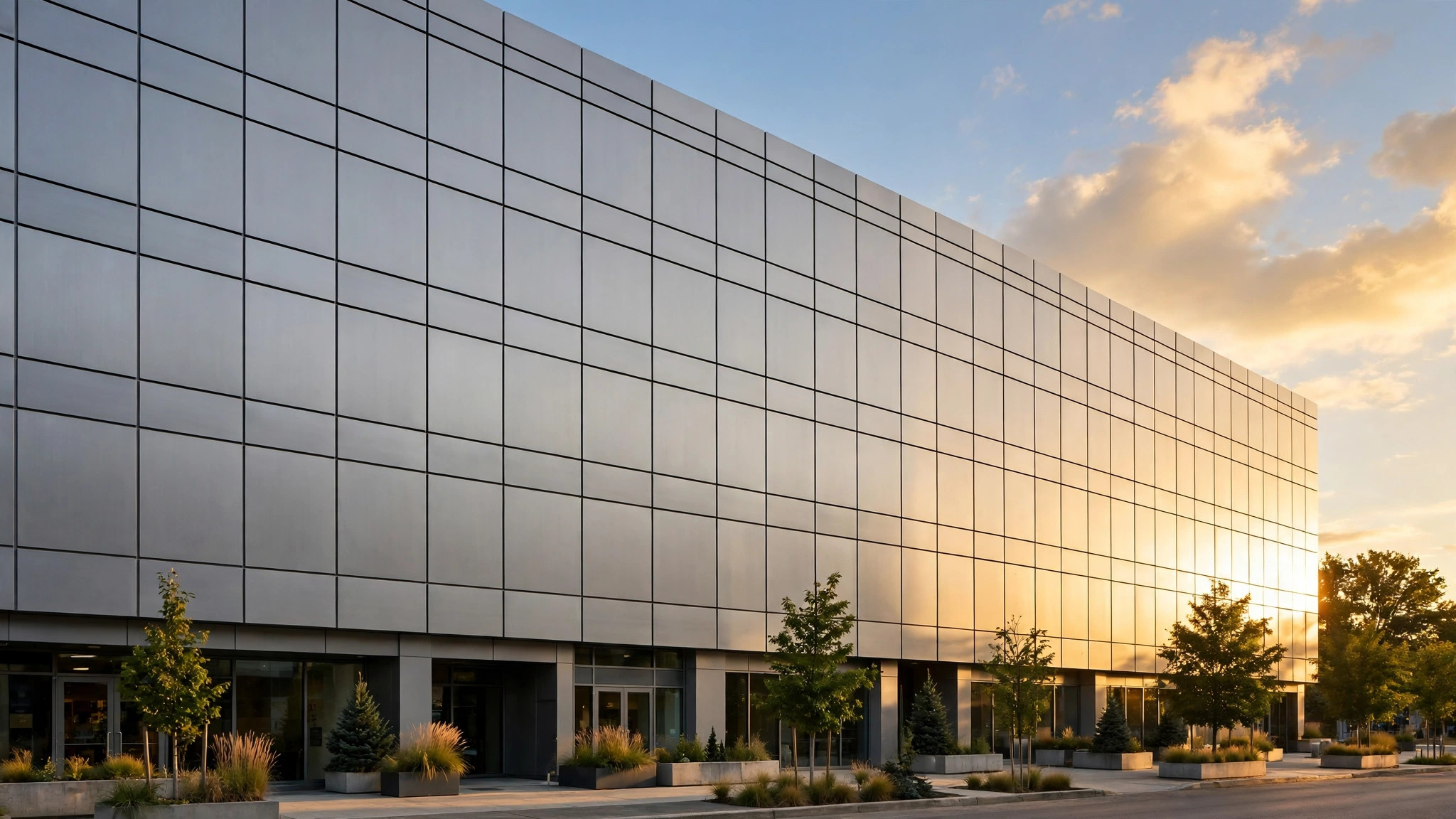
A hailstorm dents three panels on the south elevation. A delivery truck clips a ground-floor cassette. A sealant failure lets water behind one corner of the facade. The damage itself is usually straightforward to fix — order a replacement panel, swap it in, move on. The hard part is what comes next: making the new panel look like it belongs next to panels that have been weathering in the sun for five, eight, or twelve years.
Color and finish matching is one of the most common — and most underestimated — challenges in facade maintenance. This guide explains why an exact match is difficult, what information gives you the best shot at a close one, and what to do when a perfect match simply isn’t achievable.
Why Matching a Panel Years Later Is Harder Than It Looks
Two panels that left the factory as an identical color can look noticeably different after several years on a building. The difference is rarely the fault of the replacement panel. It comes from three separate changes that accumulate over time.
First, the coating weathers. PVDF and powder coatings are engineered for long-term color retention, but years of ultraviolet exposure, rain, and airborne pollutants still shift the surface slightly — usually toward a lighter, flatter version of the original color. South- and west-facing elevations age faster than shaded north faces, so even panels on the same building weather unevenly.
Second, the original production conditions no longer exist. Coating formulations, pigment suppliers, and application lines evolve. A color mixed on one coil-coating line in one year may not be reproducible to the same recipe years later, even by the same manufacturer.
Third, the panels themselves may have come from different production batches in the first place. On large projects, panels are often produced in several runs. If the damaged panel came from batch A and the replacement comes from a new run, small batch-to-batch variation adds to the weathering gap.
None of this means a good match is impossible. It means the match has to be managed as a process, starting long before you place the order.
Start with the Original Records
The single most valuable thing you can have when ordering a replacement is the original project documentation. Before contacting any supplier, gather everything you can find:
- Color code and coating type. The RAL number, the manufacturer’s color reference, and whether the finish is PVDF, powder coating, or roll coating. A color name alone — “silver grey” or “champagne” — is not enough; the same name can cover several different formulations.
- Panel specification. Alloy, thickness (commonly 2.0, 2.5, or 3.0 mm for solid aluminum facade panels), and the panel’s finished dimensions, including the return depth of the cassette edges.
- Batch or production information. Any delivery notes, packing lists, or project files that record the production batch. This helps the factory check whether any retained material or color records survive.
- Retained samples. Many well-run projects keep one or two spare panels in storage, or a flat color chip from the original production run. A physical sample is worth more than any written description, because it can be measured and compared directly.
If the original supplier is still in business, send them this information first. A factory that produced the original panels can check its own archives for the color formulation and, in some cases, for retained color chips from the same production run. That is almost always a better starting point than asking a new supplier to reverse-engineer a color from a photograph.
Measure What You Actually Have
A common mistake is ordering a replacement matched to the original color code, then being surprised when it stands out against the weathered facade. The replacement should be matched to the panels as they look today, not as they looked on installation day.
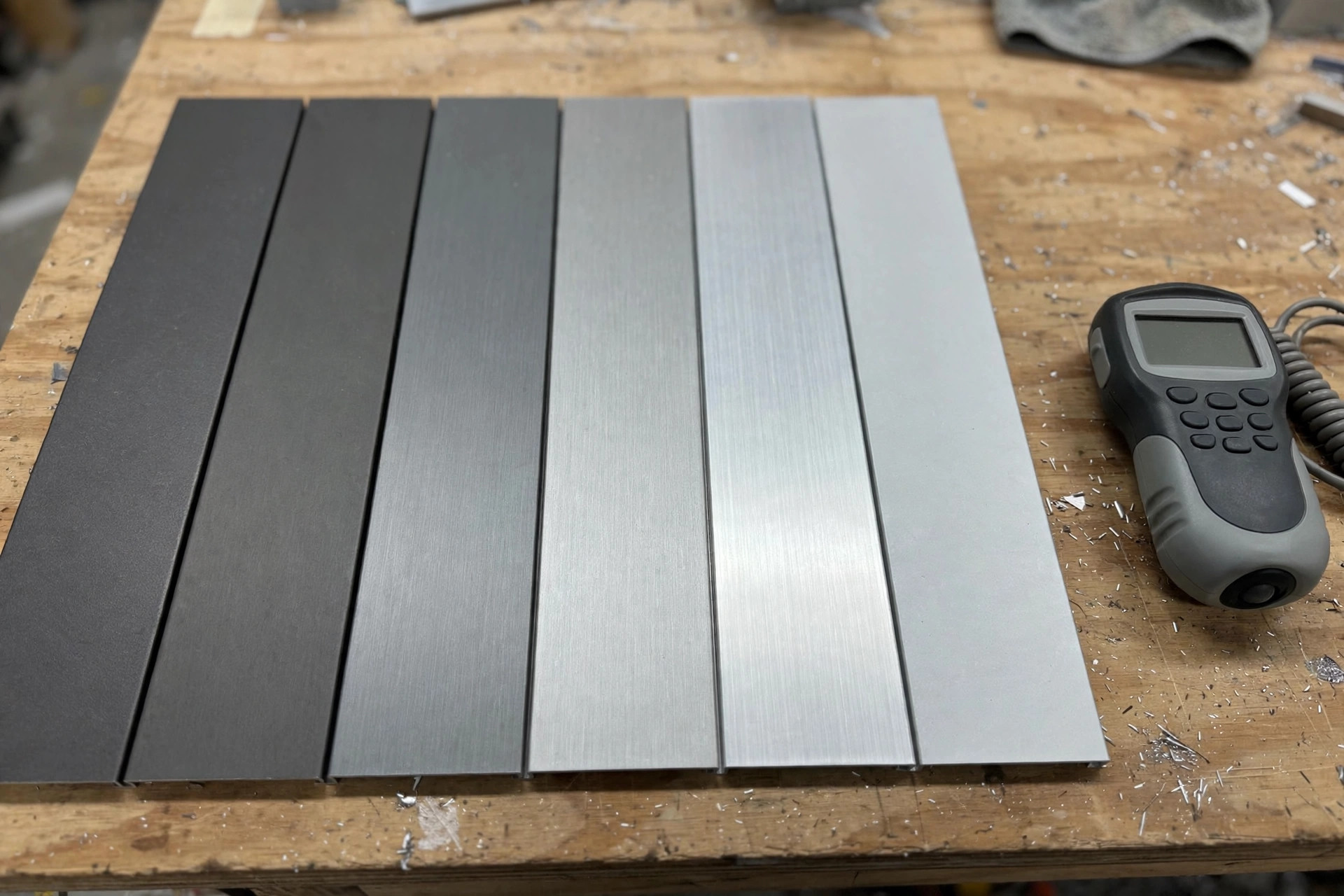
The practical way to do this is to measure the existing panels. A handheld colorimeter or spectrophotometer can record the color of an undamaged panel adjacent to the damaged one, expressed as L*a*b* values and a ΔE figure that quantifies the difference between two colors. Ask the factory whether they can work from a measured color reading rather than only from a color code — many can, and it materially improves the result.
Also consider where on the building you measure. Measure a panel in the same elevation and orientation as the damaged one, and measure more than one spot: weathering is rarely uniform even across a single elevation. If the undamaged panels on the south face measure noticeably lighter than those on the north face, the replacement should be matched to its actual neighbors.
Photographs help for communication, but they are not a substitute for measurement. Phone cameras adjust white balance automatically, and the same panel can look different in morning and afternoon light. Send photos as supporting material, never as the only reference.
Ordering Replacement Panels: What to Send the Factory
When you request a quotation for replacement panels, the more complete your package, the better the outcome. A good replacement order includes:
- The measured color data (L*a*b* values and ΔE target) from the adjacent existing panels, plus the original color code if you have it.
- A physical sample when possible — either a retained color chip or a small cut piece from an undamaged panel in a hidden location, such as behind a parapet or inside a soffit return.
- Exact panel dimensions, including the cassette return depth, fixing hole positions, and any stiffener layout. Do not assume the replacement will be made to the same shop drawings as the original; confirm the dimensions against the opening on site.
- The finish specification — PVDF, powder, or roll coating — matched to the original, since different coating types age differently and a mixed finish will diverge further over time.
- Photos of the surrounding facade in daylight, showing the damaged area and its neighbors, so the factory can see the weathering context.
Ask the factory to produce a color sample for approval before full production. A flat sample panel, roughly the size of a sheet of paper or larger, lets you hold the proposed color next to the existing facade in daylight and judge the match with your own eyes before committing to the full order. This step costs a little time; skipping it costs far more if the delivered panels don’t blend.
Blending New Panels into an Existing Facade
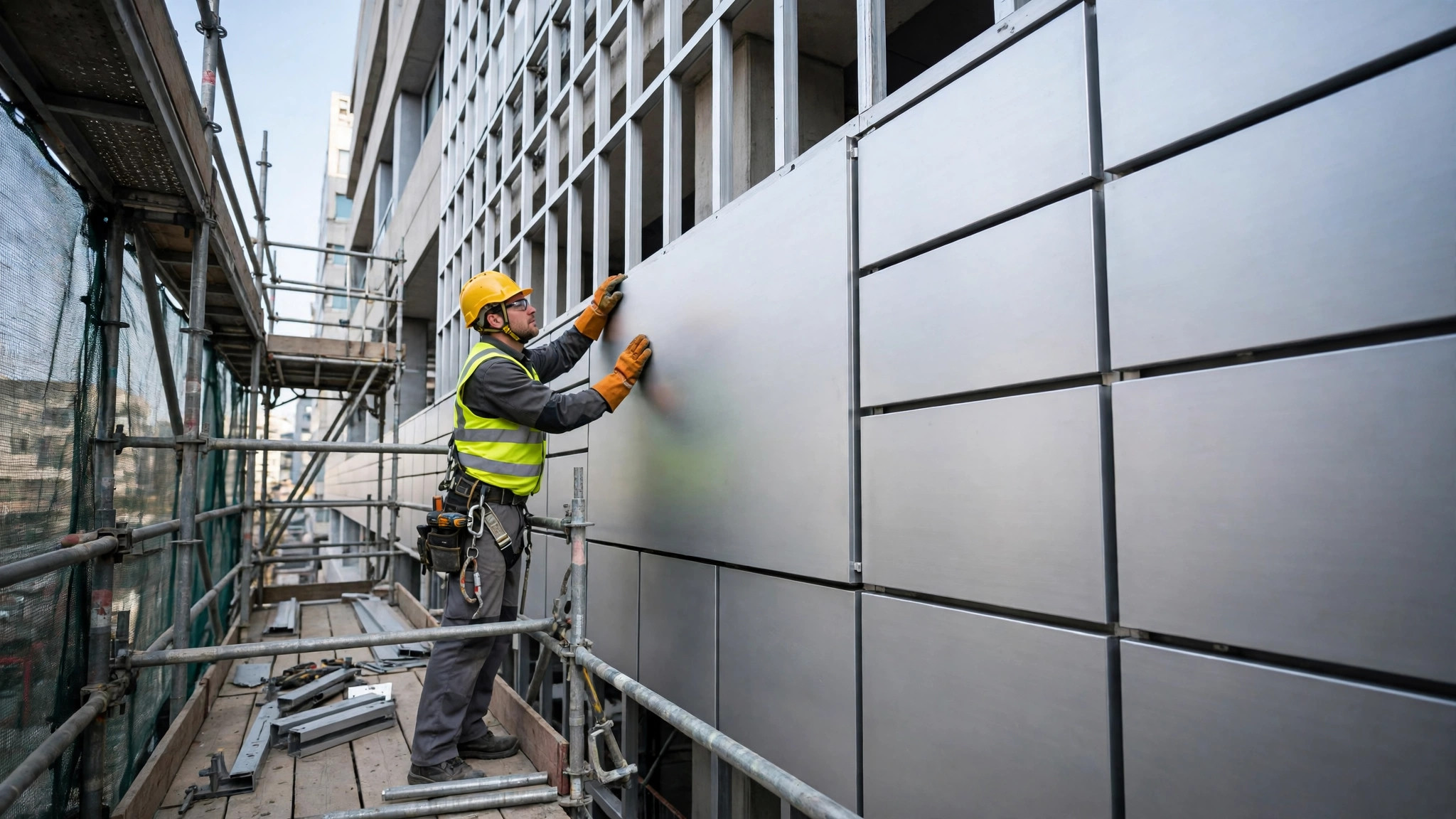
Even with a well-matched color, a brand-new panel can catch the eye because its surface is cleaner and its gloss slightly higher than its neighbors. A few installation strategies reduce that contrast:
- Replace in a logical group. If several adjacent panels are damaged, replacing the whole group reads as one intentional repair rather than a patch. Where the damage is limited to one panel, consider whether the adjacent panel is also due for replacement.
- Clean the surrounding panels first. Years of grime can account for a surprising share of the visible difference. Wash the neighboring panels before judging the match, and judge it again after the new panel is installed.
- Choose a discreet location for the first inspection. View the match from the normal viewing distance — usually street level — rather than from a ladder a meter away. A difference that is obvious up close is often invisible from where people actually look at the building.
- Allow a short settling period. A new coating will lose a little of its initial gloss in the first months outdoors, which usually brings it closer to the weathered panels around it.
When a Perfect Match Isn’t Possible
Sometimes, despite the best preparation, an invisible match is not realistic — the original color is discontinued, the weathering gap is too wide, or the remaining panels have faded unevenly. In that case, the goal shifts from hiding the repair to making it look deliberate:
- Break the elevation at a natural joint. Re-clad a full bay, a full floor band, or the area between two expansion joints, so the new panels form a coherent block rather than a single odd panel.
- Use a close-but-deliberately-different finish. A slightly darker shade of the same color family, used across a defined area, can read as a design accent rather than a failed match.
- Plan a phased re-clad. If the facade is nearing the end of its service life, replacing the damaged section now and scheduling the remaining elevations over the next year or two spreads the cost while keeping the building looking intentional.
Discuss these options openly with the factory and the building owner before ordering. A frank conversation at the start avoids a dispute about a “mismatched” panel later.
Planning Ahead: Make the Next Replacement Easier
If you are specifying panels for a new project today, a few decisions now will make any future replacement far simpler:
- Order spare panels with the original run. Two or three extra panels, stored flat and indoors, cost little at the time of the project and are the most reliable source of a matching replacement later.
- Keep a color archive. File the color code, coating type, batch numbers, and a retained flat sample with the building’s maintenance records — and make sure the facilities team knows where the file is.
- Record the specification in the O&M manual. Alloy, thickness, finish, panel dimensions, and the factory’s contact details should all be written down where the next maintenance manager can find them, not left in one person’s email.
- Specify the same finish family across the facade. Mixing PVDF and powder coating on one elevation guarantees the two will age at different rates and complicate any future match.
Replacing a facade panel years after installation will never be as simple as swapping a tile. But with the original records in hand, a measured color reference, an approved sample, and realistic expectations about weathering, most replacements can blend in well enough that nobody notices — which is exactly the point. And the cheapest insurance of all is a few spare panels ordered on day one.
Browse our aluminum facade panel range at juchangalu.com, or send your drawings and color references for a detailed quotation on replacement panels.