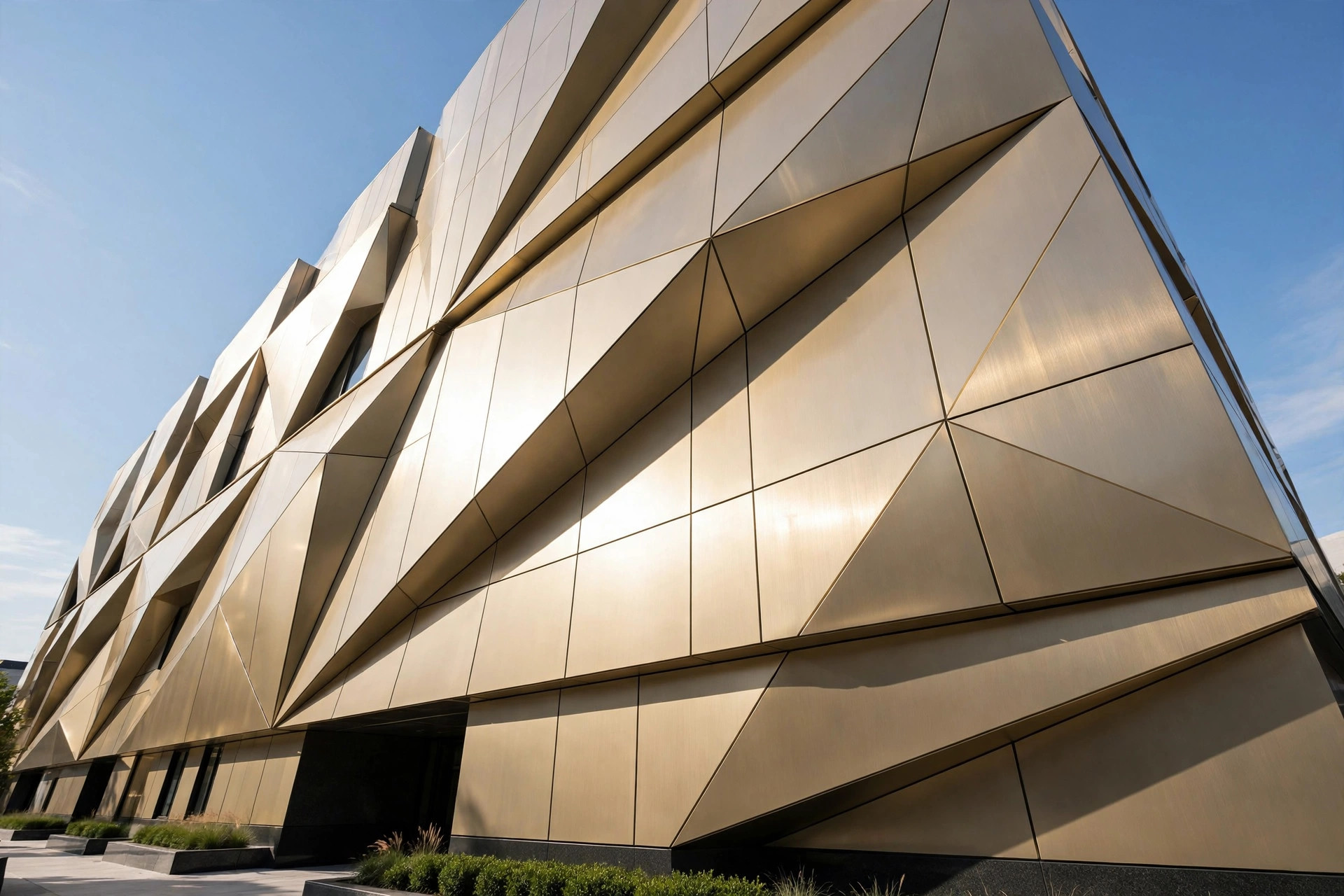
When specifying metal cladding for a new façade, US buyers usually narrow the field to two products: solid aluminum panels and aluminum composite panels (ACP). Both look like flat, crisp sheets of aluminum. Both are widely used on commercial buildings. But under the surface they are built very differently, and the wrong choice can mean callbacks, code problems, or a façade that fades long before its time.
This guide explains the real differences — construction, fire behavior, finish durability, forming limits, and lifecycle cost — so architects, contractors, and distributors can choose with confidence.
What Each Panel Actually Is
Solid aluminum panels
A solid aluminum panel is a single sheet of aluminum alloy — typically 2.0, 2.5, or 3.0 mm thick — cut, routed, folded into a cassette or tray shape, and factory-coated with PVDF, powder coating, or roller coating. There is nothing laminated, glued, or layered: the visible surface and the structure are one and the same material. Common alloys include 1001 and 3003-H24; standard sheet sizes reach up to 1300 × 4000 mm, which keeps joints clean on tall elevations.
Aluminum composite panels (ACP)
An ACP is a sandwich: two thin aluminum skins (usually 0.3–0.5 mm each) bonded to a core. The core can be standard polyethylene (PE), fire-retardant (FR) mineral-filled material, or fully non-combustible mineral board. Total thickness is commonly 3, 4, or 6 mm. The thin skins carry the same fluoropolymer coatings as solid panels, so a finished ACP can look identical to solid aluminum on day one.
Fire Performance: The Decisive Difference
This is where the comparison gets serious. A solid aluminum panel is inherently non-combustible — a single metal sheet has nothing to burn. ACP fire behavior depends entirely on the core. Standard PE-core ACP is combustible and has been restricted or banned on tall buildings in many jurisdictions after high-profile façade fires.
FR-core and mineral-core ACPs are engineered to meet façade fire requirements, but they require careful specification: the right core classification, correct installation details, and compliance documentation for the project’s code regime. For US projects, specifiers increasingly reach for solid aluminum panels when the design calls for the simplest, most defensible fire story — one homogeneous, non-combustible sheet, no core to debate.
Finish Durability: Both Can Last — If Specified Right
Both panel types accept high-performance PVDF coatings, and both can carry powder coating for budget-sensitive scopes. On either product, a two- or three-coat PVDF system is the benchmark for color retention, chalk resistance, and gloss stability over long outdoor exposure.
The difference is not the paint, it is what lies beneath. Because a solid panel is one continuous metal thickness, its edges, folds, and returns all receive the same coating as the face. On an ACP, folded or routed edges expose the core material along the return, and those cut edges need proper treatment to keep the finished assembly clean and weather-tight.
Forming, Flatness, and Fabrication Limits
- Flatness on large modules: ACP’s sandwich construction is exceptionally stiff per unit weight, which is why very large flat panels (1500 mm wide and beyond) are commonly done in ACP. Solid aluminum panels achieve comparable visual flatness with stiffener profiles bonded to the back of the cassette — a standard factory technique for wide modules.
- Complex shapes: Solid aluminum panels excel at folded, curved, and faceted geometry. A single sheet can be CNC-routed and brake-pressed into deep trays, perforated screens, columns, and custom 3D forms. ACP is more limited: tight radii and deep folds can delaminate or crack the skins.
- Repairability: A damaged solid panel can often be removed and replaced individually by cassette. Individual ACP panels can also be replaced, but matching an aged coating lot-for-lot can be tricky on both products — order spare panels with the original run.
Weight and Structure
On a per-square-meter basis, 4 mm ACP is lighter than 3.0 mm solid aluminum — that is its classic advantage. But the difference in the total façade budget is smaller than it looks: the substructure, anchors, and installation labor for both systems are comparable, and solid panels’ lighter-perception cost is often offset by simpler fire compliance and fewer engineering debates.
Cost Over the Life of the Building
Solid aluminum panels generally cost more per square meter at purchase than standard ACP. Look past the unit price and the picture changes:
- Compliance risk: FR and mineral-core ACP cost premiums narrow the gap, and a non-combustible solid panel eliminates core-related review cycles entirely.
- Maintenance: Both finishes clean the same way — mild detergent and water. PVDF on either substrate holds its appearance for decades with a regular wash cycle.
- Salvage and sustainability: A solid aluminum panel is one alloy, fully recyclable at end of life. Separating ACP skins from core material for recycling is more complex and not always practical.
A Practical Decision Matrix
Choose solid aluminum panels when: fire classification must be simple and unquestionable; the design includes deep folds, curves, perforations, or custom geometry; long-term color consistency on three-dimensional shapes matters; or the project is a high-rise, hospital, school, or transit facility with strict façade scrutiny.
Choose ACP when: the priority is maximum flatness on very large rectangular modules at the lowest unit cost; the core is specified to the correct fire classification with full documentation; and the geometry is essentially flat.
Specifying Either Panel Correctly
Whichever route you take, lock down the same checklist in the specification:
- Alloy and temper (e.g., 3003-H24 for solid panels) and skin/core thicknesses
- Coating system: PVDF coat count, or powder coating where acceptable
- Panel dimensions, module layout, and joint widths
- Backing stiffeners for wide solid-aluminum cassettes
- Fire documentation matched to the applicable code for the building’s height and occupancy
- Reference to recognized test standards (ASTM/AAMA) in the submittal package
- Shop drawings reviewed and approved before production — not after delivery
The Bottom Line
Solid aluminum panels and ACP can look alike on a rendering, but they solve different problems. ACP buys you lightweight flatness at a competitive price — provided the core classification and documentation are handled rigorously. Solid aluminum buys you simplicity: one non-combustible sheet, unlimited forming freedom, and a façade that will still look intentional in twenty years.
For many US buyers — especially on projects where code review is strict and design freedom matters — that simplicity is exactly why solid aluminum panels keep winning the specification. Send us your elevation drawings and we will help you compare both options for your specific project and return a detailed quotation.