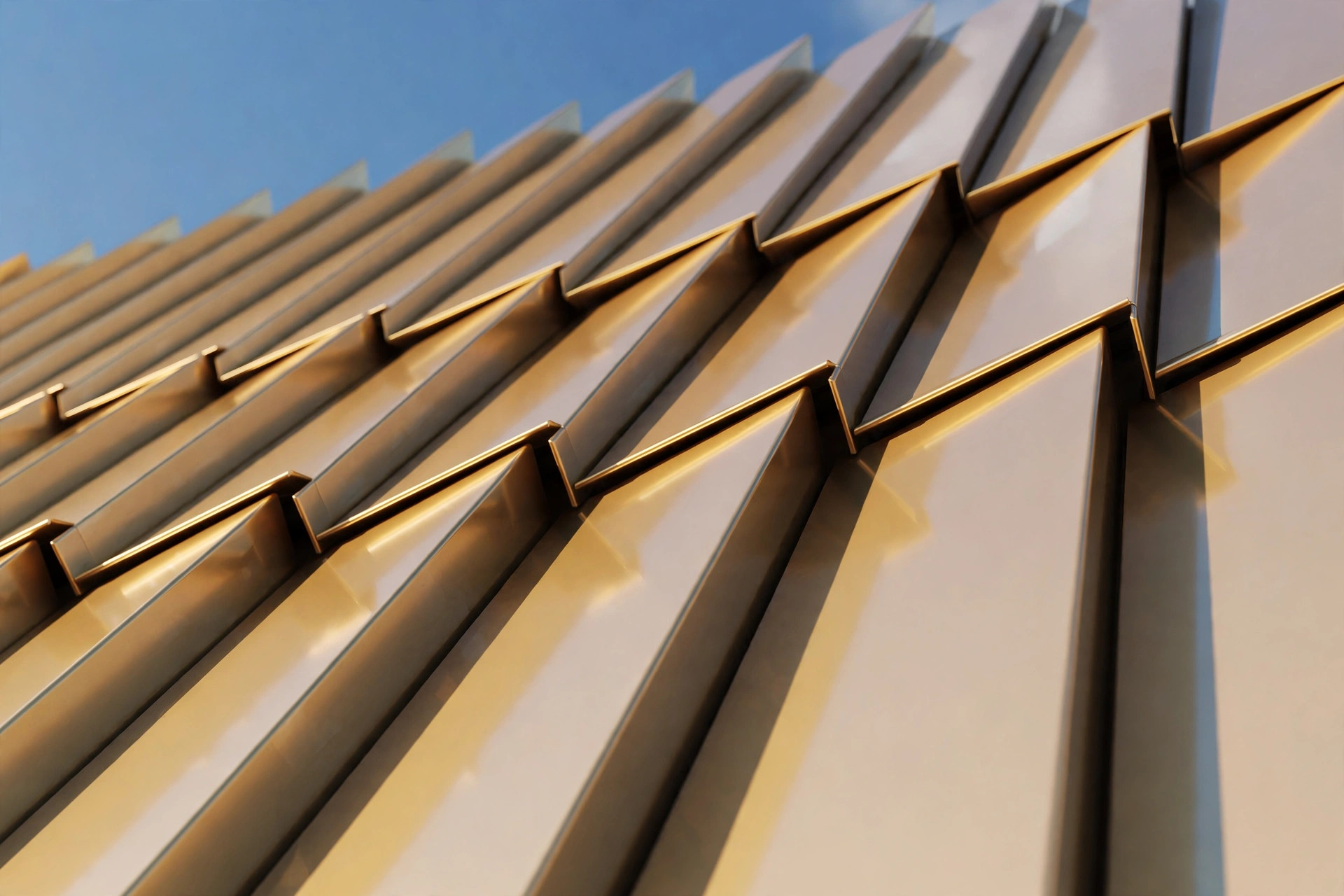
When architects and contractors specify aluminum facade panels, two decisions shape nearly everything else about the project: the panel thickness and the alloy underneath the finish. Choose wrong, and you get panels that oil-can in the wind, dent during maintenance, or flat-out fail the structural review. Choose right, and the façade stays flat, rigid, and quiet for decades. This guide breaks down how solid aluminum panels in 2.0mm, 2.5mm, and 3.0mm thicknesses — and common facade alloys — compare in real US commercial projects.
Why Thickness Matters More Than It Looks
A rainscreen aluminum facade panel is not just a decorative skin. Wind suction pulls on every cassette, thermal cycling expands and contracts the metal daily, and installers and window washers lean against the surface over the building’s life. Thickness is the single biggest factor in how a solid aluminum panel resists:
- Oil-canning — the wavy, rippled look that appears in large flat panels under changing light.
- Denting and impact damage — from ladders, maintenance equipment, and debris.
- Deflection — how much a panel bows inward or outward under wind load.
- Sound transmission — thinner panels transmit more rain noise and street noise.
As a rule of thumb, every half-millimeter of added thickness makes a disproportionate difference in stiffness. A 3.0mm panel is dramatically stiffer than a 2.0mm panel of the same size — not just 50% stiffer, because stiffness scales with the cube of thickness.
2.0mm vs 2.5mm vs 3.0mm: Where Each Thickness Fits
2.0mm aluminum facade panels
At 2.0mm, aluminum facade panels are the economical workhorse of the three. They are lighter, easier to handle on site, and a good match for:
- Interior wall cladding, column covers, and soffits where wind load is minimal.
- Low-rise facades (one to three stories) in sheltered locations.
- Smaller cassettes — keeping panel width under roughly 1,000mm helps control oil-canning.
The trade-off: at 2.0mm, large flat panels show oil-canning more readily, so fabricators often add stiffener ribs on the back of the cassette. That adds fabrication cost, which narrows the price gap with thicker panels.
2.5mm aluminum facade panels
The 2.5mm thickness is the most common specification for mid-rise commercial aluminum facade panels in the US. It is the sweet spot: noticeably stiffer than 2.0mm, yet still easy to route, fold, and install. Typical uses include:
- Office buildings, retail facades, and hospitality exteriors up to about 10 stories.
- Standard cassettes up to 1,250mm wide with good flatness.
- Projects where the budget matters but the architect wants a clean, ripple-free elevation.
For many US distributors and contractors, 2.5mm is the default stock thickness because it covers the widest range of projects without surprises.
3.0mm aluminum facade panels
The 3.0mm panel is the heavy-duty option. It delivers the flattest surface, the highest impact resistance, and the best performance in:
- High-rise facades and buildings in high wind zones.
- Oversized cassettes approaching the standard maximum panel size of 1300×4000mm, where thinner gauges would visibly deflect.
- Ground-level zones, canopies, and transit facilities where panels take physical abuse.
- Perforated panels, where the open area reduces stiffness and thicker material compensates.
The cost per square meter is higher, but 3.0mm often eliminates the need for back stiffeners, simplifying fabrication and reducing the chance of telegraphing ribs through the face.
Alloy Selection: 1001 vs 3003 H24
Thickness is only half the equation — the alloy and temper determine the metal’s strength before it ever reaches the press brake.
- 1001 aluminum — commercially pure aluminum. Excellent corrosion resistance and a very clean surface for coating, widely used for architectural aluminum veneer panels. It is softer than 3003, which makes it easier to form into complex shapes, but it benefits from a thicker gauge or shorter spans where rigidity matters.
- 3003 H24 aluminum — an aluminum-manganese alloy supplied in the H24 temper (strain-hardened and partially annealed). The manganese addition gives it roughly 20–30% higher strength than 1001 at the same gauge. For facades exposed to wind load, 3003 H24 is the workhorse choice: the added strength lets you run slightly larger cassettes or hold the same span with confidence.
The H24 temper matters because a dead-soft (O temper) sheet would be too soft for exterior service, while a fully hard (H18) temper can crack on tight folds. H24 is the balanced middle ground: strong enough for structural performance, formable enough for cassette fabrication.
How Size, Finish, and Thickness Work Together
The standard maximum panel size of 1300×4000mm is achievable in all three thicknesses, but the experience differs. A 2.0mm panel at full size will need stiffeners and careful handling; a 3.0mm panel at the same size behaves like a drum head by comparison — tight and flat.
The finish layer also plays a role. PVDF coatings are the premium exterior finish for aluminum facade panels — fluoropolymer chemistry that resists chalking, fading, and UV degradation far longer than standard coatings. Powder coating offers excellent color range and value for moderate exposures, while roller coating gives consistent, economical coverage on flat sheets. None of these finishes adds meaningful structural strength, so do not rely on the coating to compensate for an undersized gauge.
A Practical Specification Checklist
When writing the spec or reviewing a supplier’s quote, confirm these five points:
- Thickness with tolerance — the gauge should be stated as a nominal value (2.0/2.5/3.0mm) with an accepted tolerance, not a vague range.
- Alloy and temper — 1001 or 3003 H24, stated explicitly on the mill certificate.
- Maximum panel size — 1300×4000mm is the standard ceiling; larger panels require special handling and should be priced accordingly.
- Finish type — PVDF, powder coating, or roller coating, with a film thickness that matches the exposure.
- Flatness expectation — for premium elevations, state the acceptable deflection under specified wind loads so oil-canning is a measurable criterion, not a subjective argument.
The Bottom Line
For most US commercial facades, 2.5mm solid aluminum panels in 3003 H24 hit the best balance of flatness, strength, and cost. Step up to 3.0mm for high-rise, oversized cassettes, or impact-prone zones; 2.0mm earns its place in interiors and low-rise applications where budgets are tight. Match the alloy to the exposure, pick the finish for the climate, and keep panel sizes within what the gauge can honestly support — and the façade will look as good in year twenty as it did on day one.
Browse our solid aluminum panel products at juchangalu.com, or send your drawings for a detailed quotation.