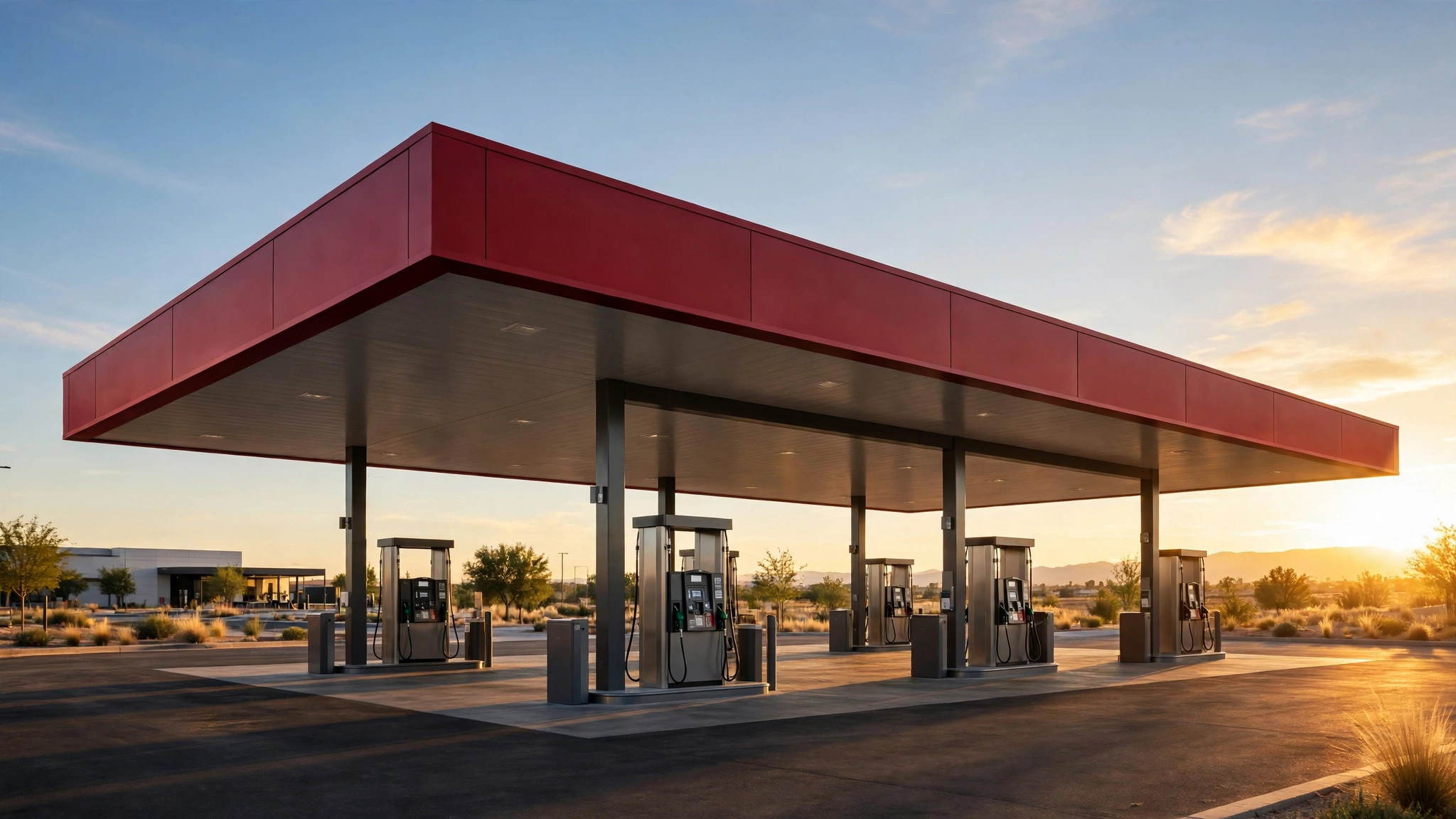
A gas station is one of the hardest-working facades in commercial construction. The canopy fascia carries the brand identity drivers recognize from half a mile away, the soffit sits inches above idling engines and fuel vapor, and the whole structure has to look freshly painted year after year — through sun, rain, road salt, and the occasional bump from a delivery truck. That is why more fuel retailers and petroleum brands are specifying solid aluminum facade panels for canopy cladding, fascia bands, and convenience-store exteriors.
This guide explains where aluminum panels make sense on a gas station project, how to specify them for brand-color consistency across multiple sites, and what to put in your request for quotation so the panels you receive match the panels you approved.
Why Gas Stations Specify Solid Aluminum Panels
A gas station canopy is a small building with an outsized visual job. Its fascia band — often only 600 to 900 mm tall — is the single most visible brand surface on the site. It must hold a flat, crisp face in wind, resist fading under direct sun, and survive the chemical environment of a forecourt without staining or corrosion.
Solid aluminum panels meet those demands for several practical reasons. Aluminum does not rust, and a properly coated panel shrugs off fuel splash, exhaust deposits, and de-icing salt far better than painted steel or cement board. The panels are light enough to hang from a canopy steel frame without heavy secondary structure, yet rigid enough — at 2.5 mm or 3.0 mm thickness — to span between fixings without visible deflection. And because the color is applied as a factory coating rather than site-applied paint, the finish is uniform across every panel on the canopy and every site in a rollout.
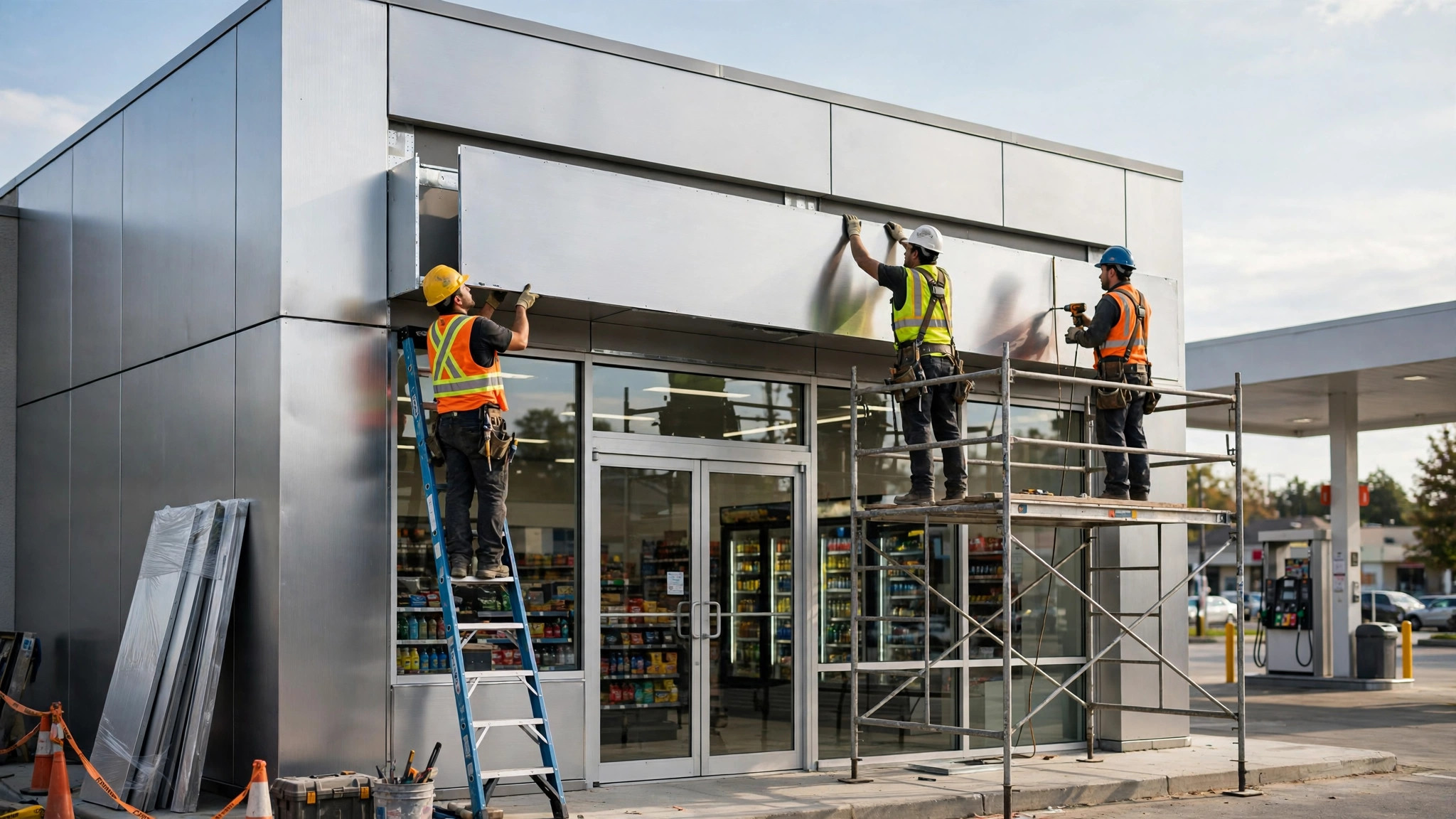
For the convenience store and car wash buildings on the same lot, the same panel system creates a consistent visual language: canopy fascia, storefront fascia, and column covers in one material, one coating system, and one brand color.
Canopy Fascia and Soffit: The High-Visibility Zone
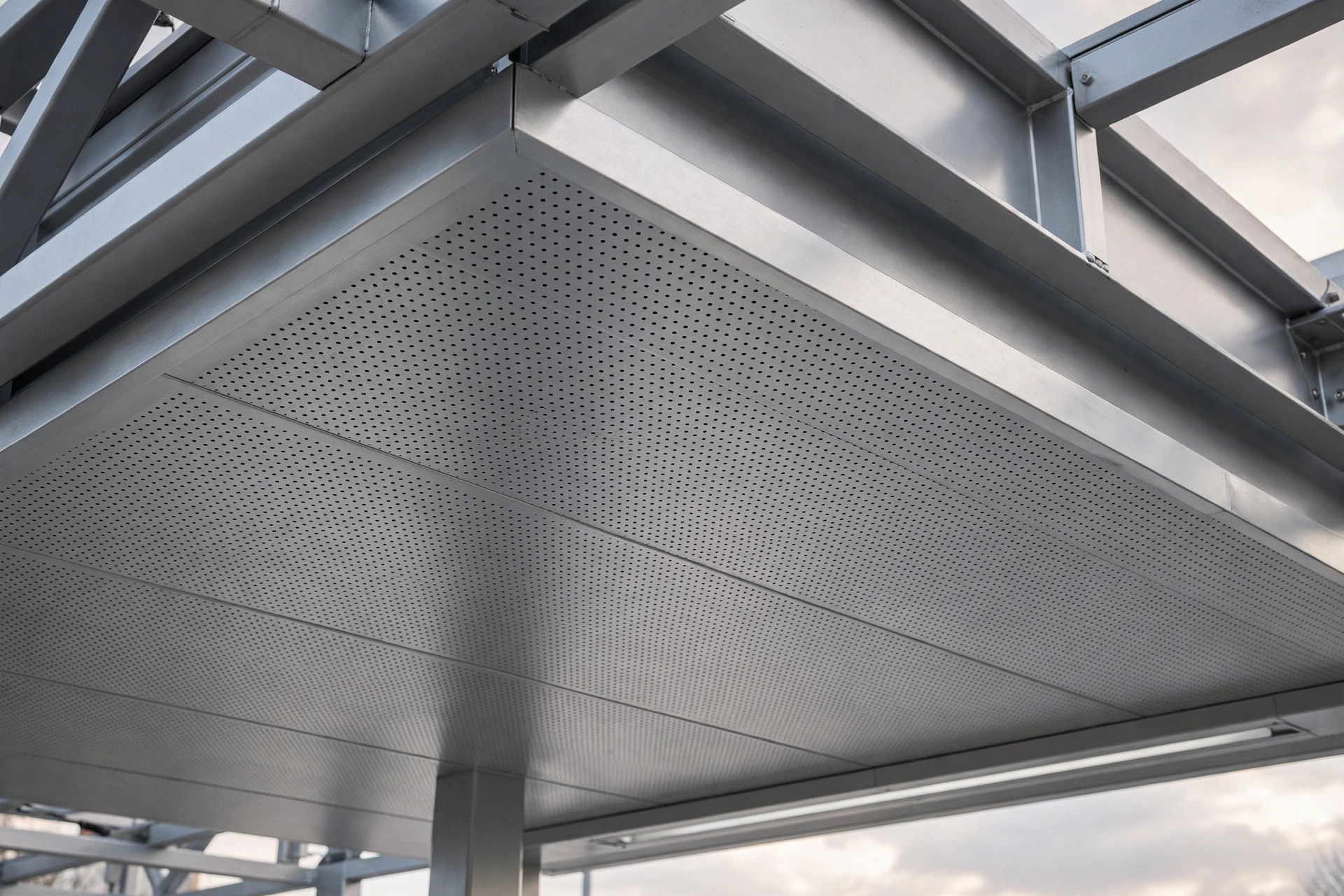
The canopy fascia is the branding surface, but the soffit underneath does the quiet work. Drivers look up at it while fueling, and it is the surface most exposed to heat and vapor rising from the forecourt. Perforated aluminum panels are a common choice here: the perforation pattern allows air movement and heat dissipation above the canopy while keeping the underside clean and uniform in appearance.
When specifying the canopy, treat fascia and soffit as one system. Use the same alloy and coating family on both, and confirm that the fascia panels and the soffit panels are produced from the same coating batch where color matching matters — the eye will compare them at the canopy edge. Standard panel sizes up to 1300 × 4000 mm suit most canopy fascia runs with minimal joints, and cassette-style fixing with concealed fasteners gives the fascia band the flat, uninterrupted face a brand fascia needs.
Pay attention to the fascia-to-soffit corner detail. A folded or extruded corner trim in matching coating hides the joint, protects the panel edge, and gives installers a clean line to work to. Ask your supplier how the corner detail is fabricated — it is the detail most likely to be improvised on site if it is not resolved in the shop drawings.
Brand-Color Matching Across Hundreds of Sites
For a fuel brand, color is not decoration; it is the asset. A driver should recognize the same red, green, or yellow at a station in Texas and a station in Florida, and the canopy fascia is where that recognition happens. That makes color consistency the single most important specification on a gas station panel order.
Start with a controlled color reference, not a screen image. Supply a physical color chip or a RAL or Pantone reference, and ask the factory to produce a sample panel in that color for approval before production. For multi-site rollouts, keep an approved sample panel on file as the master reference, and require each production batch to be checked against it.
PVDF fluorocarbon coating is the usual choice for brand fascia because it holds color and gloss far longer than standard powder coating under constant sun exposure. Specify the coating type in writing, and ask how the factory controls batch-to-batch color variation — a reputable supplier checks each batch against the approved sample and records the result. If your rollout will add stations over several years, ask the supplier to keep the color formula and the approved sample on file, so a canopy built in year three matches the one built in year one.
Durability in a Fuel-Vapor Environment
A forecourt is a harsher environment than a typical retail facade. Panels face UV exposure from above, fuel vapor and exhaust from below, and regular pressure washing. The specification should reflect that.
Alloy choice matters here. 3003 H24 aluminum is widely used for facade panels because it balances formability and strength, and it takes a coating well. Thickness selection follows the same logic as any facade: 2.0 mm suits smaller fascia panels and column covers, while 2.5 mm or 3.0 mm is the safer choice for large canopy fascia panels exposed to wind load, where flatness is critical to the brand image.
Ask about the coating’s resistance to common forecourt chemicals and about recommended cleaning. Most coated aluminum panels can be cleaned with mild detergent and water; aggressive solvents and abrasive pads should be avoided because they damage the coating and void the finish performance. Put the cleaning guidance in the handover documents for the station operator — it costs nothing to write down and prevents most long-term finish complaints.
Specifying Panels for a Multi-Site Rollout
Gas station work is rarely a single canopy. Brands roll out dozens of sites, often with several contractors, and the specification has to survive that fragmentation. Three practices help.
First, standardize the panel system, not just the color. Fix the alloy, thickness range, coating type, fixing system, and joint detail in a brand standard document, and reference it on every project rather than re-specifying from scratch. That keeps the installed result consistent even when the installer changes.
Second, standardize the drawing package. Require shop drawings for the canopy fascia and soffit on every site, with panel sizes, joint positions, and corner details shown. Variations in canopy dimensions are inevitable; the drawing package is where they get resolved before fabrication, not on the scaffold.
Third, plan for replacement panels. Canopies get hit. Keep a small stock of spare panels in the brand color — or, at minimum, keep the color formula and panel dimensions on file with the supplier — so a damaged fascia panel can be replaced without a visible color mismatch against panels that have weathered for years.
What to Include in Your RFQ
To get a comparable, accurate quotation for gas station panels, send the supplier the following: canopy and building elevations with dimensions, the fascia height and soffit layout, the brand color reference (physical chip or RAL/Pantone code), the coating type you require, the alloy and thickness, the fixing system preference, and the number of sites in the rollout with their delivery locations. Photos of an existing station in the same brand are helpful — they show the supplier exactly what “matching” means.
Also state the delivery format: panels cut to size and folded to the shop drawings, flat-packed with protective film, and labeled by elevation and position. For multi-site orders, labeled packaging is what keeps the right panel on the right canopy.
Aluminum facade panels will not make a gas station design on their own, but specified well, they do the job the brand needs: a flat, color-true fascia that reads clearly from the road, a soffit that stays clean above the forecourt, and a finish that still looks new when the next site in the rollout opens. Browse our gas station and canopy panel options at juchangalu.com, or send your canopy drawings for a detailed quotation.