
When US buyers compare aluminum facade panel suppliers, the panel price usually gets all the attention. The freight line often gets a quick glance — until the first invoice arrives. For a product shipped in flat, bulky crates from China, ocean freight can add a meaningful percentage to your landed cost per square meter. The good news: freight is not a black box. Once you understand container math, you can estimate it, compare quotes fairly, and design your order to ship efficiently.
This guide walks through the container sizes that matter for aluminum panels, how to estimate how many square meters fit in one box, and the cost drivers that sit on top of the ocean rate. It will not quote you a rate — freight prices move weekly — but it will show you how to read one.
Why Freight Deserves Its Own Line in Your Budget
Aluminum facade panels are light for their size but bulky to ship. A standard solid aluminum panel is only 2.0mm, 2.5mm, or 3.0mm thick, yet it ships as a rigid flat sheet up to 1300 × 4000mm. Panels cannot be folded, stacked without protection, or packed like small parts. They travel in wooden crates or on pallets, with protective film and edge guards, and every crate wastes some space around the panels themselves.
That combination — low weight, large volume — is exactly what makes freight math matter. Ocean carriers charge by container, and within a container, by whichever is greater: the actual weight or the volumetric (dimensional) weight. For aluminum panels, volume almost always wins. So the real question is not “how heavy is my order?” but “how much container space does it occupy?”
Container Basics: 20ft, 40ft, and 40ft High Cube
Nearly all aluminum panel shipments from China to the US travel in one of three standard dry containers. Knowing their usable space is the starting point for any estimate:
- 20ft container: about 33 cubic meters of internal volume, with a payload of roughly 28,000 kg. Best suited to smaller orders or heavy, compact loads.
- 40ft container: about 67 cubic meters of internal volume, with a payload of roughly 26,000–28,000 kg. The workhorse for most facade panel orders.
- 40ft high cube: about 76 cubic meters of internal volume, with similar payload to a standard 40ft. The extra 300mm of height is useful when crates are stacked.
For aluminum panels, the 40ft high cube is often the most economical choice per square meter, because panel crates are tall and light: you run out of space long before you run out of weight allowance. A 20ft container can make sense for a small trial order or a single elevation’s worth of panels, but its cost per square meter is usually higher.
One practical constraint: panel length. The longest standard panel (up to 4000mm) fits diagonally or lengthwise in a 40ft container, but crate design and loading sequence matter. Ask your supplier how they plan to crate and load panels of your longest size before you finalize the order — a crate that wastes 200mm of length at each end can cost you a surprising amount of capacity.
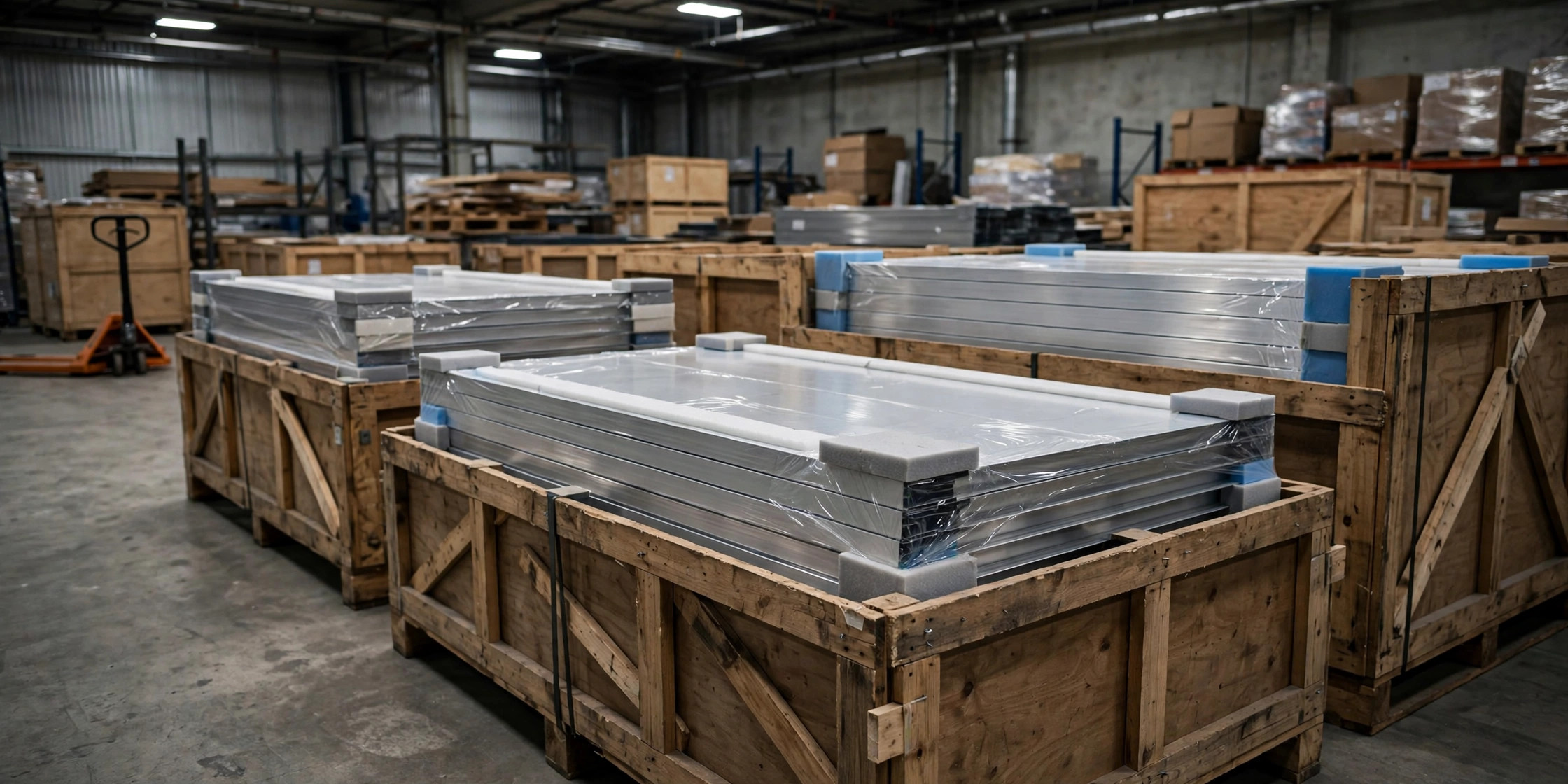
How Many Square Meters Fit in One Container?
There is no single answer, because it depends on panel thickness, panel size, and crating. But a worked example shows the method. Take a typical order of 2.5mm panels in 1250 × 3000mm sheets:
- One panel covers about 3.75 square meters.
- A 2.5mm solid aluminum sheet weighs roughly 6.75 kg per square meter (aluminum density ≈ 2.7 g/cm³), so one panel weighs about 25 kg.
- With protective film, separators, and a wooden crate, a stack of panels and its crate occupy far more volume than the panels alone — crating typically adds 15–30% to the footprint.
As a rough planning figure, a 40ft high cube commonly carries in the range of 800–1,200 square meters of crated 2.5mm panels, depending on panel sizes and crate design. Thinner 2.0mm panels pack more square meters per container; thicker 3.0mm panels pack fewer, but the difference is smaller than many buyers expect, because crate dimensions — not panel thickness — usually set the limit.
Use this kind of estimate only for budgeting. For a firm number, ask your supplier for a loading plan: how many crates, each crate’s dimensions and weight, and the total container count. A supplier who can produce that plan before you pay is showing you their export experience.
Volumetric Weight vs Actual Weight: Which One You Pay For
Ocean freight is normally priced per container (FCL — full container load), so volumetric weight matters less than it does in air freight. But it matters in two situations:
- LCL (less than container load) shipments: if your order does not fill a container, the forwarder charges by the greater of actual weight or volumetric weight, usually calculated as volume in cubic meters × 1,000 kg (or × 167 kg per cubic foot, depending on the carrier’s formula). For crated panels, volumetric weight is almost always the higher number — and the one you pay on.
- Inland trucking and port handling: drayage and some terminal charges can be weight- or volume-based, so the same logic applies at both ends of the journey.
The practical takeaway: a shipment that looks light on paper can still be expensive to move. When comparing an FCL quote against an LCL quote, compare the total landed cost per square meter, not the headline rate. An LCL shipment that saves you from paying for an empty half-container can still cost more per square meter once volumetric charges and per-shipment handling fees are added.

The Costs Beyond the Ocean Rate
The ocean freight rate is only one part of the door-to-door total. When you build your budget, leave room for these:
- Origin charges: export customs clearance, documentation, and terminal handling at the Chinese port.
- Destination charges: US port handling, chassis fees, and drayage to your warehouse or job site.
- Customs and duties: import duties and any applicable trade remedies depend on the product classification and current policy. Rates change — confirm the current treatment with your licensed customs broker before you budget, and keep a contingency line for it.
- Insurance: marine cargo insurance is inexpensive relative to the cargo value and worth including, especially for finished, coated panels where a single scratched crate can mean rework.
- Demurrage and detention: if your container sits at the port beyond the free days allowed, daily charges accrue quickly. Have your trucking and warehouse receiving plan ready before the vessel arrives.
A useful discipline is to ask every freight quote to break out origin, ocean, destination, and customs separately. Two quotes with the same total can hide very different risk — one may include destination handling, the other may leave it to you.
Five Ways to Lower Your Per-Square-Meter Freight Cost
You cannot control the market rate, but you can control how efficiently you use the space you pay for:
1. Fill the container. The single biggest lever is utilization. If your order fills 85% of a container instead of 60%, your cost per square meter drops by roughly the same proportion. Where possible, align your order quantity to full-container increments.
2. Standardize panel sizes. Mixed sizes create awkward crate layouts and wasted space. Consolidating to fewer sizes — and keeping the longest dimension consistent — lets the factory crate tighter.
3. Choose the right container. A 40ft high cube costs more than a standard 40ft, but if the extra height lets you load one more layer of crates, the cost per square meter falls. Ask for a loading comparison, not just a rate comparison.
4. Ship finished panels, not air. Protective packaging is necessary, but over-crating is expensive. A factory experienced in exporting panels will use separators and edge protection that guard the finish without inflating crate volume.
5. Plan the delivery end early. Book drayage and confirm warehouse receiving capacity before the vessel docks. Every extra day a container waits at the terminal adds cost that no supplier can absorb for you.
The Bottom Line
Sea freight shapes your aluminum panel budget through container utilization more than through weight. Understand the three container types, estimate your square meters per container, and read quotes as a breakdown — origin, ocean, destination, customs — rather than a single number. The buyers who budget this way rarely get surprised, and they can compare suppliers on true landed cost instead of panel price alone.
If you are planning an order, send your drawings and panel schedule to the factory and ask for a loading plan with the quotation. A supplier that can show you exactly how your panels will be crated and how many containers they will fill is a supplier that has shipped this product before. Browse products at juchangalu.com or send drawings for a detailed quotation.