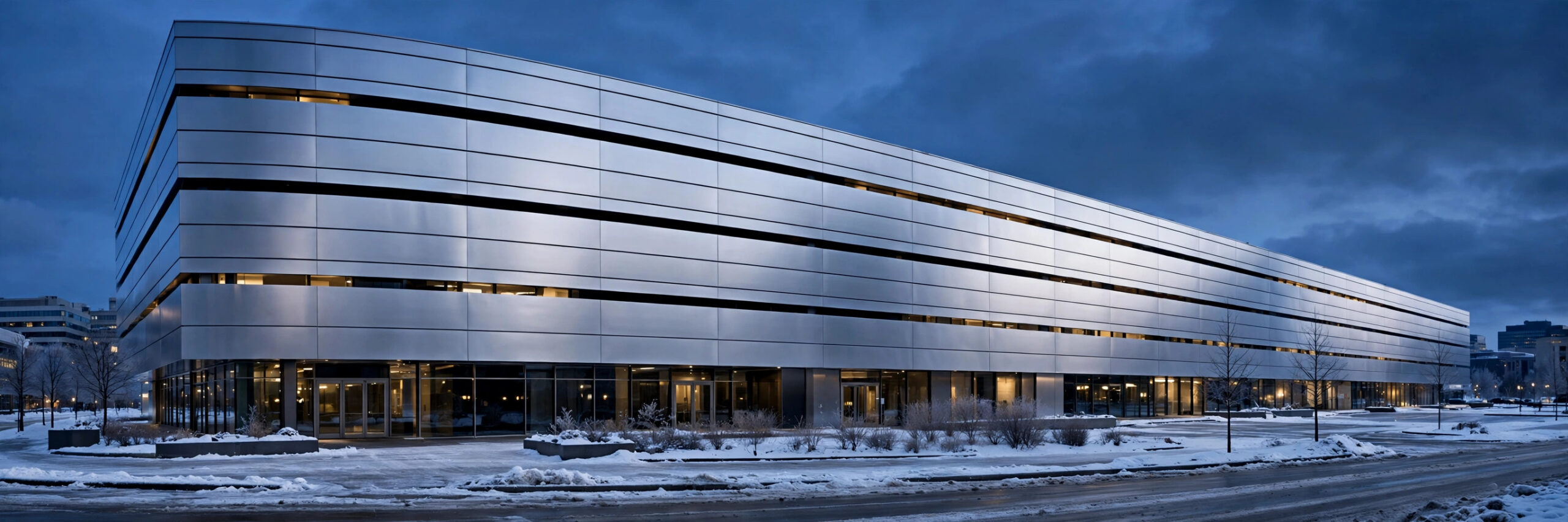
Winter schedules don’t wait for ideal weather. Across much of the United States, facade crews keep working through cold snaps — and solid aluminum panels, like every metal, behave differently when temperatures drop. A crew that understands thermal movement, sealant chemistry, and cold-weather handling can keep a project on schedule; a crew that doesn’t risks callbacks for popped fixings, failed joints, and stressed panels. This guide covers what project managers, installers, and specifiers should plan for when aluminum facade panels go up in cold weather.
Why Aluminum Moves More in Winter Than You Expect
Aluminum expands and contracts more than most construction materials — roughly twice as much as steel per degree of temperature change. That single fact drives almost every cold-weather installation decision.
Consider the numbers. The linear thermal expansion coefficient of aluminum is about 23 × 10-6/°C. For a standard 4-meter (4000mm) panel — the maximum typical length for solid aluminum panels — a 30°C temperature swing produces roughly 2.8mm of dimensional change. A panel installed at -10°C and later exposed to summer sun at 60°C+ can move more than 6mm across its length. At building scale, that movement has to go somewhere.
Winter installation maximizes the gap between the installed condition and the hot condition. Panels fixed at low temperatures will try to expand when summer arrives. The joint system and the fixing method must absorb that movement without transferring stress into the panel, the substructure, or the anchors.
Designing Joints and Fixings for Cold-Weather Movement
Whether panels are installed in January or June, the joint detailing is what determines whether thermal movement is absorbed gracefully or shows up as damage. Cold-weather installation just makes the hot-weather expansion half of the cycle more extreme.
- Allow wider joint gaps at installation. Open joints must be sized for the maximum expected expansion from the installation temperature, not from an average. Review the joint schedule against the coldest expected installation temperature — the design team should confirm that the specified joint width leaves adequate clearance when panels expand from winter lows to summer highs.
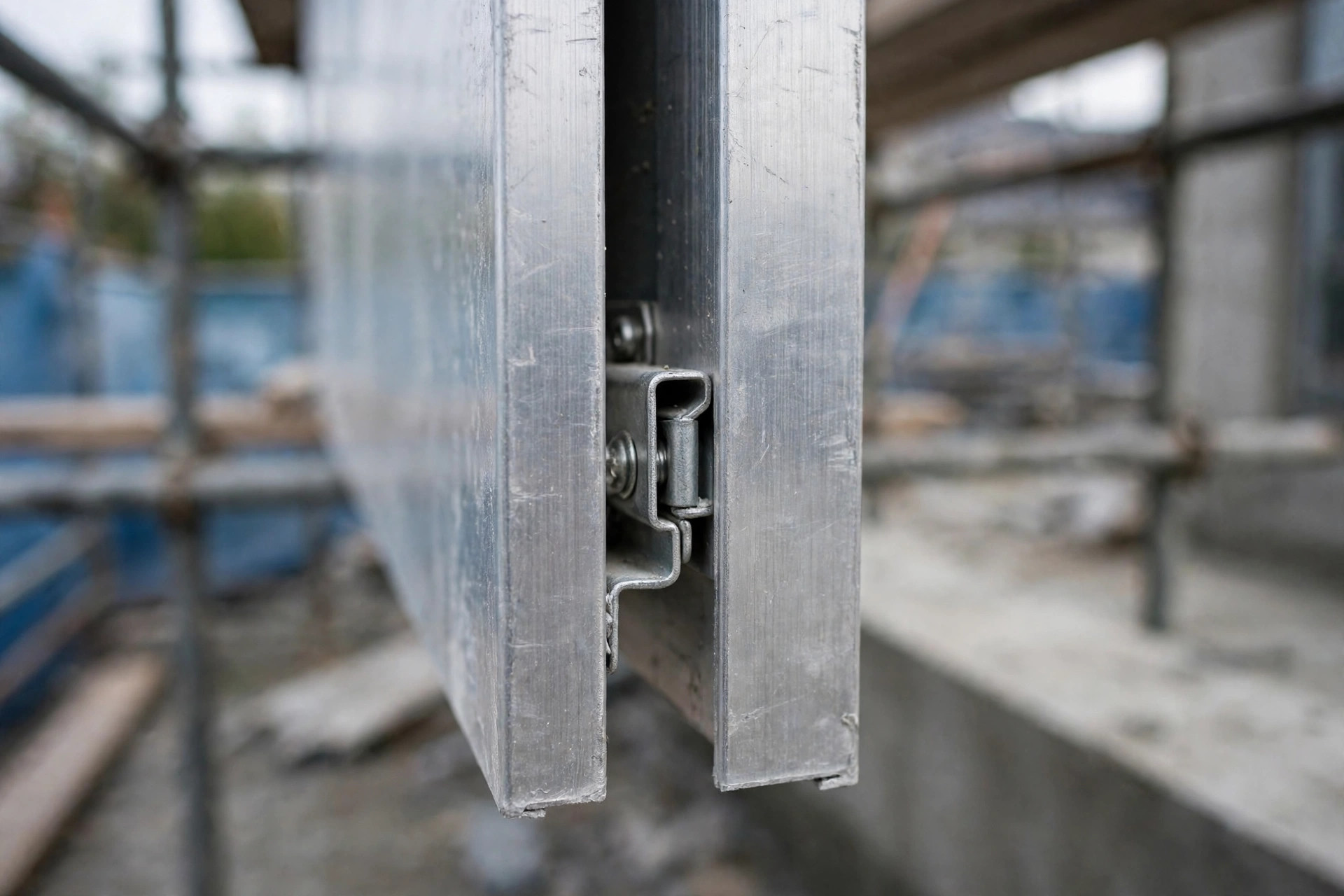
- Use fixed and sliding fixing points. A common cassette system uses one fixed point per panel (typically near the center) with sliding or slotted points elsewhere, so the panel can expand outward from its center. Verify before the cold season that every panel has exactly one fixed point — accidental double-fixing is one of the most common causes of thermal stress damage.
- Avoid over-tightening. In cold weather, crews sometimes over-torque screws because cold metal feels rigid and “safe.” Fasteners in sliding connections must remain snug but free to move. An over-tightened sliding clip becomes a fixed point, and the panel will fight it every summer.
- Check panel geometry. Large-format panels up to 1300×4000mm are practical with 2.5mm or 3.0mm aluminum, and 3.0mm stock offers the best dimensional stability for oversized panels. For winter-installed projects, confirm that stiffener placement and panel gauge match the specified wind and thermal loads — thinner panels show movement-related stress sooner.
Sealants and Gaskets: The Temperature Limit That Can Stop Your Schedule
This is the cold-weather issue most often underestimated on aluminum panel projects. Structural and weather seals behave differently at low temperatures, and the consequences are not cosmetic.
- Check minimum application temperatures. Many common polyurethane and silicone facade sealants are rated for application only above 40°F (5°C), and some specify even higher minimums. Below that, curing slows dramatically or fails, leaving joints that never develop their design strength. Always verify the specific product’s data sheet — never assume.
- Plan curing time, not just installation time. A sealant applied on a cold morning may look finished but take days longer to cure. Schedule inspections and follow-on work (like scaffold drops) around realistic cold-weather cure windows, and confirm with the sealant manufacturer when temperatures are marginal.
- Store sealants and cartridges warm. Cold sealant is stiff, hard to extrude, and difficult to tool into a clean bead. Keep cartridges and two-part materials in a heated site box or trailer, and warm them to the manufacturer’s recommended temperature before use. Joint surfaces themselves should also be dry and frost-free before sealant application.
- Review gasket flexibility. EPDM and silicone gaskets used in rainscreen systems stiffen in cold weather. Dry-gasket systems are generally more forgiving than wet-seal systems in winter work, but check the gasket manufacturer’s low-temperature rating for the expected installation conditions.
Handling and Storing Panels on a Cold Job Site
Cold aluminum panels are not fragile, but cold-weather handling creates its own risks — particularly around coatings and packaging.
- Let panels reach site temperature before unpacking. Panels delivered in sealed packaging can carry condensation if opened while the metal is significantly colder than ambient air. Allow time for temperature equalization in a dry, sheltered area, and remove protective film promptly after installation — film left on too long can be difficult to remove regardless of season, and freeze-thaw cycles do not help.
- Protect PVDF and powder-coated finishes. Coating systems like PVDF, powder coating, and roll coating are engineered for exterior durability, but finished panels should still be handled with gloves and kept clear of abrasive contact during winter staging, when crews may be less mobile and working surfaces are harder.
- Don’t stage panels on frozen ground without protection. Store panels flat or at a slight angle on level, protected dunnage — never directly on ice or wet ground. If panels are wrapped, keep the wrapping intact until the day of installation to limit frost and grit accumulation.
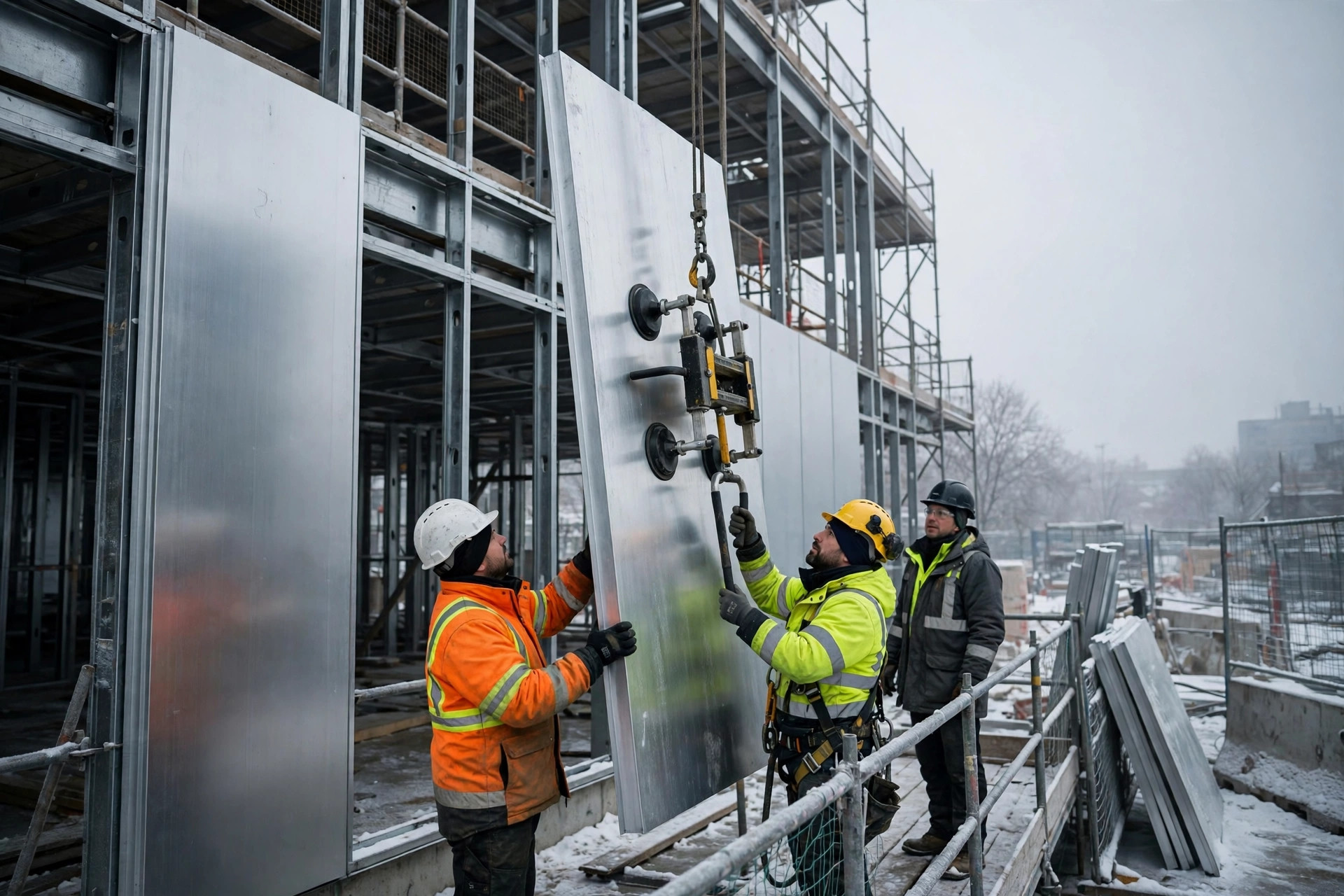
- Lift carefully in cold air. Wind chill doesn’t change panel behavior, but it changes crew behavior — stiff gloves and numb fingers drop things. Large-format panels up to 4 meters long need the right number of handlers and suction equipment regardless of the season; budget extra time for each lift in cold conditions.
Crew Workflow and Safety Notes
Panel behavior gets most of the attention, but cold-weather productivity depends on the crew. Shorter effective working days, slower sealant curing, and frost delays all compress installation output. Project managers should build buffer into winter schedules rather than assuming summer productivity rates.
Practical measures that experienced facade contractors use: schedule sealant and critical joint work for the warmest hours of the day; keep a heated area for sealant storage, small tools, and touch-up paint; rotate crews through warm-up breaks on long exterior days; and hold a pre-shift briefing whenever temperatures cross a product’s stated minimum — not after the work is already done.
Planning Ahead for Winter Panel Work
Cold-weather installation of aluminum facade panels is routine, not exceptional — it just requires the details to be checked against the actual conditions instead of default assumptions. Size joints for the coldest installation temperature, keep fixings free to slide, respect sealant temperature limits, and protect finished panels during staging. With those four habits, winter-installed facades perform exactly as designed for decades.
Starting a facade project in the colder months? Browse product options at juchangalu.com or send your drawings for a detailed quotation — the earlier the panel geometry and joint detailing are confirmed, the smoother the winter schedule runs.