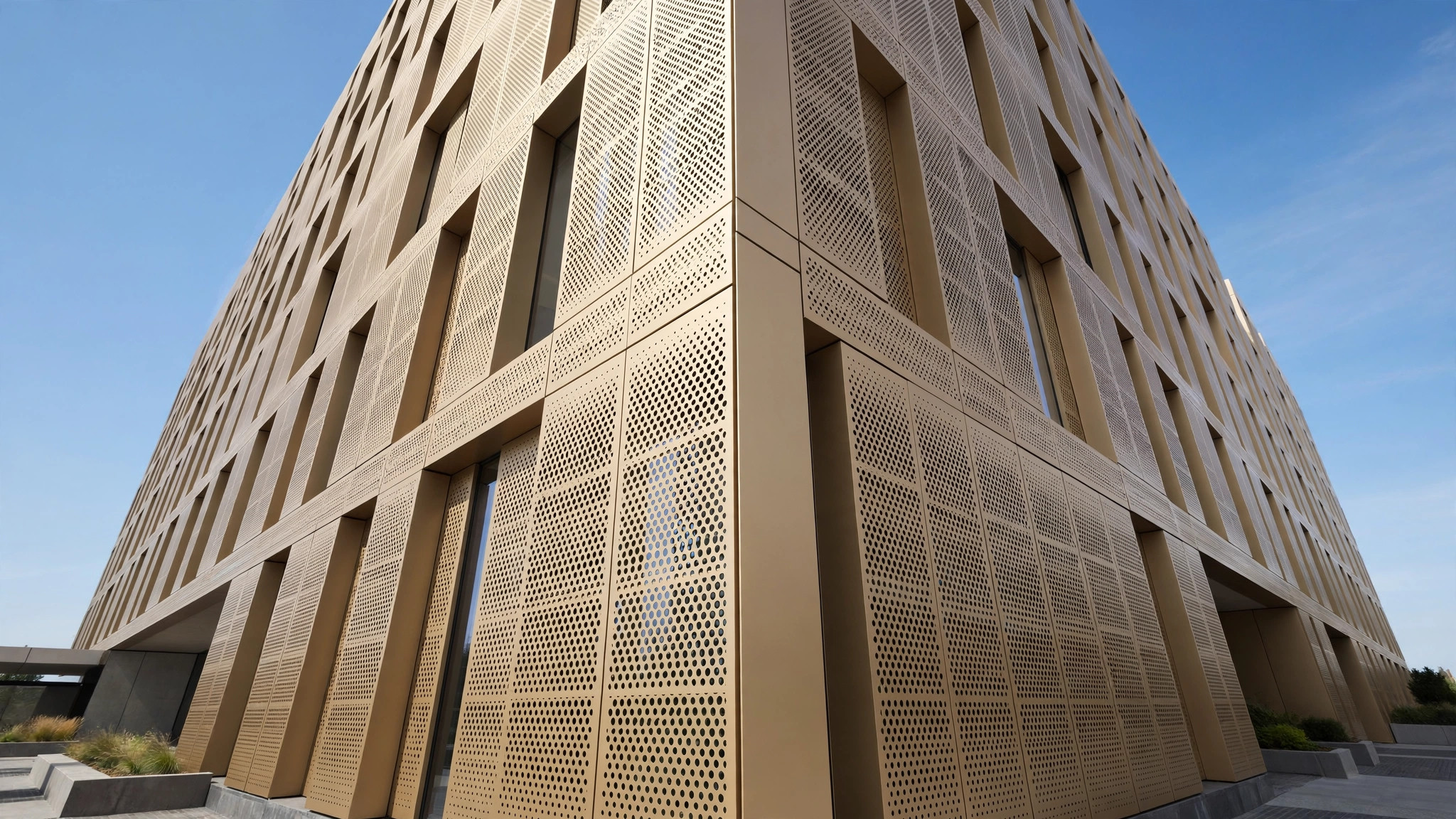
When a project calls for a metal façade with crisp lines, deep color, and decades of service life, solid aluminum panels are often the answer. This guide covers what they are, how they differ from composite alternatives, and what to specify — so your next curtain wall or cladding package goes out for bid with confidence.
What Are Solid Aluminum Panels?
Solid aluminum façade panels — also called aluminum veneer panels, single-skin aluminum panels, or metal plate wall panels (CSI 07 42 13.16) — are formed from a single sheet of aluminum alloy. Unlike composite panels, there is no plastic or mineral core: the panel is one homogeneous piece of metal, cut, folded, welded, and finished to shape.
That single-skin construction is the whole point. It gives the panel its rigidity, its clean folded edges, and its behavior in fire — solid aluminum is non-combustible by nature of the material.
Solid Aluminum vs. Aluminum Composite Panels (ACP)
Both have their place, but they are not interchangeable:
- Fire performance. Solid aluminum has no combustible core, which simplifies compliance on projects where ACP cores face scrutiny.
- Formability. Solid sheet can be brake-formed into deep folds, curved profiles, perforated patterns, and carved reliefs that composite panels cannot easily achieve.
- Repairability. A damaged solid panel can often be refinished or replaced as a single component.
- Cost profile. Solid panels typically cost more per square foot than standard ACP, but they compete directly on high-end façades where finish quality and longevity drive the decision.
If the design involves complex geometry — curved curtain walls, perforated screens, custom carvings — solid aluminum is usually the right call.
Key Specifications
When specifying or requesting a quotation, these are the parameters that matter:
- Thickness: 2.0 mm, 2.5 mm, and 3.0 mm cover the vast majority of façade work. Thicker sheet for large panels or high wind loads; thinner for soffits and interior-adjacent applications.
- Alloy and temper: 1001 and 3003 alloys in H24 temper are the industry workhorses for formed panels — a good balance of formability, strength, and corrosion resistance.
- Panel size: Standard production handles sheets up to 1300 × 4000 mm. Oversized panels are possible but should go through engineering review for flatness and handling.
- Finish: PVDF (fluorocarbon) coating is the premium exterior finish, prized for color retention and chalk resistance. Powder coating and roll coating suit budget-sensitive or interior applications.
Send your supplier the drawings or specifications with these four items defined, and you will get an accurate quotation back — vague inquiries get vague pricing.
Finishes: Why PVDF Dominates Exteriors
A façade lives outdoors for decades, so the coating is not cosmetic — it is the weathering layer. PVDF resin-based coatings resist UV degradation, chalking, and fading far better than standard polyester powders, which is why they dominate specifications for curtain walls and high-visibility cladding. For soffits, canopies, or interior feature walls, powder coating can deliver the look at a lower cost.
Whatever the coating, confirm it is applied after fabrication (not before) so folded edges and welds receive full coverage.
From Flat Sheet to Finished Panel
Understanding the fabrication sequence helps you judge a supplier’s capability:
1. CNC cutting — blanks cut to exact dimensions, including perforation patterns. 2. Bending and forming — brake presses fold edges and profiles; rolling forms curves. 3. Welding — corners and stiffeners welded for rigidity on larger panels. 4. Grinding and finishing — welds dressed smooth, surfaces prepared. 5. Cleaning and coating — chemical pretreatment, then PVDF, powder, or roll coating. 6. Inspection and packing — dimensional checks and export-ready packaging.
A true manufacturer runs all of this in-house. If a “supplier” outsources coating or fabrication, lead times and quality control suffer — ask directly who does what.
Where Solid Aluminum Panels Are Used
- Curtain wall spandrels and feature bays
- Rainscreen cladding systems
- Soffits and fascia
- Column covers and beam wraps
- Canopies and entrance features
- Perforated sunshades and decorative screens
- Interior feature walls (where the budget allows)
Sourcing: Factory-Direct vs. Middlemen
Façade panels are a made-to-order product — every project has different dimensions, colors, and details. Buying factory-direct removes the distributor markup and, more importantly, puts you in direct contact with the engineering team that will form your panels. When a detail needs adjusting mid-project, that direct line is worth more than any discount.
What a good factory-direct partner provides:
- Detailed quotation from your drawings or specifications
- Shop drawings for approval before production
- Samples on request — always approve the finish sample before full production
- Export-ready packaging and documentation
Getting Started
If you have an upcoming project, the fastest path to a real number is simple: send the drawings or specifications, note the alloy, thickness, finish, and quantities, and request a detailed quotation. A serious manufacturer will respond with engineering feedback, not just a price — that feedback is often where project savings hide.
Juchang Aluminum is a Guangxi-based manufacturer specializing in custom solid aluminum panels for curtain walls and façades: flat veneer, curved and special shapes, perforated, carved, and wood/stone finishes. Browse six panel systems and project references at juchangalu.com.