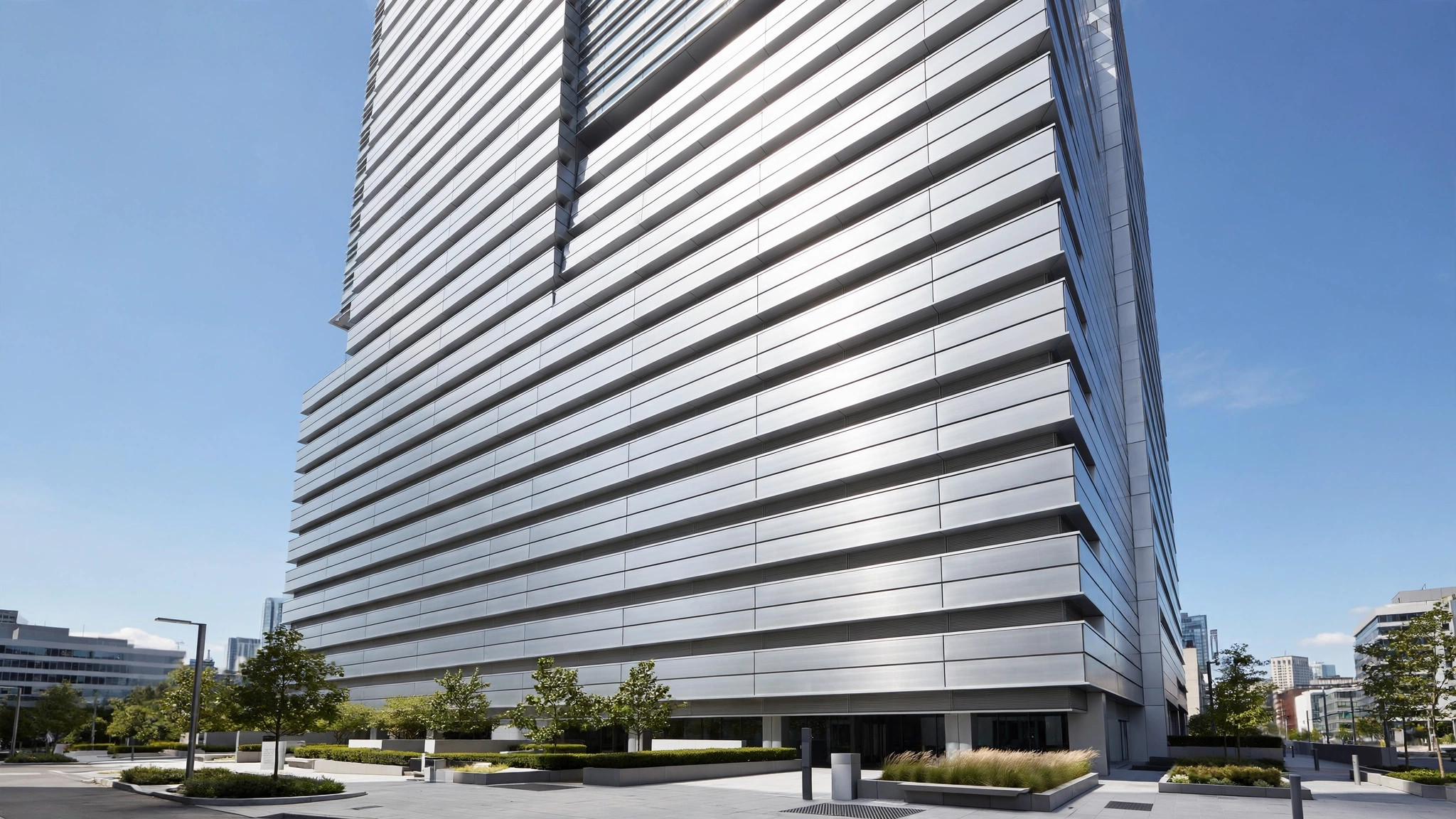
When American architects and contractors specify metal cladding for a commercial facade, two questions come up before almost anything else: will it hold up in high winds, and will it survive impact? For projects in Florida, the Gulf Coast, Texas, and other wind-prone regions, these are not academic concerns — they determine which products pass plan review and which get rejected at the submittal stage. This guide explains how solid aluminum facade panels perform under wind load and impact, what actually drives that performance, and how US buyers can specify it correctly.
Why Wind Load Performance Matters for Aluminum Facade Panels
Unlike a painted wall, a facade panel system is a collection of individual elements exposed to aerodynamic forces. Wind flowing around a building creates positive pressure on the windward face and suction on the leeward and side faces — and suction, not pressure, is usually the controlling force on lightweight cladding. Edge zones and corners can see design pressures several times higher than the middle of a wall, which is why codes require buildings to be divided into wind zones.
In the United States, wind design follows ASCE 7, which gives the wind speed map and pressure coefficients, while project specifications typically reference ASTM E330 (structural performance of exterior windows, doors, and curtain walls by uniform static air pressure difference) as the test method for cladding components. A solid aluminum panel system is generally evaluated in the same way as other metal cladding: the complete assembly — panel, fixings, and subframe — is what gets tested, not the aluminum sheet alone.
For the buyer, the practical takeaway is simple: wind performance is a system property. Panel thickness, panel size, stiffening, cassette depth, and the fixing pattern all contribute. Asking only about the aluminum alloy tells you very little about whether the facade will pass a structural review.
How Panel Thickness and Geometry Resist Wind Pressure
Wind pressure bends a panel between its support points, much like a load on a beam. Three geometric factors dominate the result:
- Panel thickness. Solid aluminum facade panels are most commonly produced in 2.0mm, 2.5mm, and 3.0mm thicknesses. Thicker material resists deflection and bending stress significantly better — all else equal, a 3.0mm panel can span a noticeably larger module than a 2.0mm panel under the same wind load. For high-wind regions, moving up one thickness grade is often the most straightforward way to meet deflection limits without shrinking the panel module.
- Panel module size. Deflection grows quickly as the unsupported span increases. Large-format panels — standard production commonly reaches up to 1300 × 4000mm — look impressive but demand careful engineering on windy elevations. On corner and parapet zones, designers often reduce module size or add intermediate fixing points to keep deflections within acceptable limits.
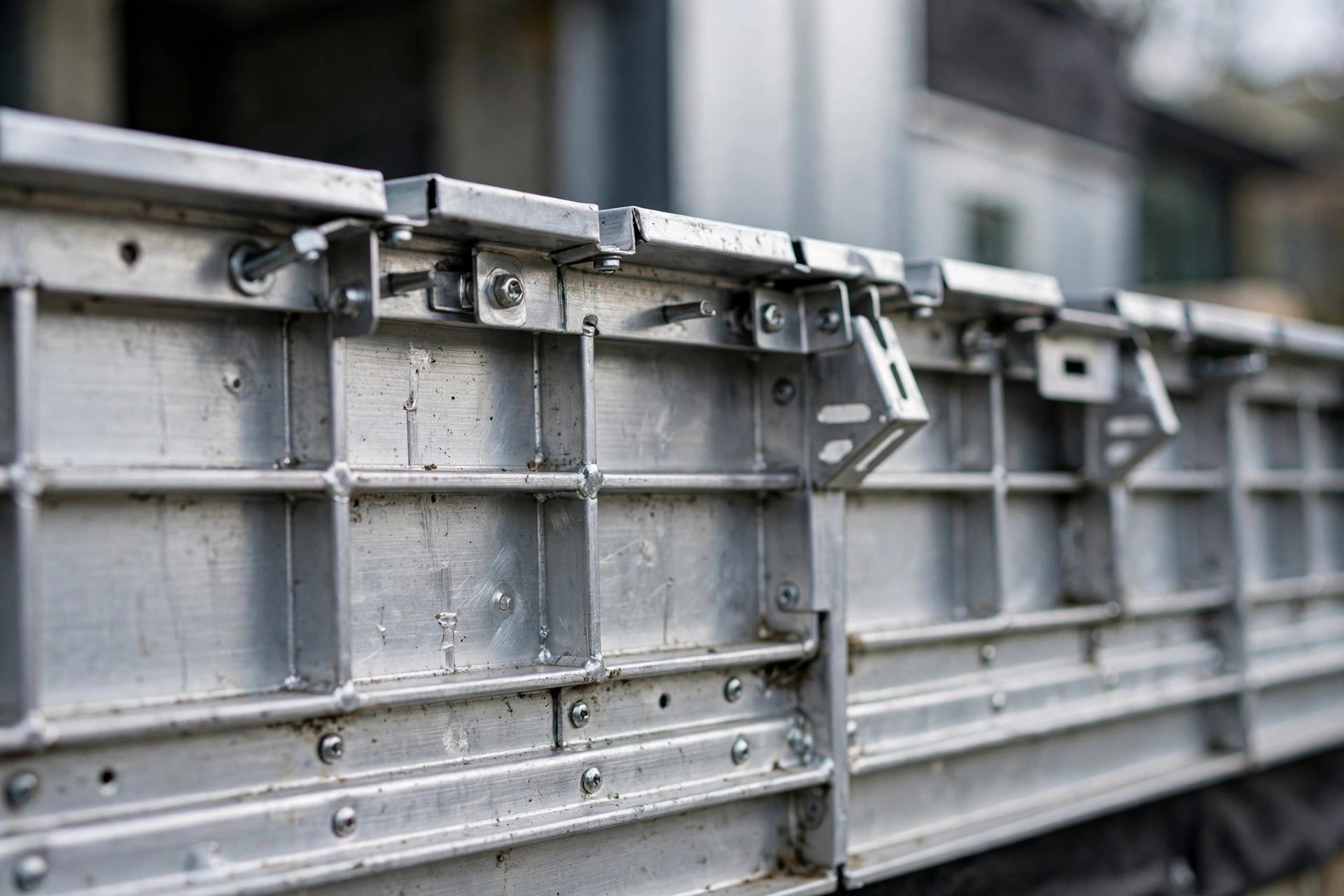
- Stiffening and cassette form. Factory-folded cassette (tray) panels with stiffener ribs on the back face behave very differently from a flat sheet. The folded edges add rigidity around the perimeter, and welded or glued stiffeners reduce mid-span deflection. When comparing quotations from different factories, ask how each supplier stiffens large modules — the answers reveal a lot about engineering depth.
Alloy choice plays a supporting role: 3003-H24 aluminum-manganese alloy offers higher strength than 1100-series pure aluminum, making it the common choice for exterior facade work. But geometry and system design, not alloy alone, decide wind performance.
Impact Resistance: Hail, Debris, and Hurricane-Borne Missiles
Impact is the second half of the storm story, and it is where solid aluminum panels show a clear advantage over composite alternatives. A solid aluminum panel is a single, homogeneous sheet of metal — there is no core layer to delaminate, no bond line that can fail after repeated strikes. Hail impact that might crack a brittle surface or deform a thin skin typically leaves a solid aluminum panel with, at worst, a local dent that does not compromise weather integrity.
In hurricane-prone regions such as South Florida, building codes add a specific requirement: the building envelope must resist wind-borne debris impact. Test protocols commonly referenced in US specifications include ASTM E1886 and E1996 for missile impact and cyclic pressure loading, and products used in the Miami-Dade High Velocity Hurricane Zone carry a Notice of Acceptance (NOA). Buyers should understand what these programs mean in practice: they evaluate complete tested assemblies, and passing them requires the exact panel thickness, size, and fixing configuration that was tested. Substituting a thinner panel or a wider module after approval can void the basis of the evaluation.
For projects outside the HVHZ, impact resistance still matters — hailstorms across the Midwest and Texas routinely damage roofs and cladding. When reviewing a supplier, ask whether they can point to impact test data for their standard cassette system, and confirm which assembly the data covers. A factory that can document its tested configuration is worth more than one that speaks only in generalities.
Designing the Fixing System for Wind Performance
The panel never works alone: it hangs on a fixing system that must transfer wind loads to the building structure without failing, fatiguing, or allowing excessive movement. Several details deserve buyer attention:
- Fixing density and layout. More fixing points mean shorter spans and lower stress per fastener — but also more penetrations and more labor. The layout should reflect the wind zones: corners and edges get tighter fixing patterns than field areas.
- Movement accommodation. Aluminum expands and contracts with temperature. Fixings must allow in-plane movement while remaining firmly engaged against suction loads. Slotted holes, sliding clips, or cassette hook systems are typical solutions; rigid point fixings that fight thermal movement invite fatigue cracking over time.
- Subframe stiffness. The aluminum or steel subframe behind the panels must be stiff enough that it does not deflect excessively under load and overload individual panels. System design — not just panel selection — determines long-term reliability.
- Fastener quality. Stainless steel fasteners are the standard choice for exterior aluminum systems to avoid galvanic corrosion between dissimilar metals. This is a small line item with outsized consequences when it is value-engineered away.
A Specifier’s Checklist: What to Ask Your Panel Factory
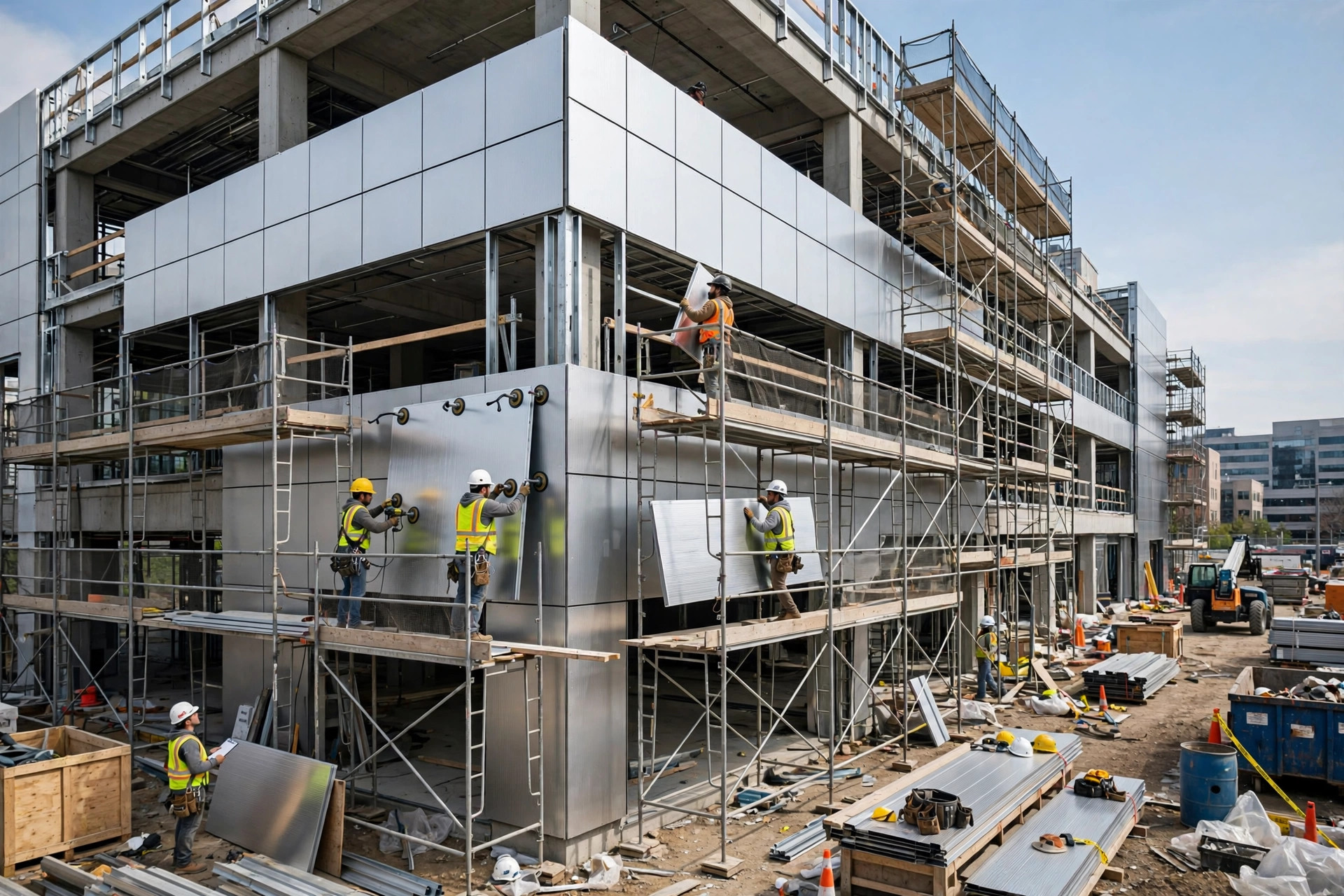
When you request quotations for solid aluminum facade panels, wind and impact performance should appear in the technical discussion, not just the price comparison. A practical checklist:
- What is the maximum standard panel size (for example, up to 1300 × 4000mm), and how does recommended module size change for high-wind elevations?
- Which thicknesses (2.0 / 2.5 / 3.0mm) and alloys (such as 3003-H24) are offered, and what does the factory recommend for the project’s wind zone?
- How are large modules stiffened — welded ribs, adhesive-bonded stiffeners, or deeper cassette folds?
- Can the supplier provide structural test data (e.g., ASTM E330-type uniform load testing) for their standard cassette assembly, and exactly which configuration was tested?
- What impact test data exists for the system, and does it cover the missile-impact protocols relevant to the project location?
- What surface finishes are available (PVDF, powder coating, or roll coating), and how is finish warranty documented for coastal or high-UV exposure?
- Are shop drawings and a fixing layout part of the supply package, so the installer and the structural reviewer work from the same geometry?
Factories that answer these questions precisely — with test reports, drawings, and configuration-specific data — are the ones whose facades perform as specified. Those that answer vaguely tend to leave the engineering to the installer, which is exactly where wind-related failures begin.
Solid aluminum panels earn their place on US facades through a straightforward combination: homogeneous metal construction, sensible thickness selection, engineered stiffening, and a fixing system designed for both suction loads and thermal movement. Specify the system, verify the data, and the facade will handle what the weather brings. Browse product options at juchangalu.com, or send your drawings for a detailed quotation tailored to your project’s wind zone.