作者: wpusername2200

  • PVDF vs Anodized vs Powder Coating: Finish Cost and Lifespan Compared for Aluminum Facade Panels

    PVDF vs Anodized vs Powder Coating: Finish Cost and Lifespan Compared for Aluminum Facade Panels

    When US buyers request quotes for solid aluminum facade panels, the line item that moves the number most — after thickness — is the finish. Two panels with identical 3.0mm alloy and the same dimensions can carry very different prices and service lives depending on whether they are coated with PVDF, powder coating, or anodized. This guide compares the three most common finishes on solid aluminum facade panels so you can specify the right one the first time, and understand what the cost differences actually buy you.

    Why the Finish Decision Comes First

    A finish is not decoration. On an exterior facade it is the weather barrier: UV exposure, acid rain, salt spray, temperature cycling, and airborne pollutants all attack the surface long before they threaten the aluminum underneath. A well-chosen finish keeps colors true for decades and reduces maintenance to occasional washing. A poorly matched one — powder coating where PVDF was warranted, for example — can chalk, fade, or peel within years, and recoating a facade in place costs many times what the right finish would have added at the factory.

    The practical way to think about it: the finish determines the panel’s service life and maintenance cost, while the alloy and thickness determine its structural performance. Both matter, but the finish is where buyers most often leave money — or decades of life — on the table.

    PVDF Coating: The Long-Life Standard

    PVDF (polyvinylidene fluoride, often sold under the Kynar 500 or Hylar 5000 brand names) is the premium finish for architectural aluminum. Applied as a liquid spray in multiple coats and oven-cured, PVDF forms a chemically stable film that resists UV degradation, chalking, and fading far better than most alternatives.

    What it costs more for: multi-layer application (primer plus two or three topcoats), specialized booths and curing ovens, and the resin itself, which is among the most expensive coating materials in architectural use. On solid aluminum facade panels, PVDF typically carries the highest unit price of the three finishes discussed here.

    What it buys: industry-standard performance is commonly specified against AAMA 2605, the highest-performance specification for organic coatings on architectural aluminum. Projects that need color to hold for decades — corporate headquarters, flagship retail, civic buildings, coastal developments with high UV and salt exposure — default to PVDF for good reason. It also tolerates aggressive environments and frequent cleaning without dulling, which matters for facades in polluted urban or marine settings.

    Specify PVDF when: the design life is measured in decades, color fidelity is critical, or the site is harsh (coast, high UV, industrial zones).
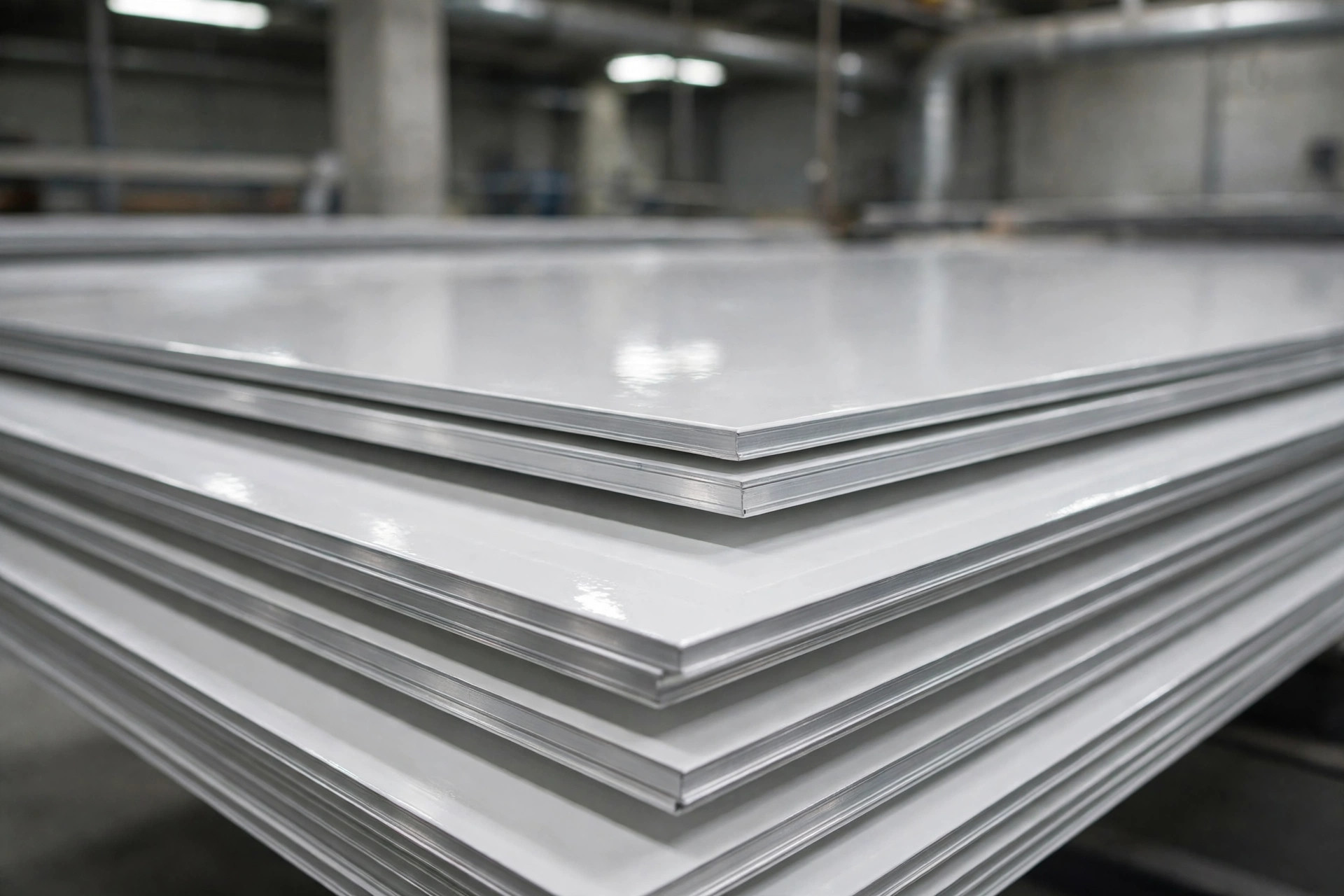
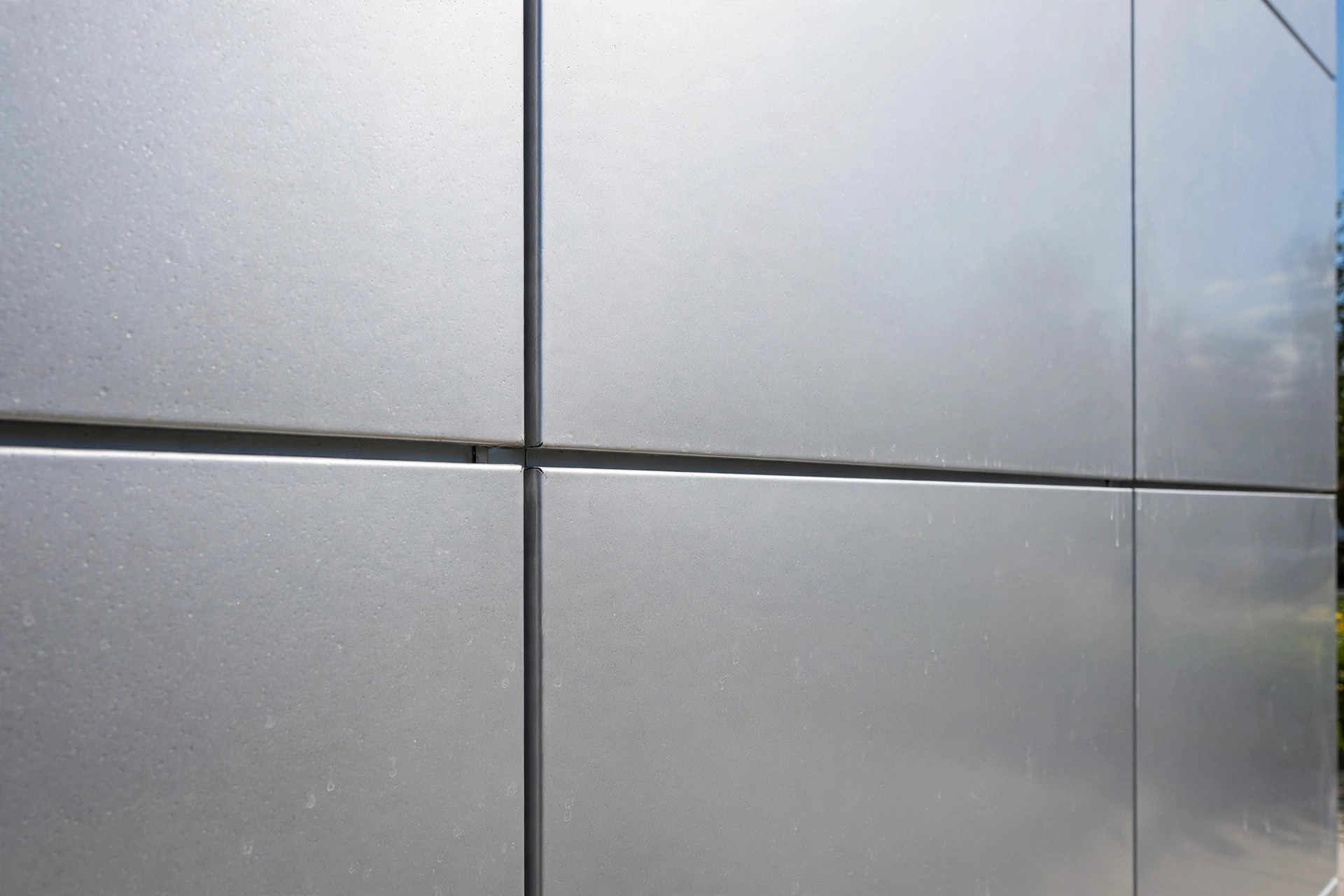
    Stacked solid aluminum facade panels with a smooth white PVDF coating in a factory finishing hall
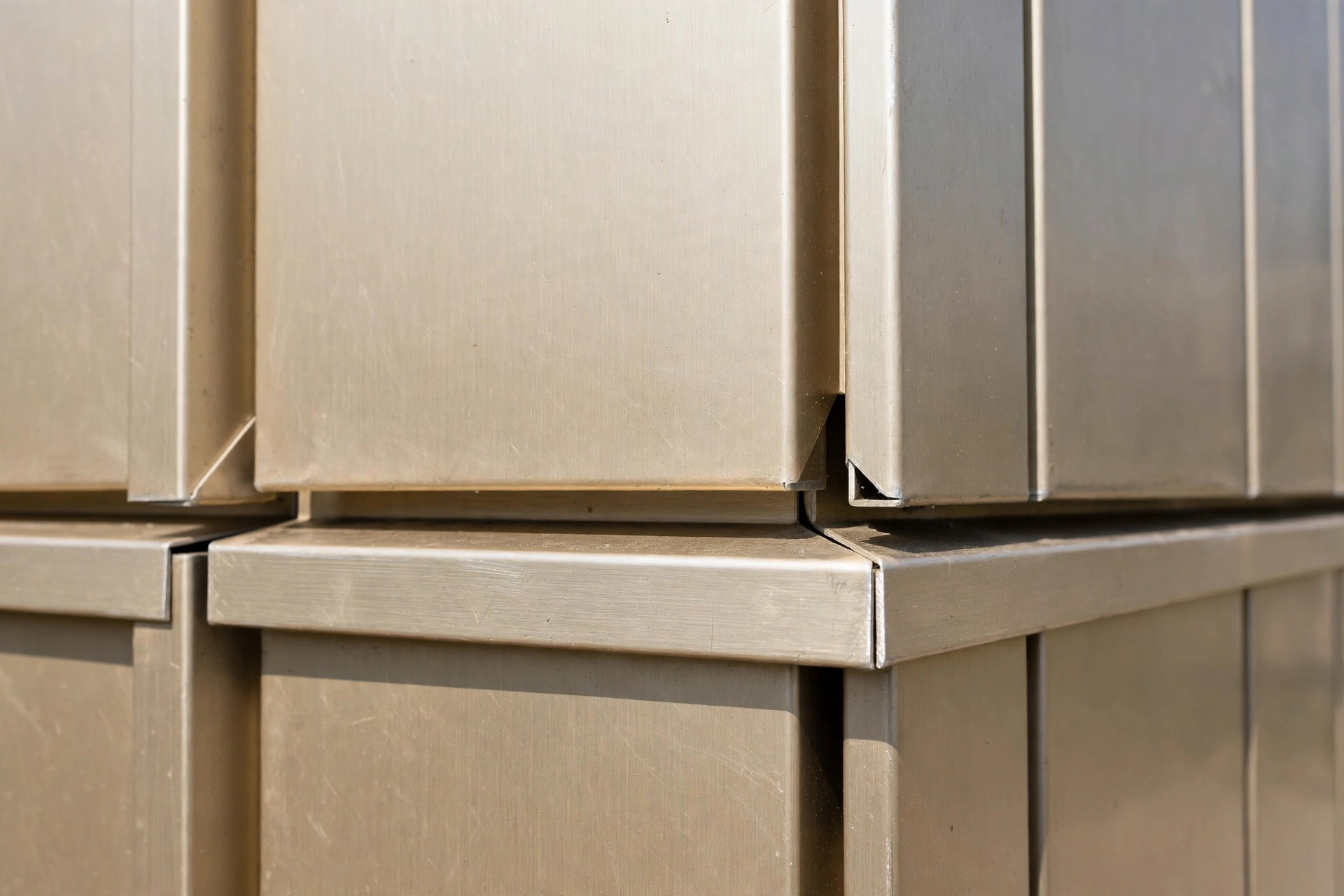
    Solid aluminum panels with a smooth factory-applied finish, stacked and ready for fabrication.

    Powder Coating: The Value Workhorse

    Powder coating applies dry resin powder electrostatically, then cures it in an oven to form a thick, hard, uniform film. On solid aluminum panels it is the most widely used finish for commercial and residential projects worldwide, because the balance of cost, color choice, and durability is hard to beat.

    Cost position: powder coating is generally the lowest-cost factory finish of the three. The process is fast, overspray can be reclaimed and reused, and it needs no solvents, which keeps both material and operating costs down. For large volumes of standard RAL colors, it offers the best price per square meter of finished panel.

    Lifespan: high-quality exterior-grade polyester or super-durable polyester powders perform well for typical commercial service lives. AAMA 2604, the mid-tier architectural specification, is the common benchmark. In mild to moderate climates, powder-coated aluminum facades routinely serve 10–20 years with minimal maintenance. What you give up versus PVDF is long-term UV resistance: in intense sun, powder coatings chalk and fade sooner, and recoating options are limited once the film weathers.

    Specify powder coating when: budget discipline matters, the climate is moderate, and the building’s planned service life or brand refresh cycle is under roughly two decades.

    Anodized Finish: The Distinctive Metallic Look

    Anodizing is not a coating in the paint sense — it is an electrochemical process that thickens the aluminum’s own oxide layer, producing an integral, metallic finish that cannot peel. The result is a crisp, satin metallic appearance (clear, champagne, bronze, and black being the classics) that designers choose when they want aluminum to read as metal rather than as paint.

    Cost and color: anodizing sits in the middle on price for standard colors, but its palette is narrow — deep, saturated custom colors are essentially off the table. That limitation is also its design signature. Where powder coating and PVDF give you any RAL or custom color, anodizing gives you the unmistakable depth of real metal.

    Durability notes: the oxide layer is hard and abrasion-resistant, and it resists corrosion well in urban environments. However, anodized surfaces are sensitive to alkaline attack — concrete splash during construction is a classic cause of staining — and color consistency across large batches requires careful process control, since the finish grows out of the metal itself rather than being sprayed onto it.

    Specify anodizing when: the design demands a genuine metallic read, the color palette stays within natural metallic tones, and the project team can manage construction-phase protection carefully.
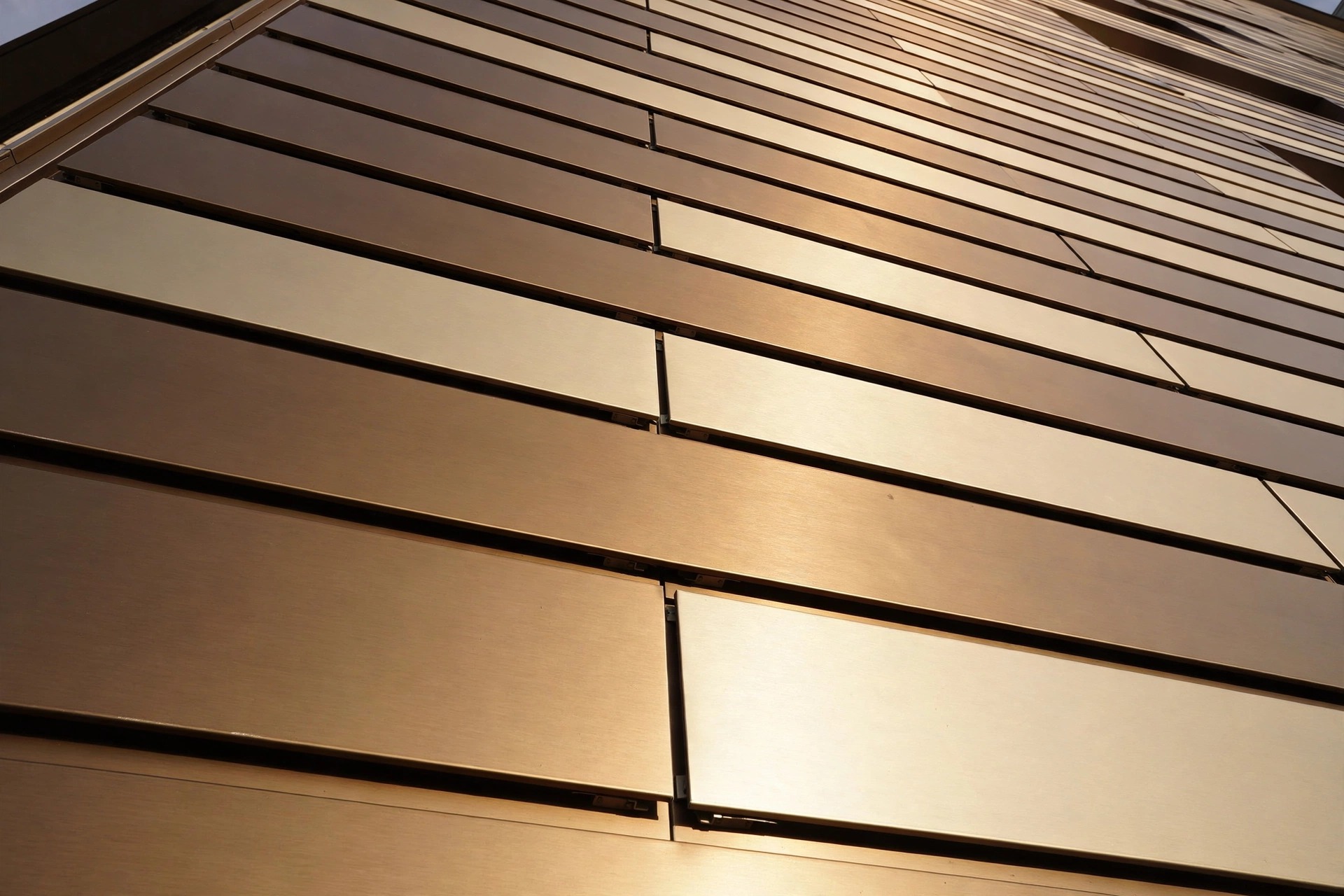
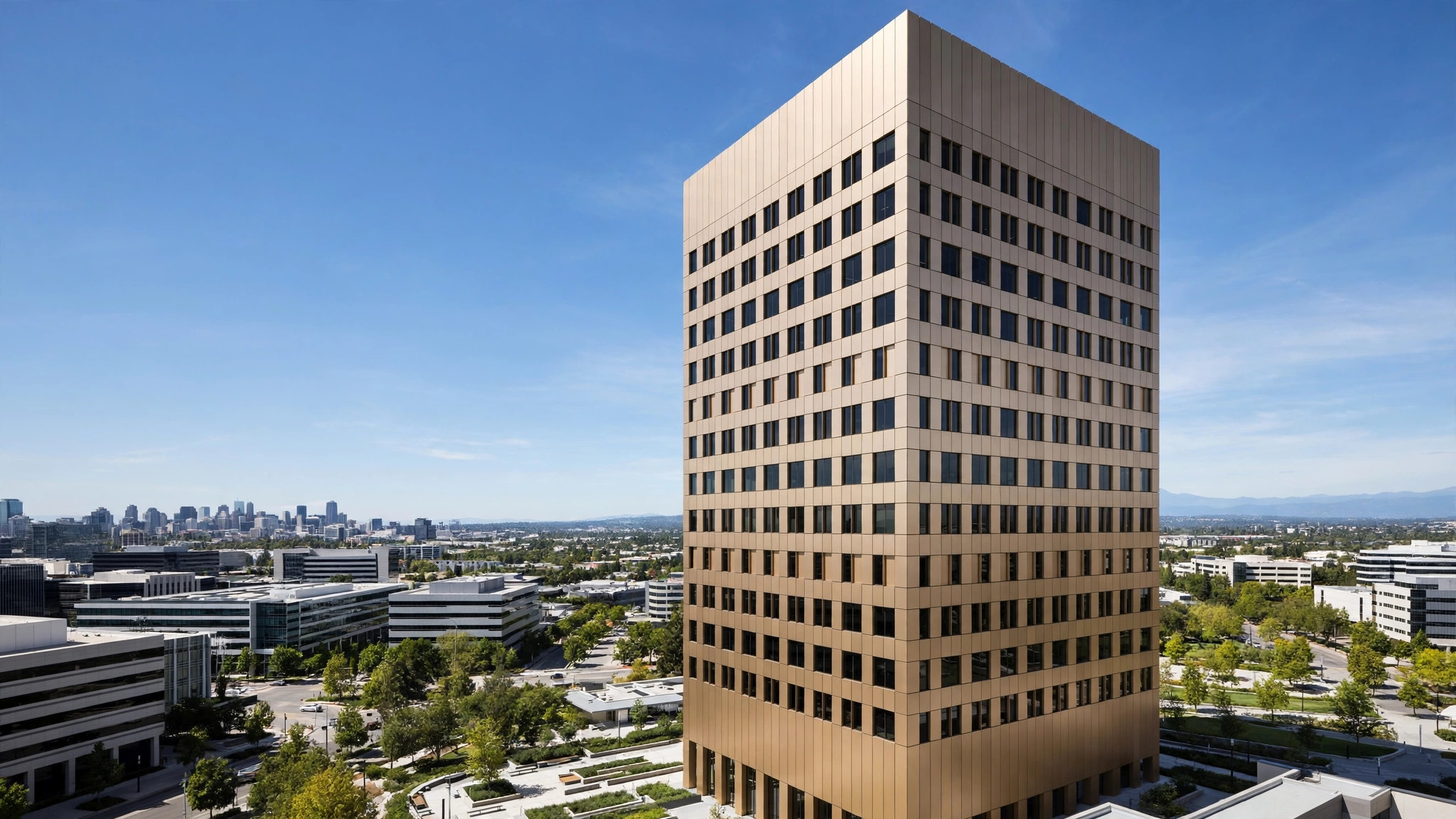
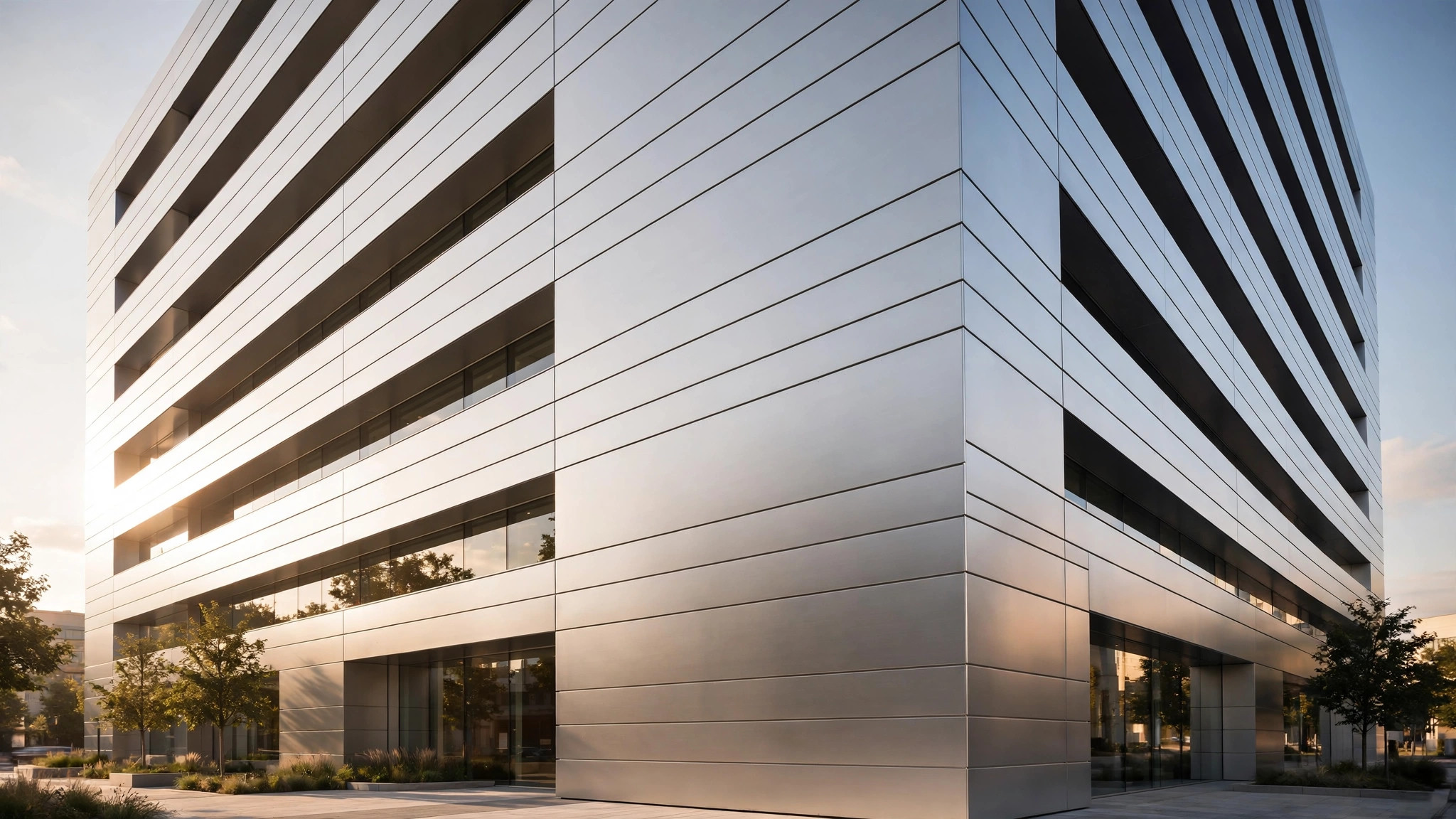
    Close-up of anodized aluminum facade panels in metallic bronze and champagne tones on a building exterior
    Anodized aluminum facade panels in metallic bronze and champagne tones — the distinctive metal look only anodizing delivers.

    Cost and Lifespan Compared: A Decision Framework

    Putting the three side by side, the trade-off is straightforward:

    • Powder coating — lowest factory cost, widest standard color range, solid 10–20 year performance in moderate climates. The default for budget-conscious commercial work.
    • Anodizing — mid-range cost, unique metallic appearance, excellent abrasion resistance, but limited colors and demanding site protection. A design-driven choice, not a price-driven one.
    • PVDF — highest factory cost, unmatched UV and weathering resistance, the standard for 20+ year design lives and harsh environments. The total-cost winner on premium and coastal projects.

    Two cautions that experienced buyers apply. First, compare equivalent specifications: ask which AAMA standard each quote is rated against (2603, 2604, or 2605 for coatings), because a “PVDF” label on a thin single coat is not the same product as a 2605-rated multi-coat system. Second, think in lifecycle cost, not unit price: on a facade expected to stand for 25 years, the premium for PVDF is typically a fraction of what even one recoating cycle would cost.

    How to Specify the Finish in Your RFQ

    To get comparable quotes, spell out the finish as precisely as the dimensions. A complete RFQ line includes: finish type (PVDF / powder / anodized), the performance specification it must meet (e.g., AAMA 2605 for PVDF), color code or RAL number, gloss level, and whether a single sample panel for approval is required before production. For anodized work, add batch-consistency requirements and site-protection notes; for PVDF, confirm the number of coats.

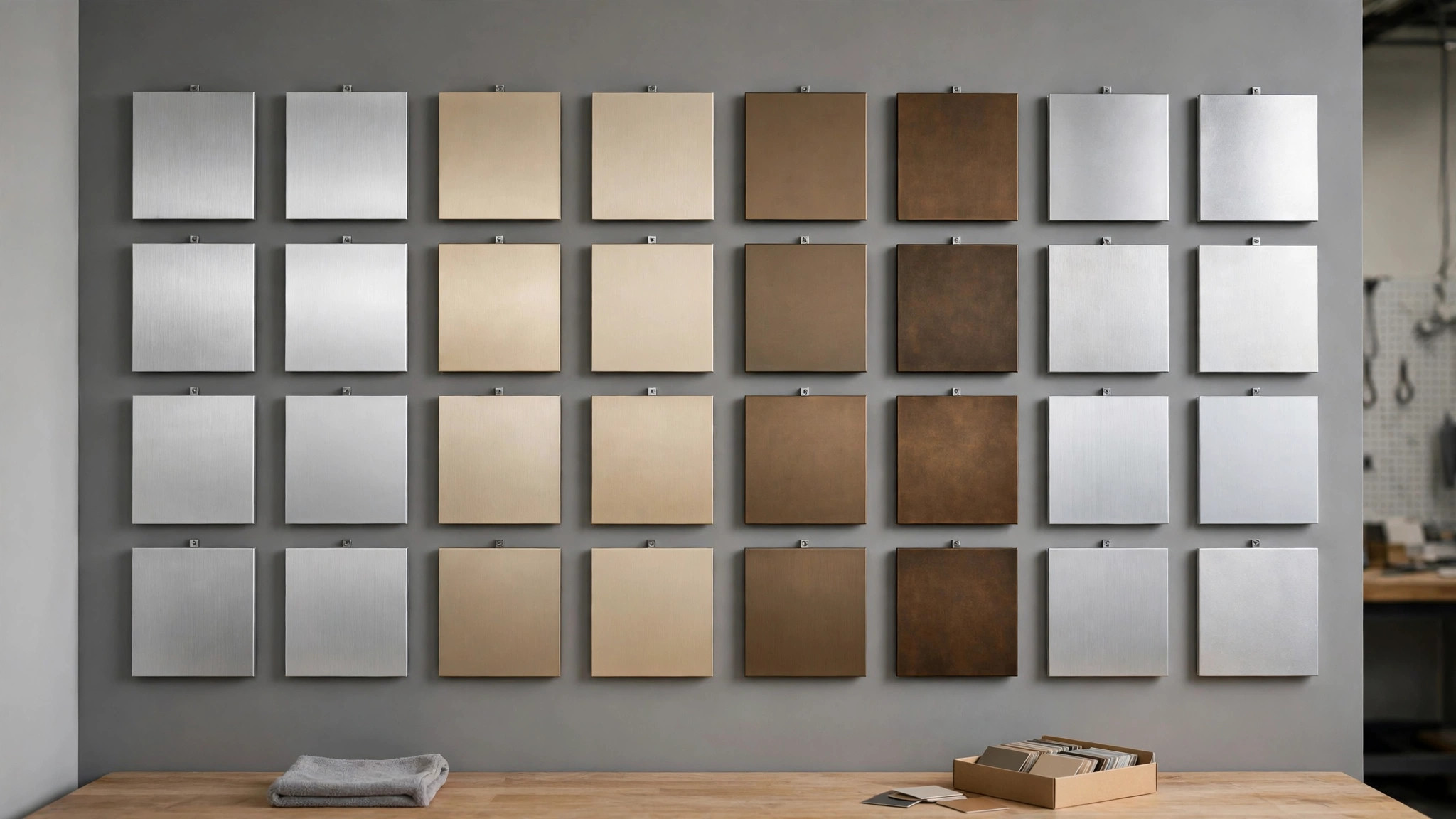
    Samples are cheap insurance: one approved finish sample, kept on file and referenced against deliveries, prevents most of the disputes buyers encounter with color and texture. Reputable factories produce approval samples from the same coating line as production panels, so what you sign off on is what ships.

    Choosing the right finish is the single highest-leverage decision in a facade panel purchase. Get it right and the panels look as specified for decades; get it wrong and every other detail — thickness, alloy, installation quality — is overshadowed by a failing surface. If your project is still at the specification stage, send your drawings and site conditions to the factory team at juchangalu.com for a finish recommendation matched to your climate, design life, and budget.
  • Aluminum Ingot Daily — October 22, 2026: A00 Rose

    Aluminum Ingot Daily — October 22, 2026: A00 Rose

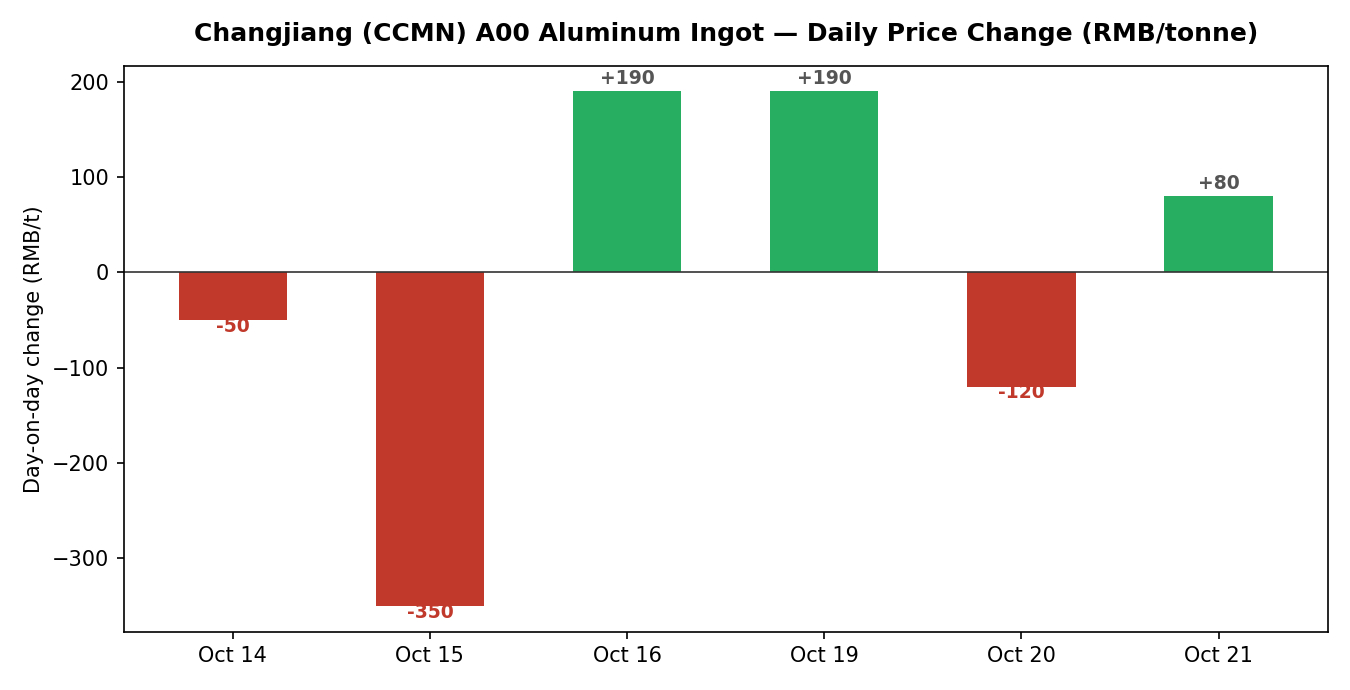
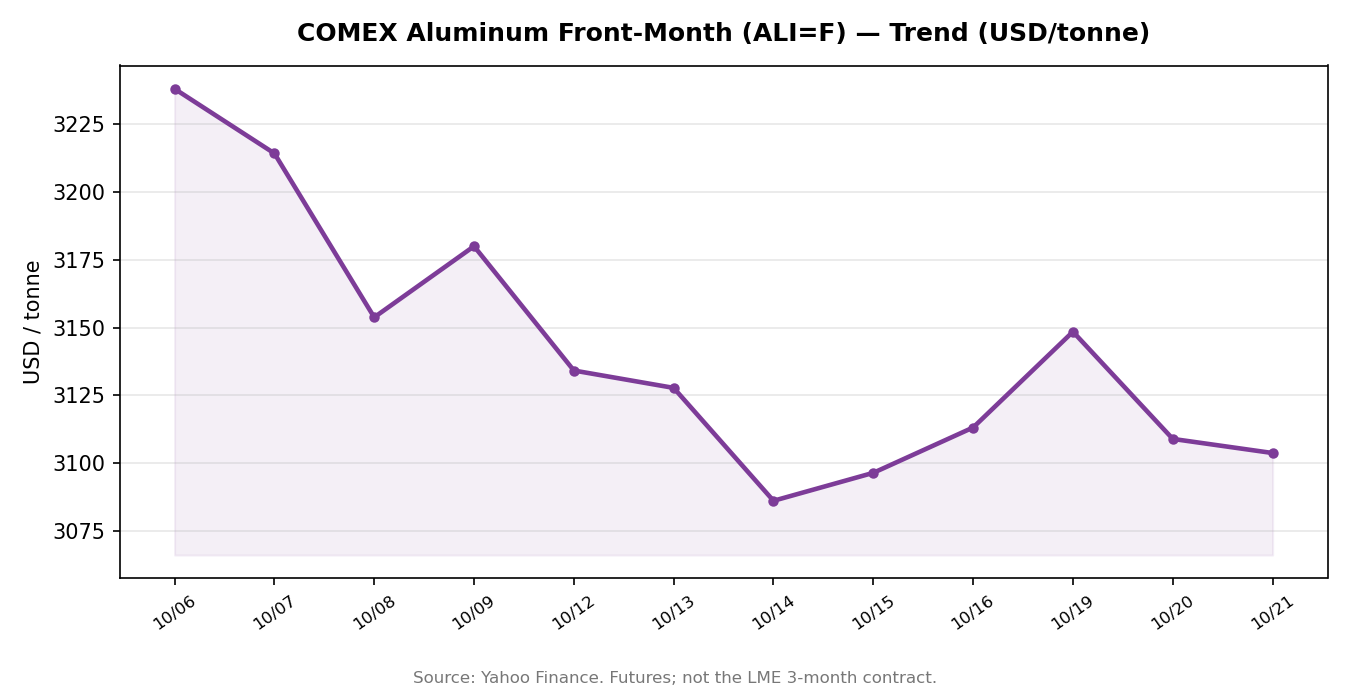
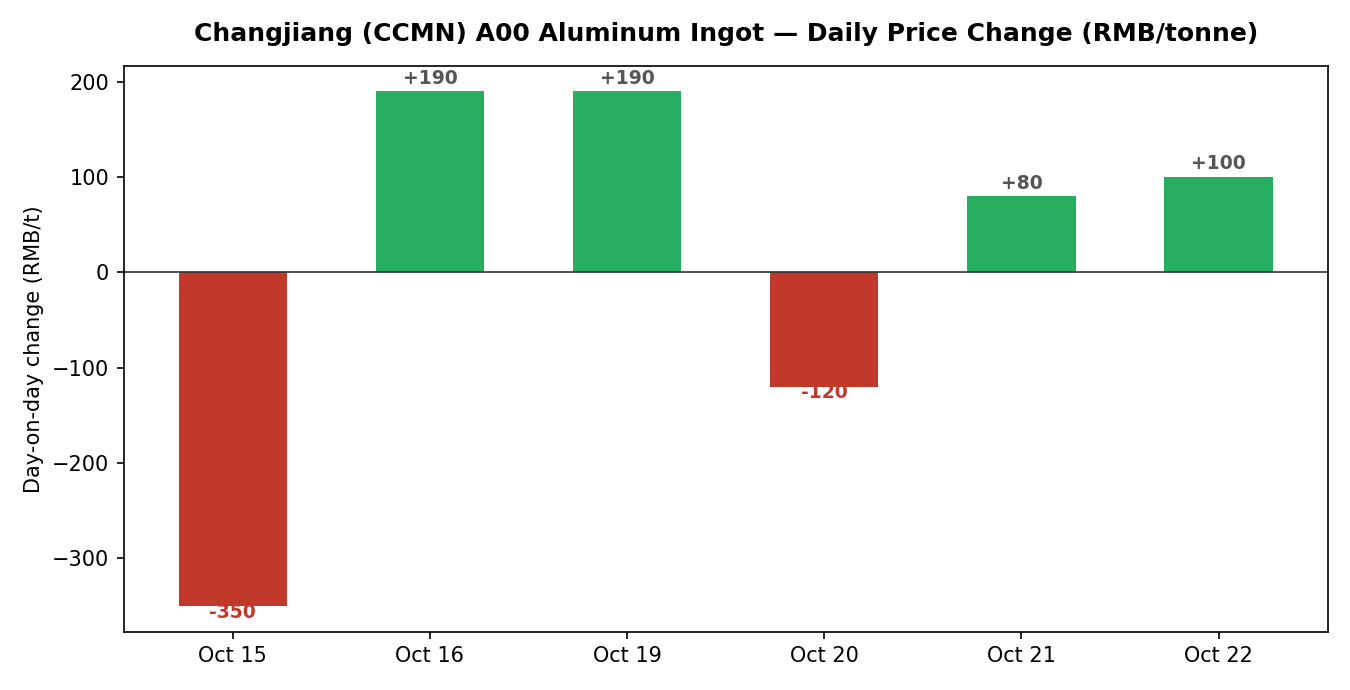
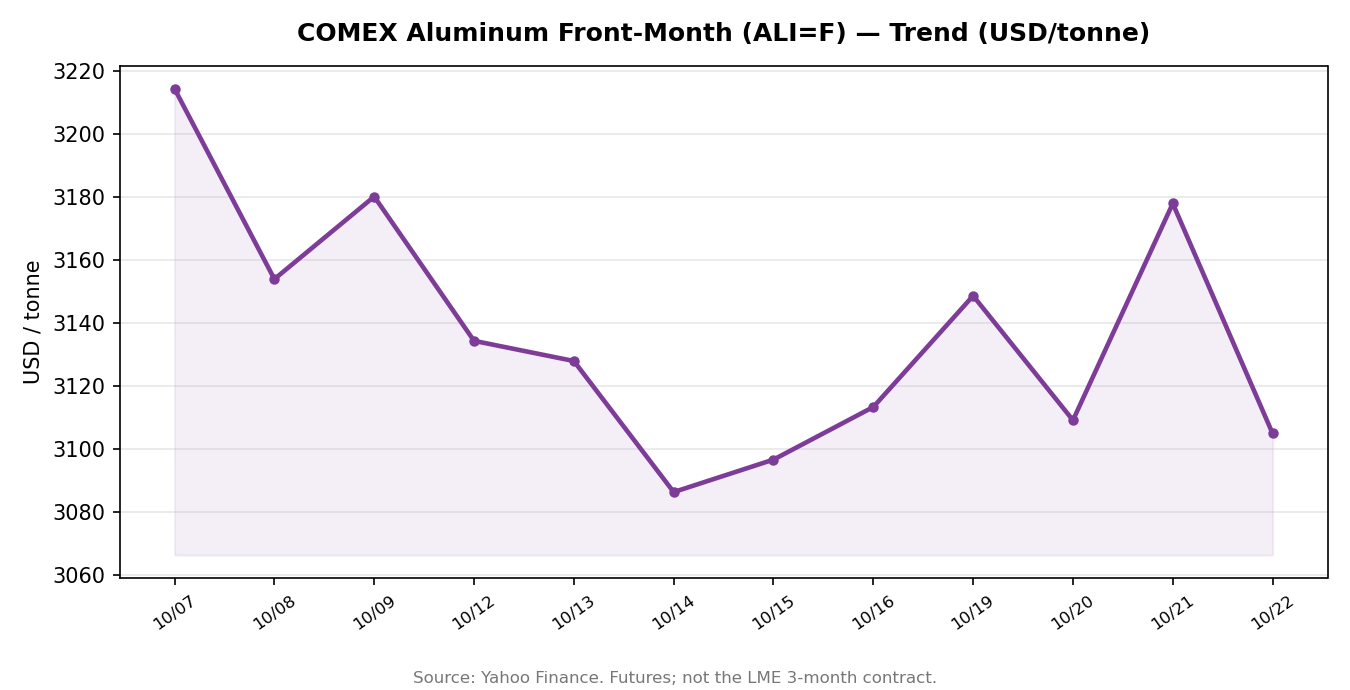
    October 22, 2026 — China’s domestic aluminum ingot market rose on the latest session. The Changjiang Nonferrous Metals Network (CCMN) A00 aluminum ingot benchmark moved +100 RMB/tonne day-on-day. Offshore, COMEX aluminum front-month futures closed at USD 3,104.8/t (-73.0, -2.30%).

    Cross-Platform Price Snapshot

    Benchmark Latest quote Day-on-day Source
    CCMN A00 aluminum ingot, spot (tax incl.) day change +100 RMB/t* +100 RMB/t Changjiang Nonferrous Metals Network
    COMEX aluminum, front month USD 3,104.8/t -73.0 USD/t (-2.30%) Yahoo Finance

    *CCMN’s absolute spot levels are member-only; day-on-day changes are public.

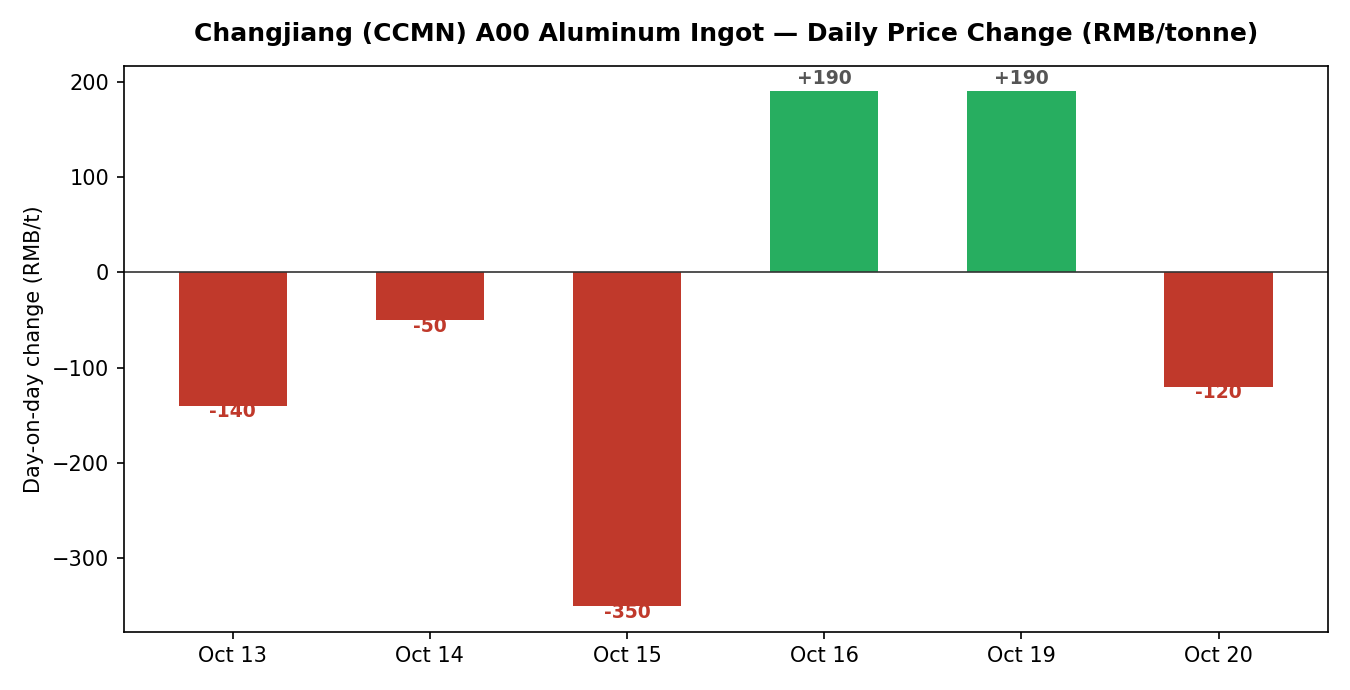
    CCMN A00: Recent Daily Changes

    Changjiang A00 aluminum ingot daily price changes

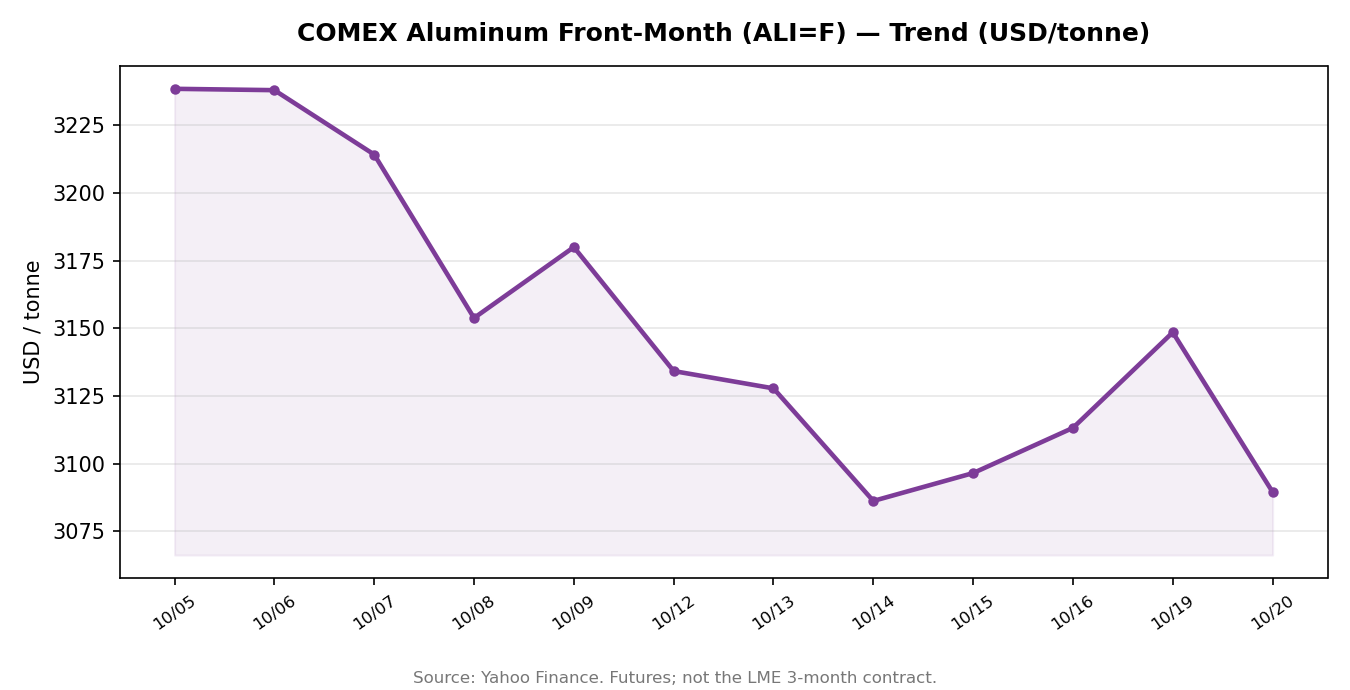
    Offshore: COMEX Trend

    COMEX aluminum front-month trend

    What It Means for Panel Buyers

    For buyers of aluminum façade panels and sheet, ingot is the single largest cost input. Sustained moves in the ingot benchmark typically feed through to mill and fabricator pricing within one to two quotation cycles. Buyers with Q4 project pipelines may want to request fresh quotes when the trend favors them — while remembering that surface treatment (PVDF, powder coating) and fabrication complexity still dominate the final panel price.

    Get this briefing every morning

    We publish a short aluminum ingot market update like this one every trading day — CCMN spot moves, offshore futures, and the charts that matter.

    Subscribe free by email →

    Data Notes

    • CCMN day-on-day changes are taken directly from CCMN’s daily A00 aluminum ingot reports (alu.ccmn.cn).
    • COMEX front-month prices via Yahoo Finance (futures contract, not LME 3-month).

    This briefing is for information only and does not constitute investment advice.

  • 2.0mm vs 2.5mm vs 3.0mm Aluminum Panels: How Thickness Affects Strength, Weight, and Budget

    2.0mm vs 2.5mm vs 3.0mm Aluminum Panels: How Thickness Affects Strength, Weight, and Budget

    When US buyers request a quote for solid aluminum facade panels, one of the first questions a factory asks sounds deceptively simple: 2.0, 2.5, or 3.0mm? The answer reaches far beyond a single line on the specification sheet. It changes how much aluminum you are buying per square foot, how flat the facade stays on a large-format panel, how many fixing points the substructure needs, and — ultimately — what the project costs to build.

    Why Thickness Is a Budget Decision, Not Just a Specification

    Most facade specifications treat panel thickness as a technical detail buried in the spec book. In reality, it behaves like a cost lever. Every tenth of a millimeter adds aluminum, and aluminum is priced by weight. A 3.0mm panel carries 50% more metal than a 2.0mm panel of the same size. That extra metal shows up not only in the factory’s material cost, but also in freight charges, structural support, and labor on site.

    What Thickness Actually Changes: Weight, Strength, and Flatness

    Aluminum has a density of about 2.70 g/cm³, so the math is refreshingly simple: a 2.0mm solid aluminum panel weighs roughly 5.4 kg/m², a 2.5mm panel about 6.75 kg/m², and a 3.0mm panel about 8.1 kg/m² — before coatings and stiffeners. Those numbers matter in three concrete ways:

    • Weight and freight. Ocean freight from China is charged by weight or volume, and aluminum panels usually hit the weight limit first. Choosing 3.0mm over 2.0mm can add roughly 50% to the metal weight of the shipment, which flows directly into your landed cost per square foot.
    • Stiffness and span. Bending stiffness grows with the cube of thickness, so a 3.0mm panel is substantially more rigid than a 2.0mm one. Thicker panels can span larger modules with fewer support points, which means fewer panels, fewer fixings, and less substructure steel.
    • Surface flatness. Thin panels on large formats are prone to “oil canning” — visible waviness under changing light and temperature. A thicker panel, or the same panel with factory-installed stiffeners, keeps the facade crisp. Reworking oil-canned panels on site is one of the most expensive fixes in facade work.
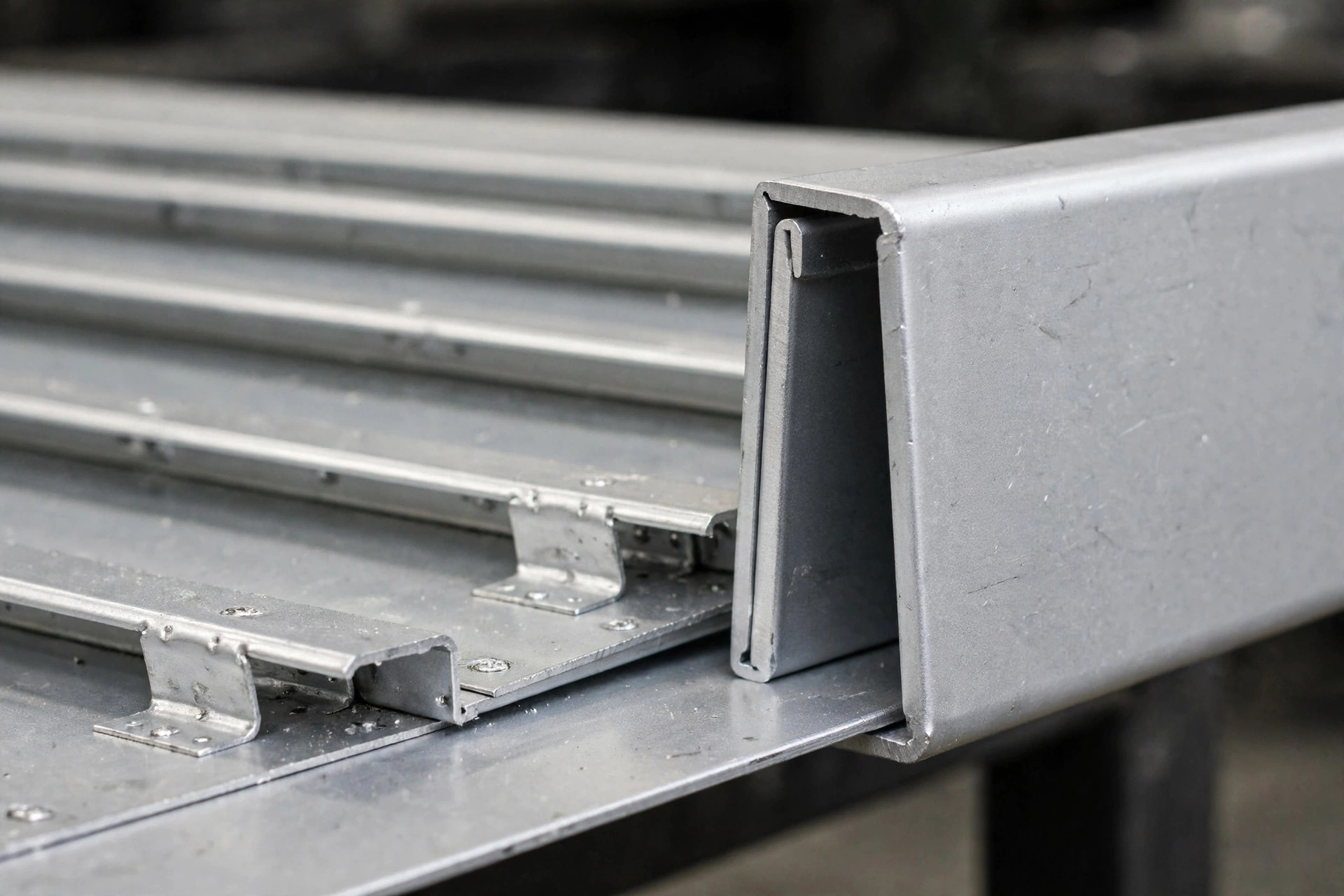
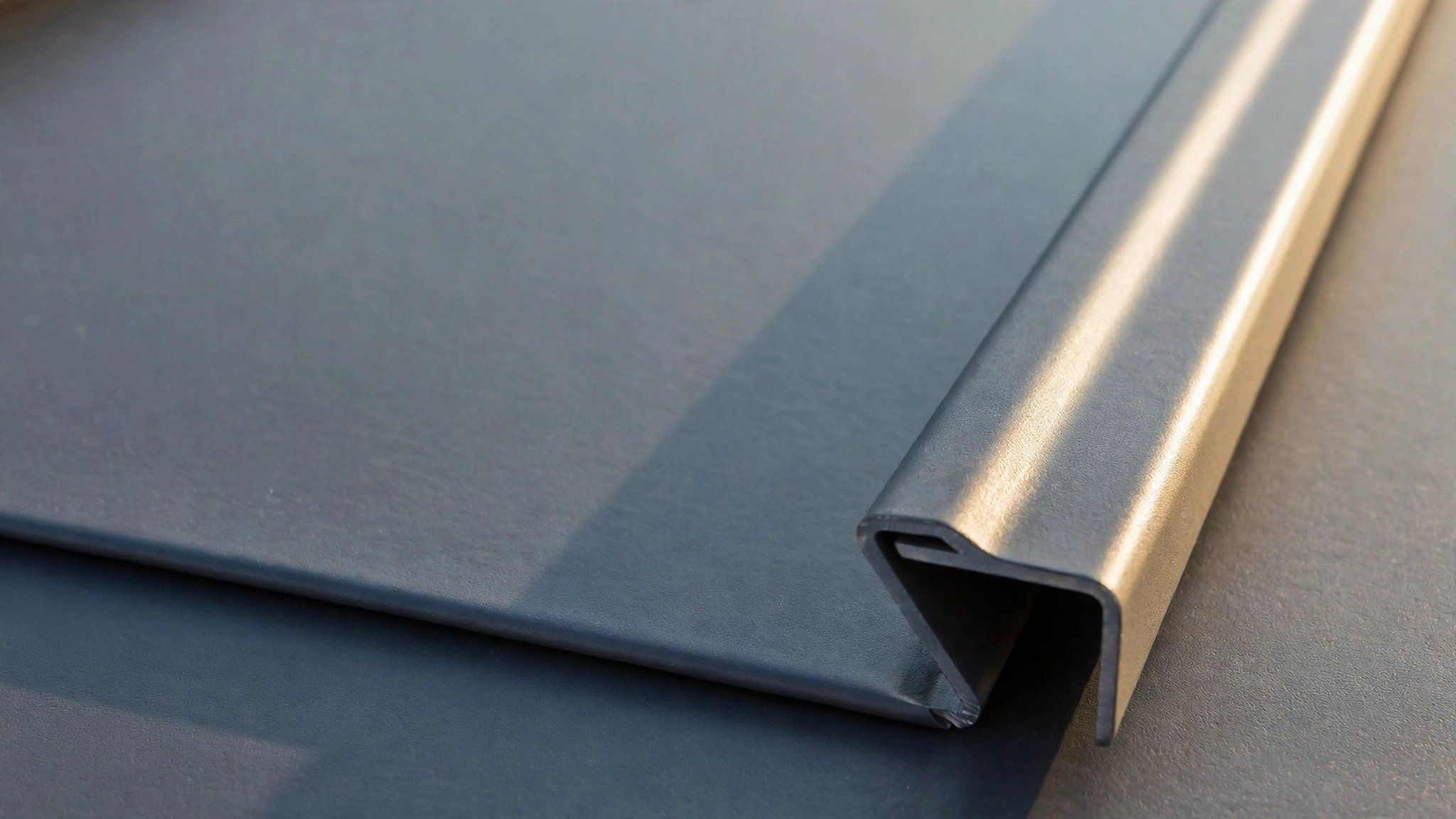
    Close-up of a solid aluminum facade cassette panel edge showing folded edges and stiffener ribs
    Edge detail of a solid aluminum cassette panel: folded edges and factory stiffener ribs keep large-format panels flat.

    2.0mm vs 2.5mm vs 3.0mm: A Head-to-Head Comparison

    Here is how the three standard thicknesses compare on the dimensions that matter to a buyer’s budget and schedule:

    • 2.0mm — the economical choice for controlled conditions. Lightest and lowest in material cost. Best suited to smaller panel modules (typically under 1.2m wide), interior walls, soffits, and column covers in sheltered locations. On large exterior formats, 2.0mm needs closer stiffener spacing or narrower modules to avoid deflection — which can quietly add fabrication cost back in.
    • 2.5mm — the commercial sweet spot. The most commonly specified thickness for ventilated rainscreen facades in the US market. It balances weight, rigidity, and cost, handles standard module sizes (up to about 1300×4000mm, a typical factory maximum) with normal stiffener layouts, and keeps freight weight moderate. For most office, retail, and institutional facades, this is where experienced specifiers land.
    • 3.0mm — the heavy-duty option. Maximum stiffness for large-format panels, high-wind zones, and prominent feature areas where flatness under raking light is critical. The trade-off is the highest material and freight cost per square foot. It also allows wider module layouts, which can reduce the total panel count and substructure work — sometimes offsetting the higher per-panel cost at the system level.

    A note on alloy: thickness and alloy work together. Panels in 3003-H24 temper offer better formability and stiffness than softer tempers at the same thickness, which is why experienced factories quote both together. Ask your supplier which alloy and temper the quoted thickness assumes.

    How Thickness Flows Through Your Project Budget

    Rather than thinking in terms of a single “price per panel,” trace how thickness ripples through the whole project cost:

    • Material cost scales with weight. As a first approximation, the metal content — and therefore the factory’s material cost — rises roughly in proportion to thickness. Everything else being equal, a 3.0mm panel costs the factory about 50% more in aluminum than a 2.0mm panel.
    • Fabrication cost barely moves. Cutting, folding, and punching a 2.5mm sheet takes nearly the same machine time as a 2.0mm one. This means fabrication is a smaller share of total cost on thicker panels — good news if your design needs rigidity.
    • Freight follows weight. For US importers, sea freight is a visible line item. The 50% weight premium of 3.0mm over 2.0mm translates into measurably higher container utilization cost, especially on full-container shipments of solid panels.
    • Substructure and labor can offset the premium. Thicker panels spanning wider modules reduce the number of panels, brackets, and fixing points. On large facades, the savings in substructure steel and installation labor can meaningfully narrow — or even erase — the cost gap between thicknesses at the installed-cost level.
    • Rework risk is the hidden line item. A too-thin panel that oil-cans after installation may require replacement panels, remobilization, and schedule delays. Specifying adequate thickness up front is the cheapest insurance against this scenario.

    Public B2B listings (for example on Alibaba and Accio) show panel prices tracking thickness, finish, and pattern complexity in broad bands — useful for market sensing, not a substitute for a project-specific quote. For an accurate number, a factory needs your drawings: panel sizes, layout quantities, color and finish, and delivery terms.

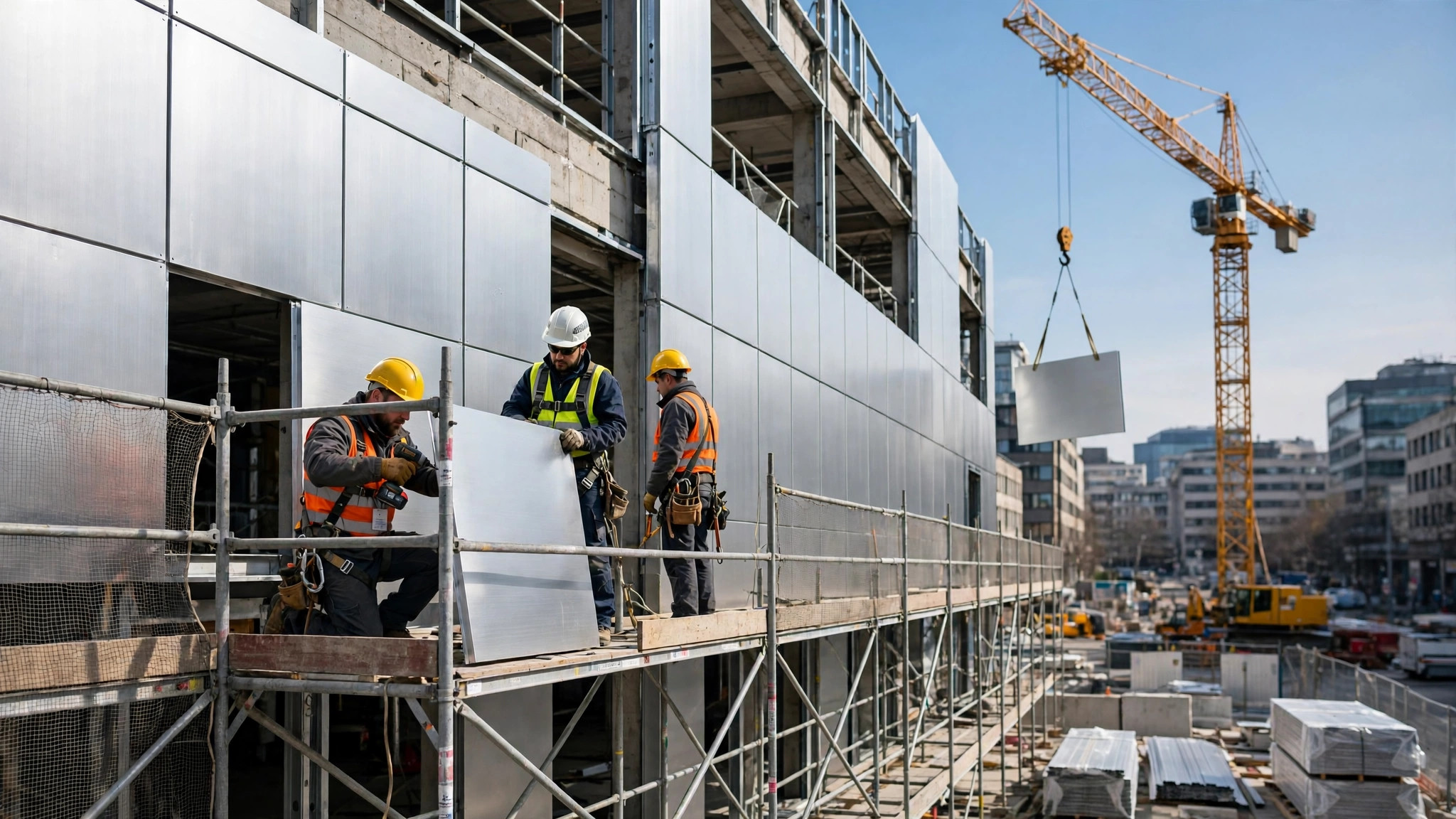
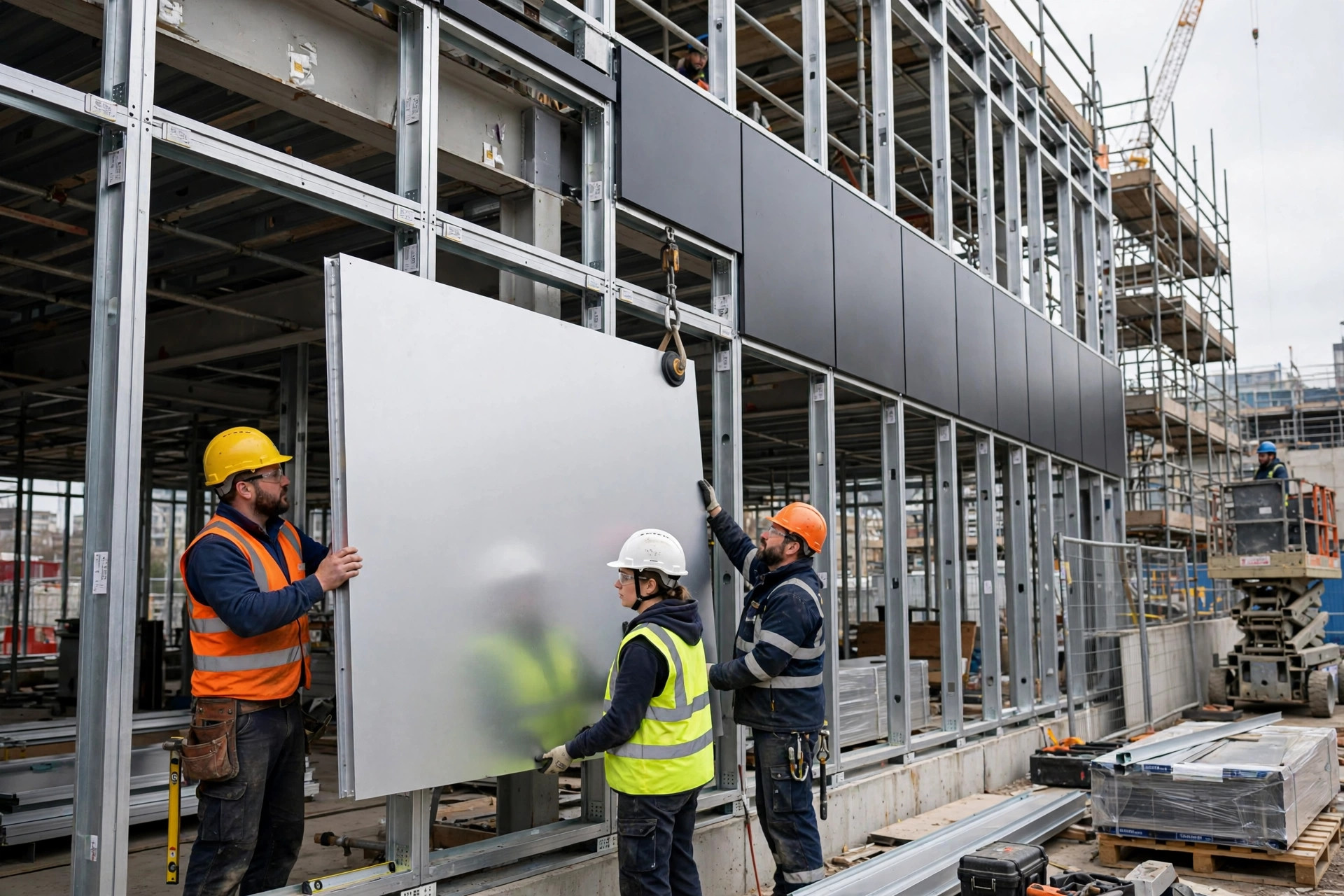
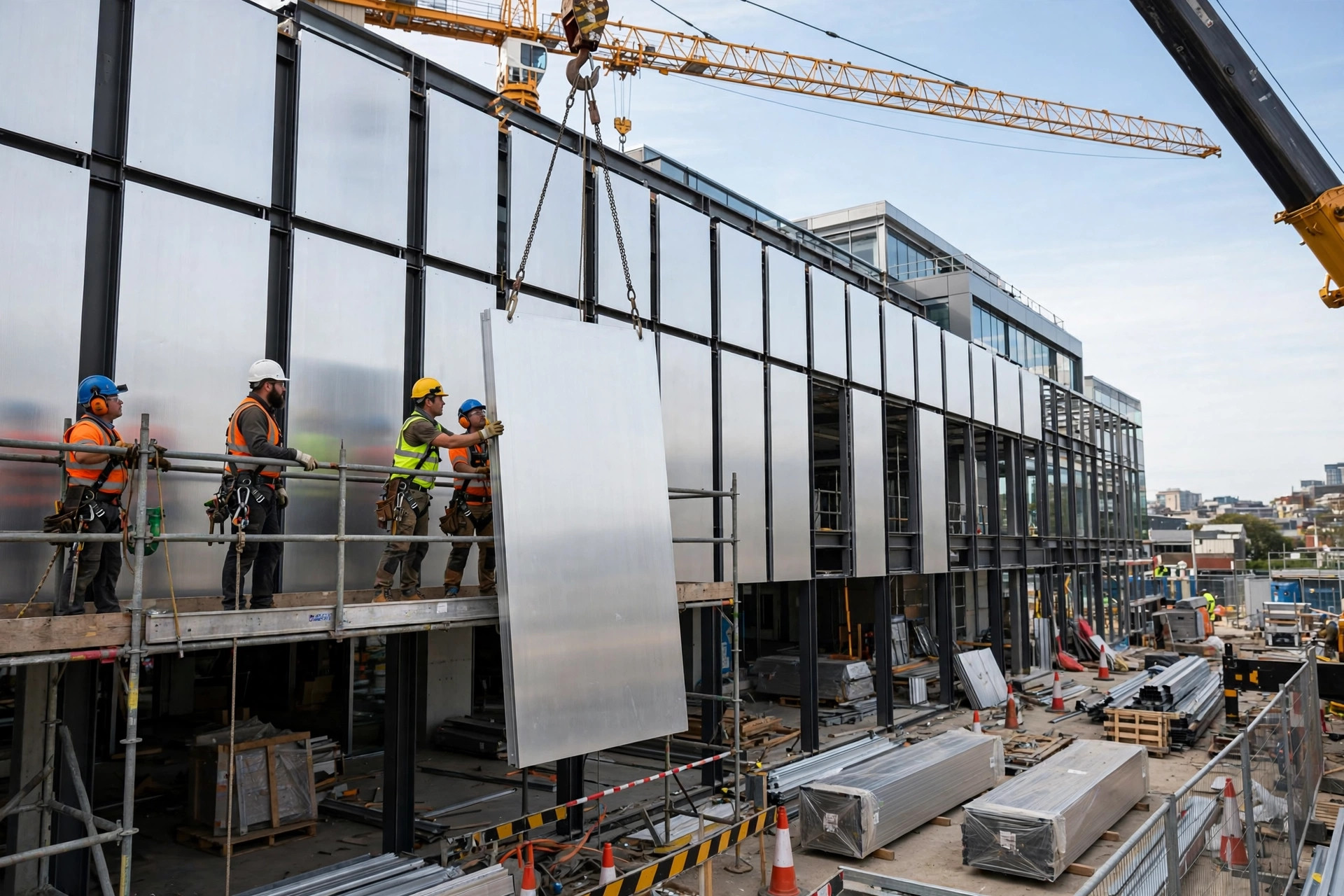
    Construction crew installing large aluminum facade panels on a commercial building
    Installing large-format aluminum facade panels: wider modules mean fewer panels, fixings, and labor hours on site.

    A Practical Decision Framework for Choosing Thickness

    Use these five questions to converge on the right thickness before you request quotes — answering them up front also gets you faster, more comparable quotations from suppliers:

    • What is the largest panel module? Modules wider than about 1.2m on exterior facades generally call for 2.5mm or 3.0mm; smaller modules and interior applications are often fine at 2.0mm.
    • What is the wind exposure? High-rise and coastal projects with elevated design wind pressures favor 3.0mm or engineered 2.5mm layouts with verified stiffener spacing.
    • How critical is visual flatness? Feature walls, entrances, and facades seen under raking sunlight justify thicker panels; service areas and soffits usually do not.
    • What does the finish require? PVDF, powder coating, and roll coating all add a thin film, but they do not change structural behavior — do not count on a premium finish to compensate for an under-specified substrate.
    • What is the total installed cost, not just the panel price? Model material, freight, substructure, and labor together. The “expensive” 3.0mm option sometimes wins once fewer panels and fixings are counted.

    When in doubt, 2.5mm in 3003-H24 temper is the specification most US commercial projects converge on — proven, economical, and readily available from experienced facade panel factories.

    Choosing the right aluminum panel thickness is one of the highest-leverage decisions in a facade budget. If you are weighing 2.0mm against 2.5mm or 3.0mm for an upcoming project, send your elevation drawings to the Juchang team for a detailed quotation — or browse the product range at juchangalu.com to see standard sizes, finishes, and fabrication options.

  • How Much Do Solid Aluminum Facade Panels Cost? A Breakdown of What Drives the Price

    How Much Do Solid Aluminum Facade Panels Cost? A Breakdown of What Drives the Price

    When a US architect, contractor, or distributor asks “how much do solid aluminum facade panels cost,” the honest answer is: it depends — and the range can be wide. Unlike commodity building products, solid aluminum facade panels are engineered-to-order: thickness, finish, pattern, panel size, and quantity each push the final number in a different direction. This guide breaks down the six factors that drive the price, shows public market reference ranges (with sources), and tells you exactly what to send a factory so your quotation comes back accurate on the first round.

    1. Thickness: The Biggest Material Driver

    Panel thickness is the single largest driver of raw material cost, because it determines how much aluminum goes into every square meter. In the US curtain wall market, solid aluminum panels are commonly specified at 2.0mm, 2.5mm, or 3.0mm. Moving from 2.0mm to 3.0mm can raise material weight by roughly 50%, which flows directly into sheet cost, freight weight, and structural support requirements.

    Thicker is not automatically better. A 2.0mm panel suits interior wall cladding and low-wind soffits; 2.5mm is the workhorse for most commercial facades; 3.0mm is reserved for large-format panels, high wind-load zones, and spans between supports. Specifying 3.0mm “just to be safe” on a low-rise project can inflate the material budget without any performance benefit. The right thickness is a structural decision first and a cost decision second — ask the factory for the maximum recommended span for each gauge before you finalize the specification.

    2. Surface Finish: PVDF, Powder Coating, or Roll Coating

    Finish is the second major cost lever and the one that determines long-term appearance. PVDF (fluorocarbon) coating — typically applied at 70% Kynar 500 / Hylar 5000 resin content — is the premium choice for exterior facades, with color and gloss warranties that far outlast alternatives. Powder coating costs less and performs well for interiors, soffits, and moderate climates. Roll coating (coil coating) is the most economical for flat panels at volume, since the coating is applied to the coil before fabrication.

    Custom colors also move the needle. Standard RAL colors run on a routine production schedule; a custom metallic, mica, or color-matched finish requires a separate coating batch, which adds setup cost that is most economical when spread across a large quantity. If budget is tight, ask whether your project color can be matched from the factory’s existing color library before requesting a custom run.

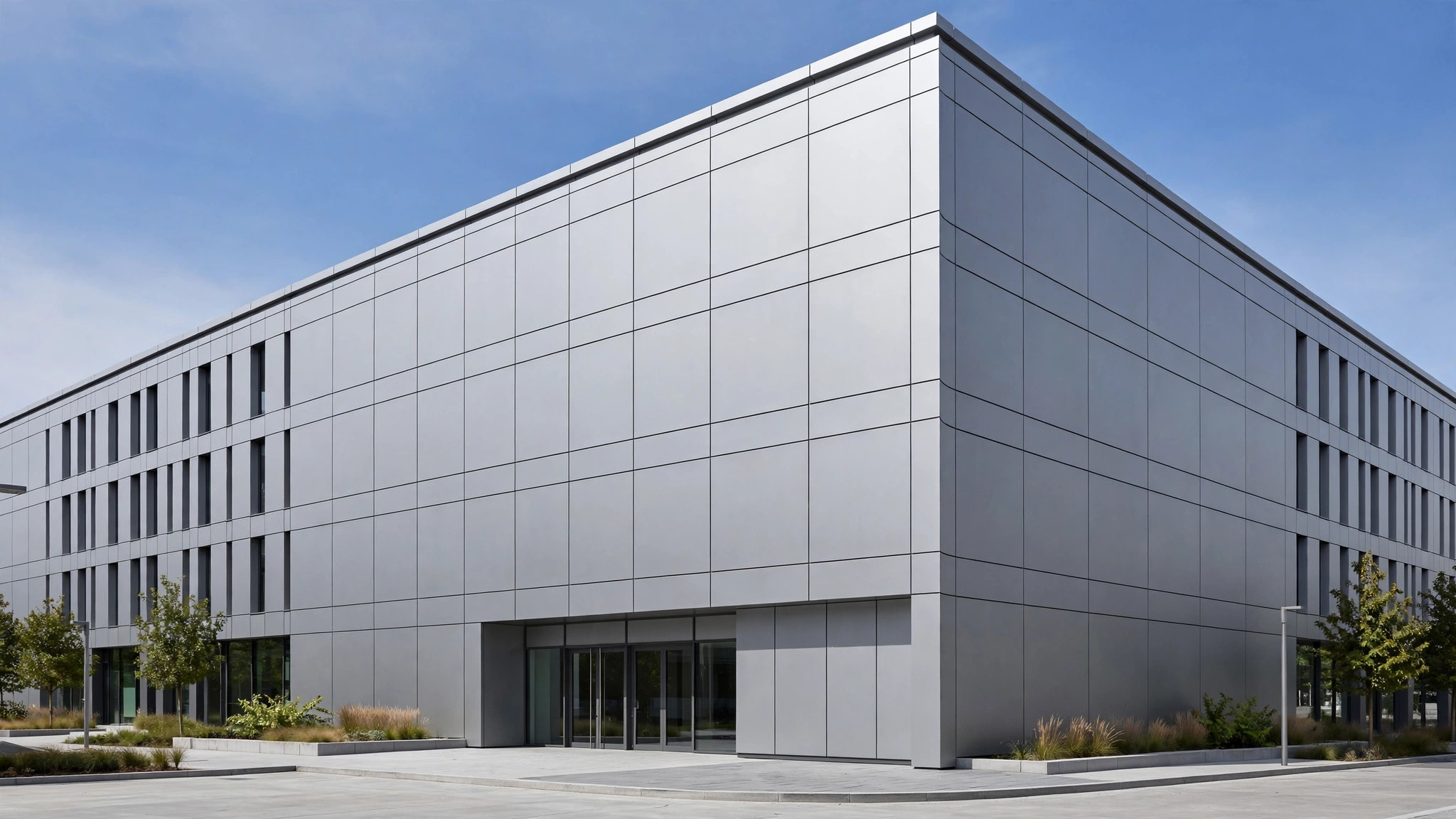
    Close-up of solid aluminum facade panels with PVDF coating on a building exterior
    Solid aluminum panels with a PVDF fluorocarbon finish — the premium coating choice for long-life commercial facades.

    3. Perforation and Pattern Complexity

    Perforated, carved, and shaped panels add machining time, tooling, and scrap. Cost scales with open-area percentage and pattern complexity: a simple round-hole perforation pattern with low open area adds modest cost, while high-density perforations, custom carved patterns, or intricate laser-cut designs can double fabrication time per panel. Each hole also means more edge finishing and stricter flatness control to prevent distortion during processing.

    The practical takeaway: finalize the perforation pattern before requesting pricing, and provide the pattern as a CAD file. Pricing a “perforated panel, pattern TBD” forces the factory to assume worst-case complexity — which guarantees an inflated quote. If the pattern is still in design development, ask for pricing at two or three open-area levels so the design team can weigh aesthetics against budget.

    4. Panel Size and Fabrication Complexity

    Larger panels reduce the number of joints and installation labor, but they cost more per square meter to make. A 1300 × 4000mm panel — a common maximum sheet size — requires heavier-gauge material to resist oil canning, more precise brake-press work, and stiffer reinforcement ribs. Non-rectangular shapes, folded returns, curved panels, and integrated reveals each add fabrication steps.

    Modularize where you can. A facade designed around a repeating module with a few accent shapes fabricates far more efficiently than one where every panel is a unique size. When requesting quotes, note the quantity breakdown by panel type: 200 identical flat cassettes plus 20 feature panels price very differently from 220 unique panels, even at the same total area.

    5. Quantity and Order Structure

    Volume economics are straightforward but often underestimated. Setup costs — coil slitting, coating batch, brake-press tooling, color matching — are largely fixed per order. On a 500㎡ order they weigh heavily per square meter; on a 5,000㎡ order they nearly disappear. This is why unit pricing drops sharply as quantity rises, and why splitting one building into multiple small orders (different phases, different POs) can quietly raise the total.

    Consolidate intelligently: combine phases into a single production run where the schedule allows, or at minimum negotiate the full project quantity as one price basis with staged deliveries. Distributors stocking standard sizes can often access better pricing by committing to a single color and gauge across multiple projects.

    6. Sea Freight, Packaging, and Delivery Terms

    For US buyers importing from China, freight is a real line item — not an afterthought. Solid aluminum panels ship flat in export crates or on pallets; a 40-foot container typically holds roughly 1,500–2,500㎡ depending on panel thickness, packaging density, and crate design. Because panels are relatively light for their volume, shipments often cube out before they weigh out, so volumetric (dimensional) weight — not just actual weight — shapes the ocean freight calculation.

    Packaging quality also carries cost: interleaf film between panels, edge protection, moisture-proof wrapping, and fumigated wooden crates all add line items, but they prevent the far more expensive problem of transit damage. Clarify the Incoterms in your RFQ — FOB, CIF, and DDP quotes are not comparable numbers. A DDP price that includes US customs clearance and last-mile trucking will look higher than FOB Shanghai, but it may be the lower total landed cost once you add your own forwarder’s fees.

    Installation of solid aluminum facade panels on a commercial building curtain wall
    Panelized solid aluminum installation on a commercial facade — modular sizing keeps fabrication and installation costs predictable.

    Public Market Reference Ranges (With Sources)

    So what do buyers actually see in the market? Two public data points, both with important caveats:

    • US installed metal siding, $9–17 per square foot (Fixr and Angi 2026 cost guides). This covers residential metal wall siding installed — labor included — and is not a commercial curtain wall number. It is useful only as a rough sense of the installed-cost band for metal cladding in the US market.
    • B2B marketplace listings for perforated/carved aluminum panels, roughly $15–65 per square meter (Alibaba and Accio supplier listings, 2026). This is the material-only price band, and it swings with thickness and pattern complexity. It is a price band observed on public listings — not any single factory’s quotation.

    Neither figure is your project’s price. Treat them as sanity checks: if a quote lands far outside these bands in either direction, ask why before proceeding. The real number for your project comes from a detailed RFQ — which is exactly what the next section covers.

    What to Send for an Accurate Quote: The RFQ Essentials

    Factories price what you give them. To get a quote you can actually compare, include these items in your first request:

    • Drawings or panel schedule: elevations, panel layout, and a schedule listing each panel type with dimensions and quantities.
    • Thickness and alloy: e.g., 2.5mm, 3003-H24 — or ask the factory to recommend based on span and wind load.
    • Finish specification: PVDF or powder coating, color code (RAL or custom), gloss level.
    • Pattern files: CAD/DXF for perforations or carved patterns, with open-area percentage.
    • Quantities by type: separate counts for standard cassettes, feature panels, soffits, and column covers.
    • Delivery terms and destination: FOB, CIF to a named US port, or DDP to the job site — plus the target delivery window.

    A complete RFQ typically gets a detailed, itemized quotation in days rather than weeks — and it is the only way to compare two factories on equal footing. Send your drawings for a detailed quotation, and make sure every bidder prices the same scope.

    Browse the full product range at juchangalu.com, or send your drawings for a detailed quotation tailored to your project’s specification.

  • Aluminum Facade Panels for Schools and University Campuses: A Practical Guide for US Specifiers

    Aluminum Facade Panels for Schools and University Campuses: A Practical Guide for US Specifiers

    From K-12 schools to university campuses, educational buildings have to work hard: they welcome thousands of students every day, stand up to weather and wear, and represent the institution’s identity for decades. The facade is where all of these demands meet. Solid aluminum facade panels have become a practical choice for school construction and renovation across the US, combining durability, design flexibility, and low maintenance in a way that fits tight public budgets and long building lifecycles.

    Why Solid Aluminum Panels Fit Educational Buildings

    School facades face a unique combination of challenges. They must resist impact and accidental damage, stay attractive between infrequent renovation cycles, and meet strict safety expectations from parents and school boards. Solid aluminum panels answer these demands well: they are rigid, lightweight, and corrosion-resistant, so they do not crack, spall, or absorb moisture the way masonry or fiber-cement can. A ventilated rain-screen assembly with aluminum panels also allows air circulation behind the cladding, helping manage moisture in the wall—an advantage in schools built in hot-humid or freeze-thaw climates.

    Maintenance is another reason facility managers favor aluminum. A smooth, coated surface sheds dirt and can be washed with water and mild detergent, keeping the building looking fresh without repainting cycles. Individual panels are removable, so a panel damaged by a stray ball or an accidental impact can be swapped out without disturbing the rest of the facade.

    Choosing Panel Thickness and Alloy for School Facades

    Panel thickness and alloy directly affect rigidity, dent resistance, and fabrication cost. For educational projects, 3.0mm panels are the standard choice for exterior walls, especially at ground level and in high-traffic zones where impact resistance matters most. 2.5mm panels work well for upper-story cladding and soffits, while 2.0mm panels are typically reserved for interior applications such as corridor walls and auditorium linings, where they do not face wind loads.

    Alloys 3003 and 1100 in the H24 temper are the industry workhorses for solid aluminum facade panels. 3003 offers slightly higher strength and is widely specified for exterior curtain-wall panels; 1100 is softer and easier to form, which suits decorative bends and curved feature elements at school entrances and atriums. For typical school facades, panels up to 1300 × 4000mm can be fabricated as single pieces, allowing generous module sizes that reduce the number of joints and keep elevations looking clean.

    Close-up of solid aluminum facade panel cassette system showing panel joints and mounting brackets
    A close-up of a solid aluminum facade panel cassette system, showing panel joints, folded edges, and mounting hardware.

    Design Freedom: School Colors, Graphics, and Perforated Panels

    School identity matters, and aluminum panels offer one of the broadest color palettes in exterior cladding. PVDF coatings provide excellent color retention and come in solid colors, metallics, and custom-matched school colors, so the facade can carry the institution’s branding for decades without fading. Powder coating is a cost-effective alternative for less exposed areas, and roll-coated (pre-painted coil) panels deliver consistent finishes for large, repetitive elevations such as classroom wings.

    Beyond flat color, perforated and carved aluminum panels open up graphic possibilities: perforated sunshades that double as wayfinding art, cut-out school emblems on entrance canopies, or wood-look and stone-look finishes that bring warmth to libraries and student centers without the upkeep of real wood or stone. Because panels are fabricated to shop drawings, each elevation can carry its own pattern while sharing the same fixing system.

    Fire Safety and Code Considerations

    Fire safety is non-negotiable in educational occupancies, and solid aluminum panels are a non-combustible cladding material—an important distinction from composite panels with polymer cores. That said, the facade system as a whole—panels, sub-framing, insulation, and cavity barriers—must be detailed and specified to meet the applicable building code for the project. US specifiers should coordinate early with the architect of record and the authority having jurisdiction to confirm the required assembly performance, especially for high-rise dormitories and mixed-use campus buildings.

    Practical specification steps include defining the panel alloy and temper, coating type, and thickness in the spec section; requiring shop drawings that show every panel, joint, and fixing; and planning for full-size mock-ups on flagship projects so the design team can approve color, texture, and joint rhythm before production begins.

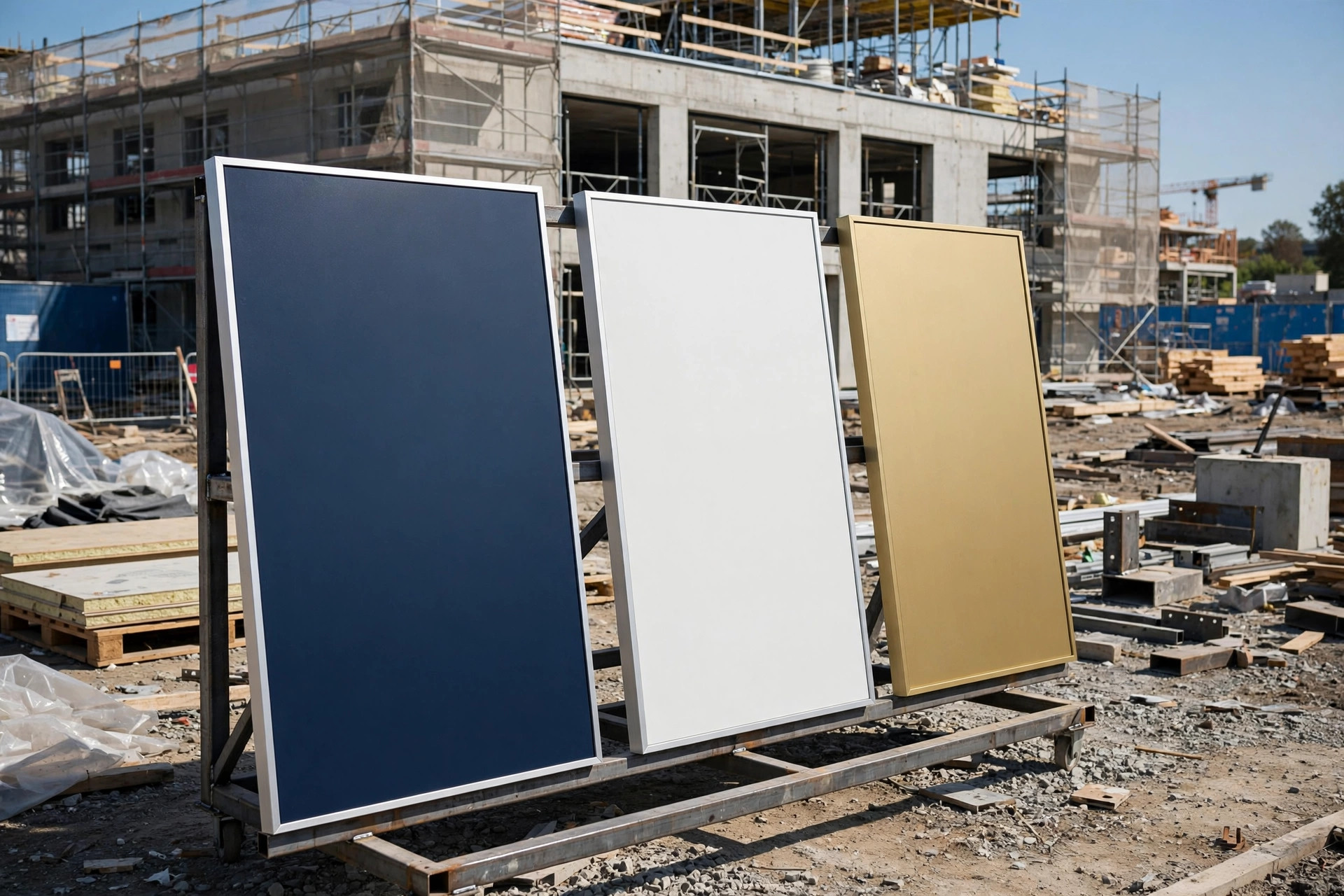
    Full-size solid aluminum facade panel mock-up samples in school colors on a display rack
    Full-size solid aluminum facade panel mock-ups in school colors, mounted on a display rack for design-team approval before production.

    Maintenance Planning for Busy Campuses

    Schools rarely have large maintenance crews, so the facade should be as self-sufficient as possible. Aluminum panels fit this reality: annual or semi-annual washing with clean water and a soft brush is usually enough, and PVDF finishes resist graffiti better than most alternatives—spray paint can typically be removed with approved cleaners without damaging the coating. Facility teams should also schedule a visual inspection of joints and sealants each year, since sealant is the component most likely to need attention over a facade’s life.

    It is worth keeping a small stock of spare panels in the school color, ordered with the original batch. Coatings can shift slightly between production batches, and having matching spares on hand means a damaged panel can be replaced invisibly years later.

    Budget and Procurement Tips for School Projects

    Public school projects live or die by the budget, and aluminum facades can be value-engineered without sacrificing performance. Keeping panel modules within the standard 1300 × 4000mm sheet size avoids oversize fabrication steps and extra material waste. Limiting the color palette to two or three finishes reduces setup costs, while using perforated or carved panels as accents—rather than across the whole facade—delivers visual impact where it counts, at entrances and feature walls.

    For phased campus work, where buildings are added over several years, record the exact alloy, thickness, coating system, and color formula in the project files. Sharing this documentation with the panel supplier on later phases helps new panels match the original buildings. Contractors should also coordinate panel delivery with the construction schedule so panels arrive just in time for installation, minimizing on-site storage and handling damage.

    Solid aluminum facade panels give schools a facade that is tough enough for daily student life, flexible enough to express school pride, and simple enough for a lean maintenance team to keep looking new. If you are planning a new school building or a campus renovation, browse the panel options at juchangalu.com or send your drawings for a detailed quotation tailored to your project.

  • Aluminum Ingot Daily — October 21, 2026: A00 Rose

    Aluminum Ingot Daily — October 21, 2026: A00 Rose

    October 21, 2026 — China’s domestic aluminum ingot market rose on the latest session. The Changjiang Nonferrous Metals Network (CCMN) A00 aluminum ingot benchmark moved +80 RMB/tonne day-on-day. Offshore, COMEX aluminum front-month futures closed at USD 3,103.8/t (-5.2, -0.17%).

    Cross-Platform Price Snapshot

    Benchmark Latest quote Day-on-day Source
    CCMN A00 aluminum ingot, spot (tax incl.) day change +80 RMB/t* +80 RMB/t Changjiang Nonferrous Metals Network
    COMEX aluminum, front month USD 3,103.8/t -5.2 USD/t (-0.17%) Yahoo Finance

    *CCMN’s absolute spot levels are member-only; day-on-day changes are public.

    CCMN A00: Recent Daily Changes

    Changjiang A00 aluminum ingot daily price changes

    Offshore: COMEX Trend

    COMEX aluminum front-month trend

    What It Means for Panel Buyers

    For buyers of aluminum façade panels and sheet, ingot is the single largest cost input. Sustained moves in the ingot benchmark typically feed through to mill and fabricator pricing within one to two quotation cycles. Buyers with Q4 project pipelines may want to request fresh quotes when the trend favors them — while remembering that surface treatment (PVDF, powder coating) and fabrication complexity still dominate the final panel price.

    Get this briefing every morning

    We publish a short aluminum ingot market update like this one every trading day — CCMN spot moves, offshore futures, and the charts that matter.

    Subscribe free by email →

    Data Notes

    • CCMN day-on-day changes are taken directly from CCMN’s daily A00 aluminum ingot reports (alu.ccmn.cn).
    • COMEX front-month prices via Yahoo Finance (futures contract, not LME 3-month).

    This briefing is for information only and does not constitute investment advice.

  • Winning US Project Bids: How an Aluminum Façade Panel Factory Supports Distributors from Submittal to Shop Drawings

    Winning US Project Bids: How an Aluminum Façade Panel Factory Supports Distributors from Submittal to Shop Drawings

    For many US distributors, the hardest part of selling solid aluminum façade panels is not finding the projects — it is winning them. On a commercial bid, the architect, the general contractor, and the installer all ask the same underlying question: can this panel system actually be delivered, fabricated, and installed exactly as drawn? The distributor that answers that question with crisp submittal documents usually wins the job, even when its panel price is not the lowest on the table.

    Behind most winning bids stands a factory that understands the American bidding process. A good aluminum panel factory supplies the engineering backup, shop drawings, samples, and technical documentation a distributor needs to turn a design concept into a bankable bid package. Here is what factory-level bid support should look like.

    What US Architects and General Contractors Expect in a Panel Submittal Package

    A typical US commercial submittal package for aluminum façade panels includes product data sheets, finish and color documentation, panel fabrication details, structural attachment information, and representative samples. On public and large private projects, the submittal is often reviewed by the architect’s façade consultant too, and any gap in the documentation can push the bid out of contention.

    The factory’s role at this stage is to make sure the distributor never submits a guess. Product data should describe the actual panel the factory makes — for solid aluminum veneer panels, that means sheet thicknesses of 2.0, 2.5, and 3.0 mm, aluminum alloys such as 1100 and 3003 in H24 temper, and standard maximum sheet sizes up to 1300 × 4000 mm. Finish documentation should cover the coating system the factory actually applies, whether fluorocarbon PVDF spray coating, powder coating, or pre-painted roll coating. When the distributor can pass along factory-verified data instead of marketing estimates, the submittal reads as a technical package rather than a sales brochure.

    Shop Drawings That Earn Trust: Layout, Joint Details, and Fixing Patterns

    Shop drawings are where panel bids are won or lost. Architects want to see how the architect’s design intent translates into real panel sizes: module widths, cassette depths, joint widths, and the exact locations of reveals, corners, and transitions. Installers want to see the attachment logic: how each panel cassette hangs on its sub-frame, where the fixed points and sliding points sit, and how thermal movement is accommodated at the joints.

    A factory that fabricates cassette panels daily can prepare elevation layouts and detail drawings quickly, because it knows what it can actually bend, fold, and weld. A capable factory will flag design details that are hard to fabricate — such as excessively tight returns or unsupported panel spans — and suggest practical alternates before the distributor commits to a bid number. That kind of honesty protects the distributor’s margin and reputation.

    Close-up of folded aluminum facade panel cassette edges and corner joints
    Folded cassette edges and crisp joint details: the fabrication features architects and installers look for in shop drawings.

    Engineering Coordination: Panel Sizes, Load Paths, and Anchorage

    On US projects, the façade engineer or structural engineer of record typically confirms that the panel system transfers wind loads into the building structure through a defined load path: panel to cassette stiffener, cassette to fixing bracket, bracket to sub-frame or structure. The distributor’s bid must show that this load path has been considered, even when the final stamped calculations come later during the shop drawing approval stage.

    Factory support here means practical coordination, not guesswork. The factory can advise on realistic panel module sizes for the specified thickness — a 3.0 mm panel can span wider modules than a 2.0 mm panel for the same flatness expectations — and on cassette depth options that give the installer room for adjustment. It can also confirm maximum single-panel dimensions from its production line, so the distributor never bids a panel size the factory cannot physically produce. For solid aluminum panels with a maximum standard sheet size of 1300 × 4000 mm, keeping bid modules inside that envelope avoids costly splices and design compromises later.

    Samples, Color Chips, and Mock-Ups: Winning Approval at the Bid Stage

    Many US bid specifications require physical samples before the contract is awarded: small finish chips for initial color review, larger panel samples showing the actual folded cassette construction, and sometimes a full-size visual mock-up assembled from several panels. Distributors that can place these samples on the architect’s desk on time enjoy a real advantage over competitors still waiting on overseas sample shipments.

    This is an area where factory responsiveness matters enormously. A factory with a proper sampling workflow — color chip library, sample fabrication cell, and a habit of photographing each sample against a neutral background before shipping — shortens the approval cycle dramatically. Distributors should also ask how the factory manages color consistency between the sample batch and the production batch: consistent coating lines and batch documentation mean the sample the architect approved is the panel that arrives on site. For color-critical projects, factory samples measured against an agreed color tolerance give everyone a defensible reference.

    Aluminum facade panel finish samples and color chips in a factory sample room
    Factory finish samples and color chips: placing them on the architect’s desk early shortens the bid-stage approval cycle.

    Documentation That Backs Your Bid: Coating Data and Factory Traceability

    Beyond the visible sample, bid reviewers increasingly ask for the paper behind the panel. Coating data sheets describe the finish system — PVDF fluorocarbon, polyester powder, or roll-coated pre-painted aluminum — along with the coating build and performance characteristics the factory stands behind. Mill certificates or material declarations document the alloy and temper of the aluminum sheet used. Fabrication records, panel marking, and packing lists make the panels traceable from factory to site.

    None of this documentation is exotic, but it is exactly what separates a professional bid from a bare price. When a general contractor compares two distributors, the one whose submittal includes complete coating data, material traceability, and clear fabrication drawings signals lower risk — and lower risk is worth paying for. Distributors should treat a factory’s willingness to provide thorough, accurate documentation as a core selection criterion, right alongside product quality and communication speed.

    A Practical Bid-Support Checklist for Distributors

    Before committing to a factory partner for a US bid, work through this checklist:

    • Submittal package: Can the factory provide complete, factory-accurate product data, finish documentation, and fabrication details — not generic catalog pages?
    • Shop drawing support: Will the factory prepare or review elevation layouts, joint details, and fixing patterns for your specific project?
    • Fabrication honesty: Does the factory flag details it cannot fabricate well, and suggest buildable alternates before bid day?
    • Size discipline: Are the bid panel modules confirmed against the factory’s real maximum sheet size and fabrication limits?
    • Sample turnaround: Can color chips, construction samples, and mock-up panels be produced and shipped on a timeline that fits your bid schedule?
    • Documentation depth: Are coating data, alloy declarations, and traceability records available for every production batch?
    • Single point of contact: Is there an engineer or technical contact at the factory who answers questions in hours, not weeks?

    A distributor that can answer yes to all seven will submit bids that architects trust and installers can actually build. On competitive US projects, that is the difference between being the low bidder and being the safe bidder — and safe bidders get called back for the next project.

    Browse the solid aluminum façade panel range at juchangalu.com, or send your project drawings for a detailed technical quotation and a factory-supported submittal package.

  • Color Consistency in Aluminum Façade Panels: How US Buyers Specify ΔE Tolerance and Control Batch Variations

    Color Consistency in Aluminum Façade Panels: How US Buyers Specify ΔE Tolerance and Control Batch Variations

    Walk up to a large commercial facade on a sunny afternoon and you may notice something disappointing: panels that were supposed to be the same champagne silver look subtly different from floor to floor. This is color inconsistency — one of the most common, and most preventable, quality complaints in aluminum facade panel projects. For US buyers, architects, and contractors, understanding how color variation happens — and how to control it in specifications and factory processes — is the difference between a crisp, uniform curtain wall and an expensive patch-up job.

    Why Color Consistency Matters More Than You Think

    A solid aluminum facade panel project can involve thousands of square feet of material produced in multiple batches, often months apart. When adjacent panels differ in shade, the whole building reads as defective — even if every panel meets its structural specification. Color inconsistency is also hard to fix: unlike a dent or scratch, a panel that is half a shade off cannot be “repaired,” only replaced, and replacements made later may match even less well.

    On commercial projects, inconsistent color is typically rejected by the architect’s field review or the owner’s punch list. That means re-fabrication, air freight for rush replacements, schedule delays, and a damaged relationship with your client. Specifying color tolerance up front — and choosing a factory that can actually hold it — costs far less than any of these outcomes.

    What Causes Color Variation in Aluminum Panels

    Understanding the sources of variation helps you ask the right questions when qualifying a supplier:

    • Coating batch differences. PVDF and powder-coat paint are mixed in batches. Even with the same formula, microscopic differences in pigment dispersion between paint lots can shift the final color.
    • Coating method. Coil-coated (roll-coated) panels are pre-painted in continuous lines and generally show tighter batch-to-batch consistency than panels sprayed individually, because the coating environment — line speed, oven temperature, film thickness — is held constant.
    • Application conditions. For post-coated (sprayed) panels, film thickness variation, cure time, and even ambient humidity during spraying can all nudge the final appearance.
    • Base metal texture. Surface grain direction of the aluminum sheet influences how light reflects off the finished panel. Factories control this by cutting and orienting panels consistently.
    • Viewing geometry. Metallic and pearl finishes shift appearance with the viewing angle. This is not a defect, but it must be accounted for when approving samples — panels should always be evaluated installed vertically, under daylight, at a consistent viewing distance.
    Close-up of PVDF-coated solid aluminum facade panels showing panel joints and surface finish
    Close-up of solid aluminum facade panels: consistent film thickness and grain orientation are key to a uniform finish.

    ΔE: The Number That Defines “Same Color”

    In the facade industry, color difference is measured, not eyeballed. The standard metric is ΔE (Delta E), which quantifies the difference between two colors using a spectrophotometer. A ΔE value of 0 means the colors are identical; larger numbers mean a more visible difference.

    For reference, most people cannot detect a color difference below ΔE 1.0 under controlled conditions. In practice, a ΔE of 2.0 or less between adjacent installed panels is generally considered excellent for solid-color facades, and many US specifications set acceptance limits in this range. For metallic finishes, slightly wider tolerance bands are commonly accepted, because flake orientation naturally creates more variation — but the acceptance range should still be defined in writing before production begins.

    The key point for buyers: do not rely on a verbal promise of “no color difference.” Ask the factory to state its color-tolerance control in terms of ΔE, measured with a calibrated spectrophotometer, and ask what happens when a batch falls outside that range.

    How to Specify Color Consistency in Your Project

    A strong specification protects you. Include these elements in your purchase order or submittal requirements:

    • Define the acceptance metric. State the maximum allowable ΔE between panels within one elevation (for example, ΔE ≤ 2.0 for solid colors), and how it will be measured (spectrophotometer, D65 light source, measured on installed panels).
    • Require a full-size mock-up. Before mass production, have the factory produce a mock-up wall of several square meters using panels from at least two different coating batches. Approve it under natural daylight, standing at the typical viewing distance for the building.
    • Control batch planning. Ask the factory to schedule all panels for a single elevation — or better, the whole project — within as few coating batches as practical, and to label panels by batch so installation crews can distribute panels evenly across the facade rather than clustering one batch in one area.
    • Specify panel orientation. Require grain-direction arrows on the back of each panel so installers mount every panel the same way. This single step eliminates a surprising number of “color problem” claims.
    • Address replacements. Agree in advance on how replacement panels will be matched — ideally produced from a retained paint sample or reference panel, not from memory.
    Workers installing large aluminum facade panels on a commercial building under construction
    On-site installation: blending panels from different batches across each elevation reduces the risk of visible color banding.

    How a Well-Run Factory Controls Batch Consistency

    When you tour or audit an aluminum panel factory, look for these controls:

    • Single-source paint procurement. Reputable factories buy coating paint for an entire project from one paint supplier, in one order, to minimize lot-to-lot drift.
    • In-line color monitoring. Coil coating lines measure color continuously and adjust in real time; good factories also pull periodic samples for spectrophotometer verification against the approved standard.
    • Retained reference panels. A physical master panel, signed off by the buyer, is kept in a controlled environment and used to calibrate every production batch.
    • Batch records. Every panel’s production batch, paint lot number, and coating date should be traceable, so that if a variation is found, the factory can identify exactly which panels are affected.
    • Pre-shipment layout inspection. Before crating, panels are laid out under consistent lighting and visually checked as a group — this catches variation that spot checks miss.

    Practical Tips for US Buyers and Contractors

    Even with a good factory, a few project-side habits make a real difference. First, order all panels for the project at once rather than phasing orders across months; each production run is a new opportunity for drift. Second, store approved color chips and sample panels in a dark, climate-controlled place — sun-faded reference samples have caused many false “mismatch” disputes. Third, when panels arrive, installers should open multiple crates and blend panels from different batches across each elevation instead of finishing one crate before opening the next. Finally, conduct the architect’s color review before panels are permanently fixed, while repositioning is still cheap.

    Color consistency is not luck. It is a chain of small, deliberate decisions — a measurable ΔE target, a daylight mock-up, batch-controlled production, and disciplined installation. Buyers who manage that chain end up with facades that look exactly as the renderings promised. To discuss color control and batch planning for your project, browse our products at juchangalu.com or send your drawings for a detailed quotation.

  • 7 Aluminum Facade Panel Installation Mistakes to Avoid on US Commercial Projects

    7 Aluminum Facade Panel Installation Mistakes to Avoid on US Commercial Projects

    Solid aluminum facade panels are forgiving in many ways — they are rigid, non-combustible, and hold their finish for decades. But that reputation can breed overconfidence. On US commercial projects, the most expensive facade failures rarely come from the panels themselves. They come from the decisions made on site: the fixing that doesn’t move, the sealant that reacts with the coating, the measurement taken one phase too early. This guide walks through seven installation mistakes we see again and again — and what experienced contractors do instead.

    1. Forgetting to Design for Thermal Expansion

    Aluminum moves with temperature — more than steel, more than glass. A solid aluminum panel facade that is rigidly fixed at every point will either buckle, drum (oil-can), or push against adjacent panels when the surface heats up in summer sun. The mistake is treating fixing points as interchangeable: every screw driven tight is another point where movement is blocked.

    The practical fix is to design the fixing pattern around movement. Panels are typically held with a combination of fixed points and sliding (floating) points so each panel can expand and contract along its designed axis. Expansion joints at building corners, floor lines, and long runs should be part of the shop drawings from the start, not improvised on the scaffold. Before fabrication begins, confirm with the panel supplier which fixing zones are intended as movement points.

    2. Using Incompatible Sealants and Dissimilar Metals

    Two invisible mistakes live in the joint cavity. The first is sealant incompatibility: some silicone and polyurethane sealants cure with chemistries that can stain or react with PVDF and powder-coating finishes. Once a PVDF coating is stained by a curing sealant, no cleaning brings back the original color — the panel has to be replaced.

    The second is galvanic corrosion from dissimilar metals. Steel screws and brackets in direct contact with aluminum, especially in coastal or de-icing-salt environments, will corrode where they touch. The fix is simple and cheap: use stainless steel or aluminum fasteners, isolate any carbon-steel substructure with EPDM gaskets or isolation washers, and check the sealant’s compatibility data sheet against the panel finish (PVDF, powder coating, or roll coating) before the first cartridge is opened.

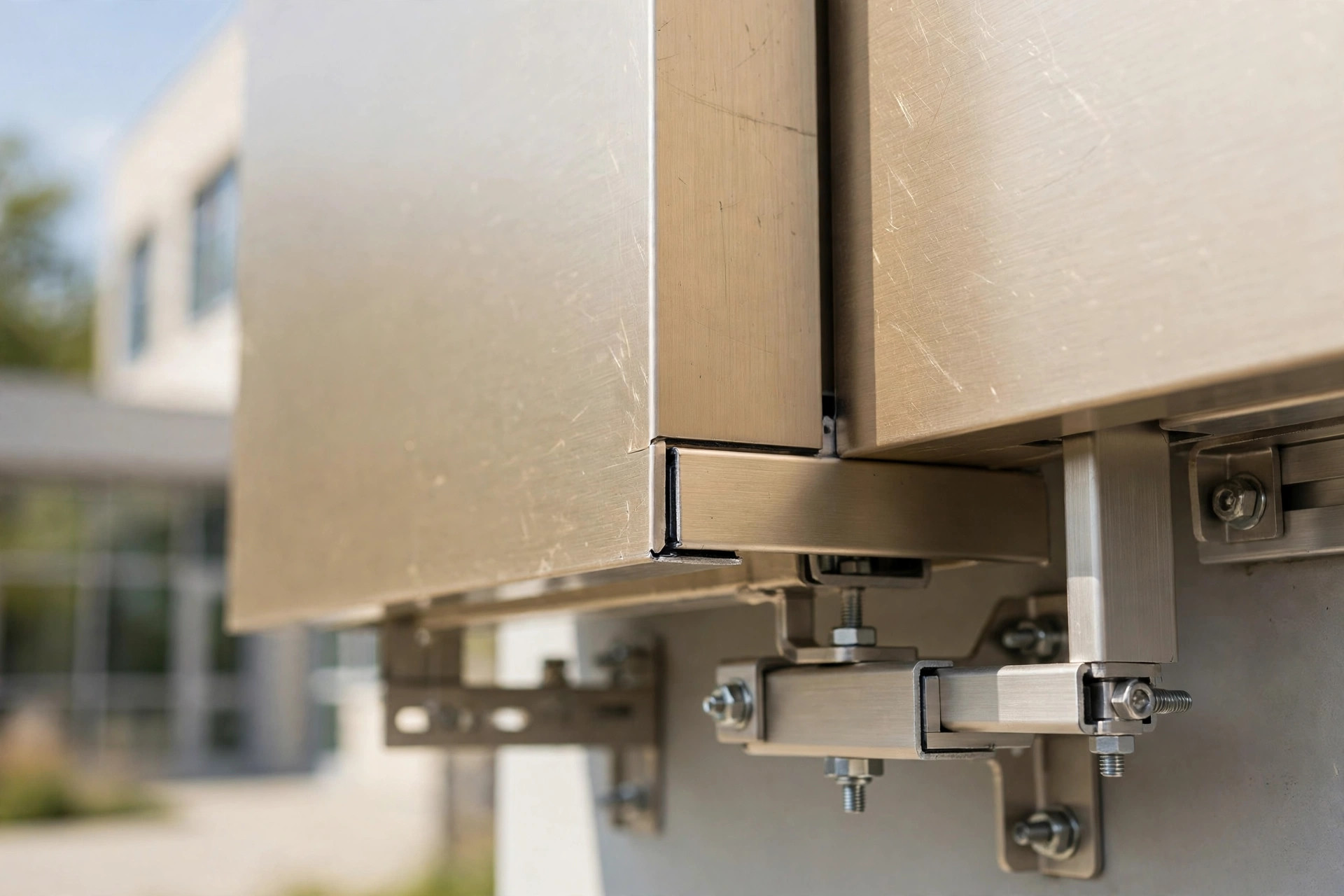
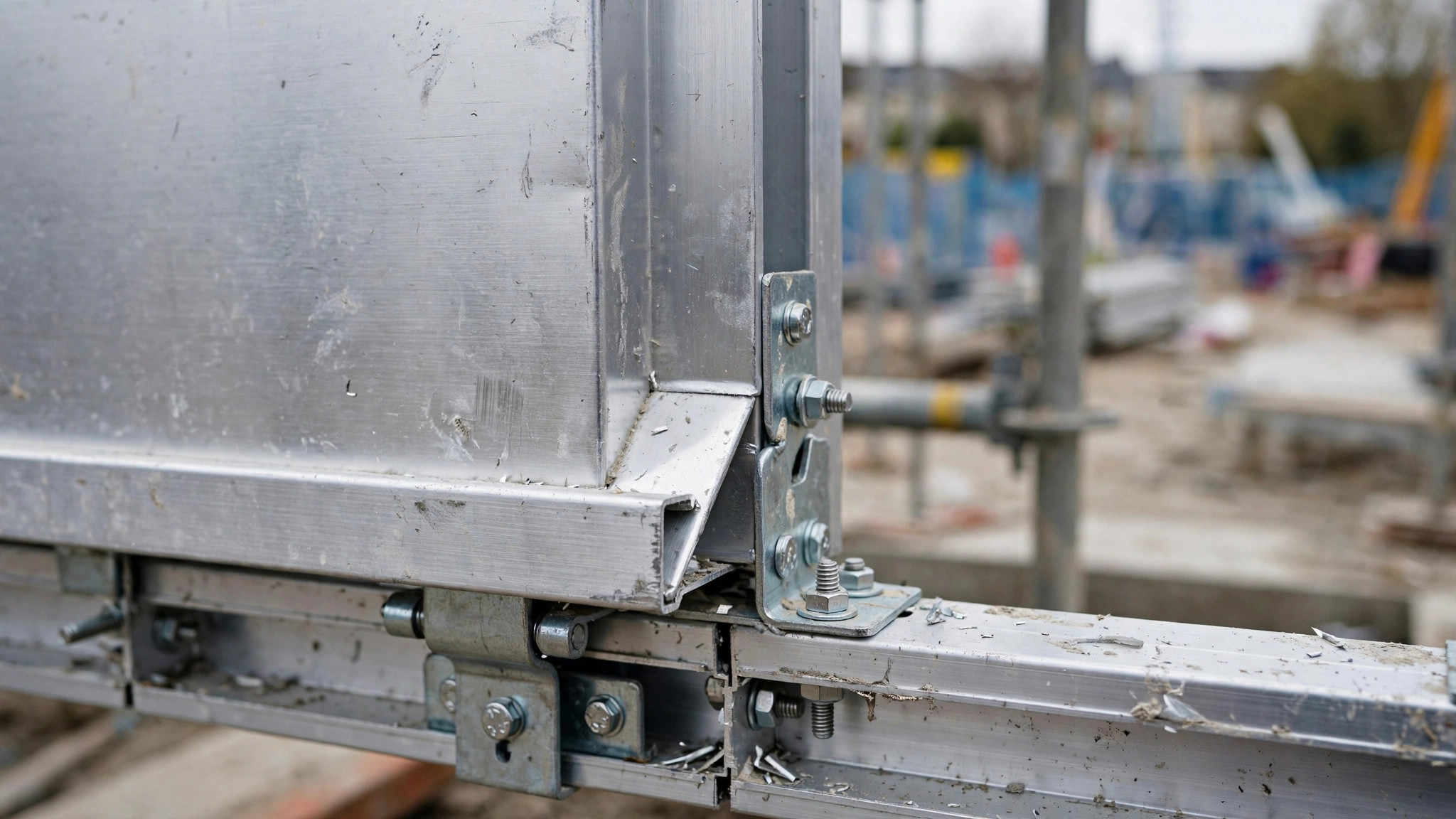
    Close-up of solid aluminum facade panel fixing bracket on aluminum subframe
    Panel fixing brackets on an aluminum subframe: isolate dissimilar metals and verify sealant compatibility with the panel finish before installation.

    3. Skipping Layout Planning Before Panels Arrive

    Solid aluminum panels are usually fabricated to the shop drawings — 2.0, 2.5, or 3.0 mm thick sheets cut, folded, and reinforced into cassettes sized to the project grid, within the conventional maximum of about 1300 × 4000 mm. That makes them precise, but also unforgiving: once fabricated, a panel fits the plan or it doesn’t.

    The common error is treating the first delivery as the moment to start planning. Experienced installers finalize the panel layout — module widths, joint widths, starter courses, and reveal details — before fabrication, and mark the actual grid lines on the building substrate first. Any mismatch between the approved drawings and field conditions should be resolved with the fabricator while the panels are still on the press, not on the lift. A layout mock-up on the substrate, even with just the first few cassettes, exposes alignment issues when they are still cheap to fix.

    4. Handling Panels Without Adequate Support

    Large-format panels are stiff, but only when supported the way they were designed to be supported — at their stiffening ribs and engineered fixing zones. Carrying a 3 mm panel by its corners, standing it on one edge, or dragging it across a rack invites exactly the damage that is hardest to see until it is too late: subtle bends, creased edges, and scratched finishes that show up only after the protective film comes off.

    Set a simple site rule: panels are always lifted with the film on, always carried vertically by two or more workers using the reinforced edges, and always stored flat or near-vertical on padded racks, never stacked horizontally without separation. PVDF and powder-coating finishes are hard, but an edge strike on a neighboring panel will leave a mark that cannot be polished out without changing the gloss.

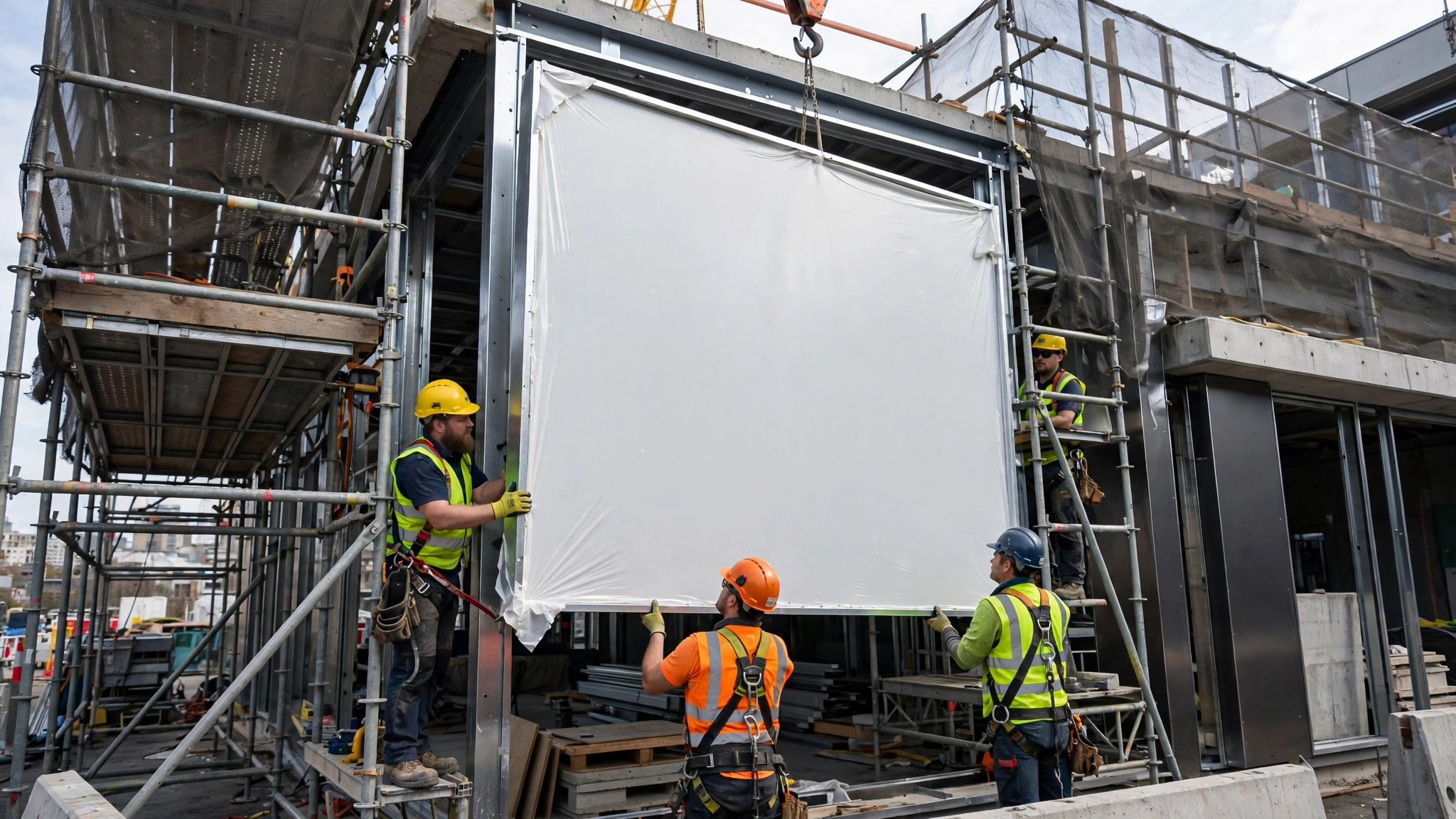
    Workers installing a solid aluminum facade panel with protective film still on
    Installers lift a large-format aluminum panel with the protective film still on, handling it by the reinforced edges to avoid edge damage.

    5. Removing the Protective Film at the Wrong Time

    The protective film is the cheapest insurance on the whole facade. Peel it too early — before the adjacent trades are finished — and every panel becomes a target for concrete splatter, welding sparks, and scaffold scuffs. Leave it on too long, especially through a hot summer, and the adhesive can bake onto the coating, leaving residue that resists normal cleaning and may ghost the finish.

    The rule of thumb contractors use: keep the film on until the panel is fully fixed, adjusted, and the surrounding wet trades are done, then remove it panel by panel during final cleaning, checking for adhesive residue as you go. If a project stalls with film still on, check with the film and panel supplier how long the film can remain before removal becomes a problem — film rated for a few months of UV exposure is not the same as one rated for a full season.

    6. Skipping the Full-Scale Mock-Up

    Drawings and material samples approve colors, profiles, and finishes. They do not approve the reality of the wall: how the fixing brackets behave against the real substrate, how the joint widths read at twenty meters, or how the panels sit at corners and floor transitions. The mistake is treating a small color chip as the entire approval and going straight to full production.

    A full-size mock-up — even a modest one, a few panels in the exact alloy and thickness, with the actual substructure and joint details — answers questions no sample can: Are the fixing tolerances realistic? Do the reveals stay consistent? Does the PVDF color match hold across panels from different sheets? One mock-up that reveals a problem saves a whole facade of it. Many US general contractors now require a visual mock-up before releasing the balance of the order — treat it as cheap insurance.

    7. Ordering Panels Before Final Field Measurements

    Buildings are never as square as their drawings. Concrete substrates drift, steel embeds move, and curtain-wall grids shift between design and construction. Ordering every panel from the bid dimensions locks in assumptions that the building may not honor — and remade panels cost far more than one more site survey.

    Successful projects split the order into phases: release the standard-field panels on the approved drawings, but hold edge, corner, and termination panels until final field measurements confirm the actual dimensions. Because solid aluminum panels are fabricated per project, the factory can cut later batches to corrected sizes — but only if the measurement schedule is built into the program. Confirm the sequencing with both the installer and the factory before the first purchase order goes out.

    Getting It Right the First Time

    None of these mistakes is about panel quality — it is about planning, sequencing, and site discipline. The contractors who install solid aluminum facade panels without callbacks share the same habits: they plan the layout before fabrication, protect the finish until the last trade leaves, respect thermal movement, and verify everything with a mock-up and field measurements. Browse the panel options at juchangalu.com, or send us your drawings for a detailed quotation tailored to your project.

  • Aluminum Ingot Daily — October 20, 2026: A00 Fell

    Aluminum Ingot Daily — October 20, 2026: A00 Fell

    October 20, 2026 — China’s domestic aluminum ingot market fell on the latest session. The Changjiang Nonferrous Metals Network (CCMN) A00 aluminum ingot benchmark moved -120 RMB/tonne day-on-day. Offshore, COMEX aluminum front-month futures closed at USD 3,089.5/t (-59.0, -1.87%).

    Cross-Platform Price Snapshot

    Benchmark Latest quote Day-on-day Source
    CCMN A00 aluminum ingot, spot (tax incl.) day change -120 RMB/t* -120 RMB/t Changjiang Nonferrous Metals Network
    COMEX aluminum, front month USD 3,089.5/t -59.0 USD/t (-1.87%) Yahoo Finance

    *CCMN’s absolute spot levels are member-only; day-on-day changes are public.

    CCMN A00: Recent Daily Changes

    Changjiang A00 aluminum ingot daily price changes

    Offshore: COMEX Trend

    COMEX aluminum front-month trend

    What It Means for Panel Buyers

    For buyers of aluminum façade panels and sheet, ingot is the single largest cost input. Sustained moves in the ingot benchmark typically feed through to mill and fabricator pricing within one to two quotation cycles. Buyers with Q4 project pipelines may want to request fresh quotes when the trend favors them — while remembering that surface treatment (PVDF, powder coating) and fabrication complexity still dominate the final panel price.

    Get this briefing every morning

    We publish a short aluminum ingot market update like this one every trading day — CCMN spot moves, offshore futures, and the charts that matter.

    Subscribe free by email →

    Data Notes

    • CCMN day-on-day changes are taken directly from CCMN’s daily A00 aluminum ingot reports (alu.ccmn.cn).
    • COMEX front-month prices via Yahoo Finance (futures contract, not LME 3-month).

    This briefing is for information only and does not constitute investment advice.